
Computational Quantum Physics: Quantum Materials
We combine chemical realism with many-electron physics to develop predictive theories of the many-electron properties of materials and molecules.
About
Focus Areas
Topology and Strong Correlations
 The setting for quantum mechanics is Hilbert space—the abstract space defined by the set of quantum wave functions. We now know that the geometry and topology of Hilbert space can have decisive effects on physical properties, leading for example to the fractional Chern insulator states observed in graphene [Nature volume 600, pages 439–443 (2021)] and transition metal dicalcogenide [ Nature (London) 622, 63 (2023)] materials and even controlling basic properties such as dielectric constants.
CCQ scientists, with many external collaborators, are developing and applying methods to elucidate the impact of wave function geometry and topology on quantum many body physics.
Topics of interest range from method development and basic theory of topological bands [Phys Rev Research 5 L032048 (2023)] and topological Mott insulators [Nature Communications volume 14, Article number: 7531 (2023)} to new phases of matter such as anomalous hall crystals [Phys Rev Lett 132 23660] and topological Kondo semimetals [Phys. Rev. B 110, 165128 (2024)]
Project Leaders: Nicolas Regnault
Project Scientists: Antoine Georges, Andrew Millis, Nicolas Morales-Duran, Saúl Antonio Herrera González, Daniel Choi, Patrick Tscheppe, Agnes Valenti, Shiwei Zhang, Miguel Morales, Ammon Fischer
Model Systems
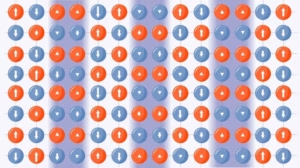 Idealized models of quantum particles interacting together capture the essence of physical phenomena hosted by quantum materials. An outstanding example is the iconic fermionic Hubbard, which is relevant to the description of high-temperature superconductors, moiré materials as well as ultra-cold atoms in optical lattices. Despite its simplicity, this model has a remarkably rich phase diagram.
Because these models also retain the intrinsic computational complexity of the quantum many-body problem, they are prime targets for the methods developed at CCQ. We emphasize a synergistic approach to solving these models, involving an array of diverse computational methods such as tensor networks, quantum embedding and quantum Monte Carlo methods, neural quantum states and more.
Project Leaders: Shiwei Zhang, Antoine Georges
Project Scientists: Andy Millis, Olivier Parcollet, Anirvan Sengupta, Miles Stoudenmire, Joseph Tindall, Samuele Giuli, Andrew Klevorkin-Hardy, Ivan Pasqua, Hannah Lange, Riccardo Rende
Superconductivity
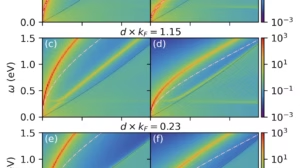 Superconductivity, the ability of certain materials held at low temperatures to conduct electricity with absolutely zero resistance and to expel magnetic fields, has fascinated scientists since its discovery by Heike Kamerlingh-Onnes in 1911. We would like to know what causes it, and how might we raise the critical temperature below which superconductivity occurs.
Of particular interest to CCQ is the plethora of unconventional superconducting states in quantum materials hosting strongly correlated electrons. Basic to our work is the construction (Phys Rev B111, 035135; JOSS 06297) of compressed, low-dimensional representations of quantum data that make calculations tractable.
CCQ scientists, along with the Simons Collaboration on Superconductivity [link] are investigating new mechanisms [2D Materials 10, 045031 (2023), Phys. Rev. B 110, 054509 (2024), Phys. Rev. Lett. 133, 146503] or calculating superconducting states and elucidating new classes of superconducting properties and (see the Quantum Monte Carlo group) studying the superconducting phase diagram of basic models such as the Hbbard model. We are also looking in detail at the physical origin and basic properties of the new kinds of superconductivity observed in quantum materials ranging from Sr2RuO4 and the high transition temperature copper-oxide materials to twisted multilayer systems including multilayer graphene and transition metal dicalcogenides.
Project Leader: Andrew Millis
Project Scientists: Antoine Georges, Shiwei Zhang, Olivier Gingras, Samuele Giuli, Ammon Fischer
Transition Metal Oxides and Beyond
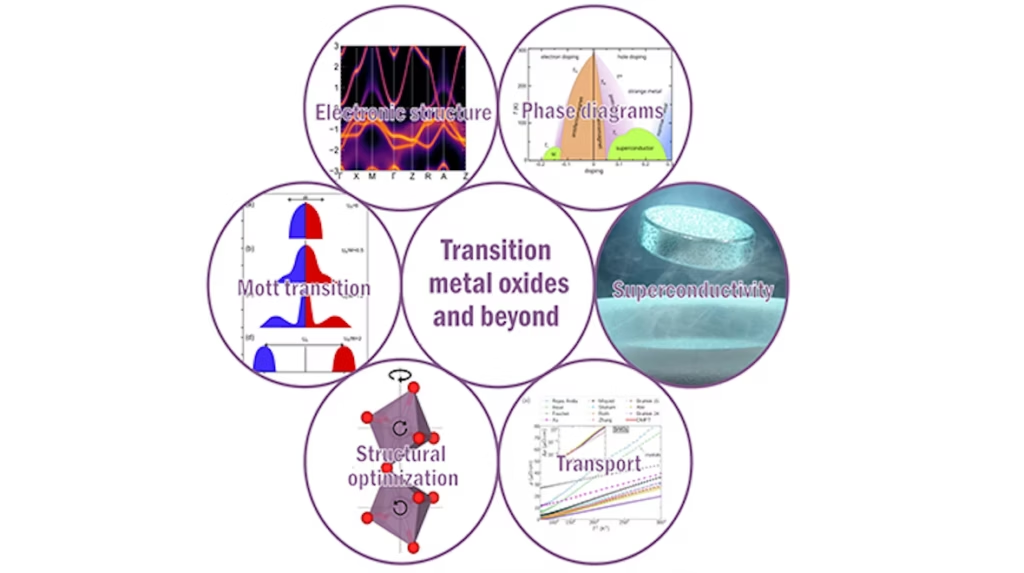
Transition metal oxides are a class of materials that exhibit a rich variety of emergent quantum states due to the presence of strongly correlated electrons within their partially filled d-orbitals. The interplay between electron-electron interactions, crystal field effects, spin and orbital degrees of freedom and lattice vibrations often leads to phenomena that cannot be captured by conventional band theory. At CCQ, we develop methods tailored to solve the many-body problems encountered in this context, implement them in open-access software and apply them to investigate, uncover and predict physical properties of these fascinating quantum materials.
Our efforts are focused on computing correlated electronic structures, studying quantum phases such as magnetism, pseudogaps, strange metallicity, superconductivity and metal-insulator transitions, calculating transport properties, and investigating the structural optimization of transition metal oxides and beyond. To do that, we develop and employ combinations of first-principles approaches, such as density functional theory (DFT) and the GW approximation, with quantum-many body methods, such as the dynamical mean-field theory (DMFT) or the ghost Gutzwiller approximation.
Project Leader: Olivier Gingras
Project Scientists: Jennifer Coulter, Antoine Georges, Harrison LaBollita, Andrew Millis, Miguel Morales, Olivier Parcollet, Ina Park, Chia-Nan Yeh, David Abramovitch
People
Antoine Georges
Director, Center for Computational Quantum Physics
Olivier Gingras
Associate Research Scientist, Center for Computational Quantum Physics

Saúl Antonio Herrera González
Flatiron Research Fellow, Center for Computational Quantum Physics

Andrew Millis
Co-Director, Center for Computational Quantum Physics
Miguel Morales
Research Scientist, Center for Computational Quantum Physics

Nicolas Regnault
Research Scientist, Center for Computational Quantum Physics

Agnes Valenti
Flatiron Research Fellow, Center for Computational Quantum Physics
Shiwei Zhang
Senior Research Scientist, Center for Computational Quantum Physics