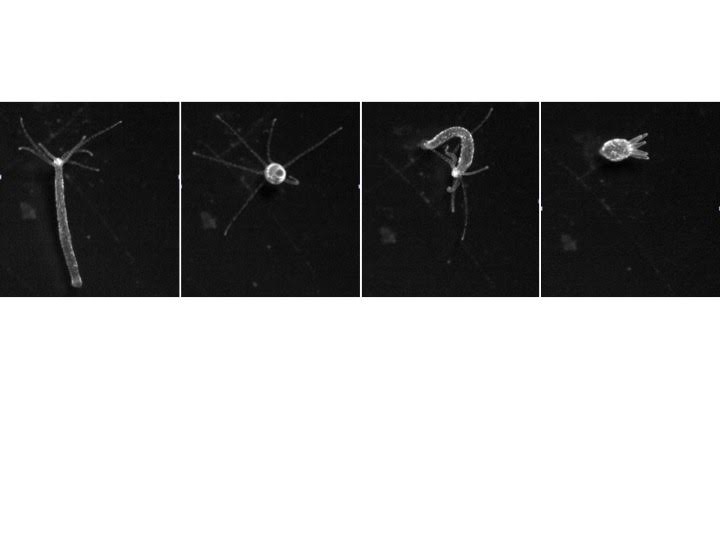
Our group is helping Rafael Yuste’s lab to pioneer the use of Hydra vulgaris, a small, freshwater polyp that attaches itself to underwater surfaces in lakes, rivers and ponds and uses its tentacles to capture prey, as a model organism for studying neural function. Hydra has a simple nervous system, a network of about 600 to 2,000 neurons, depending on the animal’s size.
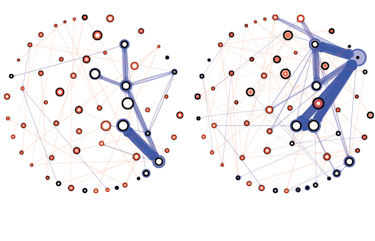
(The human brain, in contrast, houses nearly 100 billion neurons). Despite its simple anatomy and tiny nervous system, Hydra boasts a dozen different behaviors: It can expand and contract, move its tentacles, and even somersault across surfaces. Until recently, scientists knew little about Hydra’s nervous system and had few technical tools with which to study it. We will develop techniques to track the activity of every neuron and muscle in Hydra, even when it is active (a challenge in Hydra, which can dramatically deform its soft body). We can disrupt or manipulate the activity of neurons and observe how that affects Hydra’s behavior. A detailed map, or connectome, of Hydra’s nervous system is in development, and we will take advantage of these advances to build near-complete computer models of its nervous system’s structure and function. How do distributed networks of neurons control behavior in a concerted manner? How do neurons sync up to control these behaviors? What types of connections are necessary for this synchronization? What does the ongoing activity in the nervous system mean even when the animal isn’t moving? Complete access to Hydra’s neurons will allow us to make headway on these questions. In addition, we will study another simple organism — the fruit fly — to elucidate how the entire brain coordinates behavior in the face of an ever-changing environment. Both Hydra and the fruit fly share a surprising number of basic neural building blocks with all animals, so we expect our insights will apply to any nervous system, humans included.
FULL PROJECT
Awardees

Adrienne Fairhall
Investigator, Simons Collaboration on the Global Brain