Atom-interferometry Limits on Dark Energy

Lecture

Speaker

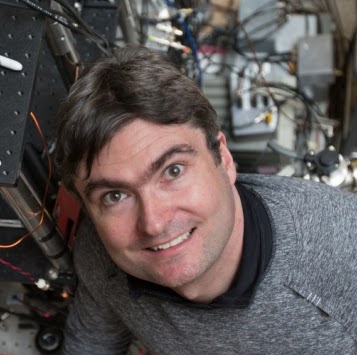
  • Portrait photo of Holger Müller
    Holger Müller Faculty, University of California, Berkeley

When

  • – ET

Where

Gerald D. Fischbach Auditorium

160 5th Avenue

New York, NY 10010, United States

Open Map for Gerald D. Fischbach Auditorium

Dark energy drives the expansion of the universe, but its nature remains mysterious. Some proposed theories can soon be confirmed or falsified by searching for tiny forces on individual atoms. As a first step, an atom interferometer has already ruled out a range of models.

In this lecture, Dr. Holger Müller will explain recent experimental searches for certain models of dark energy. How can it be that dark energy, which is supposedly ubiquitous in the cosmos, has never been observed in experiments? Called chameleon theories of f(R) gravity, some theories postulate long-ranged fields in empty space that become extremely short-ranged near massive objects and, thus, hard to observe. But advanced technologies from atomic physics can be used to sense them anyway. They already place stringent bounds on chameleons and could one day be used to find or definitely rule out a broad class of dark-energy candidates.

About the Speaker

Holger Müller is an experimental physicist and a faculty member at University of California, Berkeley. He applied for his first patent at the age of 14, graduated from Humboldt University (Berlin, Germany) and worked with later Energy Secretary Steven Chu on atom interferometry at Stanford. He is now developing atom interferometers for measurements in fundamental physics, for which he won the Francis M. Pipkin Award of the American Physical Society in 2015. He loves the guitar and the opera.

A softly shaded, grainy blue circle with a glowing center sits on a light beige background, creating a subtle gradient and halo effect.

Event Series

Presidential Lectures 2015

Free public talks that spotlight groundbreaking research.

This series spotlights groundbreaking research across neuroscience and autism, physics, biology, and mathematics and computer science. Featuring leading scientists and mathematicians, these talks foster discussion and discovery within the New York City research community.

See events

More Events

October 12–14, 2026

Speaker

Shep Doeleman

A man in a checked shirt and dark blazer faces the camera, wearing a pin on his jacket and a pen in his pocket, against a plain background.

Speaker

Sonya Hanson

A portrait photo of Sonya Hanson.

