Emmanuel J. Candès
Stanford University
Around the Reproducibility of Scientific Research in the Big Data Era: What Statistics Can Offer
The big data era has created a new scientific paradigm: collect data first, ask questions later. When the universe of scientific hypotheses that are being examined simultaneously is not taken account, inferences are likely to be false. The consequence is that follow up studies are likely not to be able to reproduce earlier reported findings or discoveries. This reproducibility failure bears a substantial cost and this talk is about new statistical tools to address this issue. In the last two decades, statisticians have developed many techniques for addressing this look-everywhere effect, whose proper use would help in alleviating the problems discussed above. This lecture will discuss some of these proposed solutions including the Benjamin-Hochberg procedure for false discovery rate (FDR) control and the knockoff filter, a method which reliably selects which of the many potentially explanatory variables of interest (e.g. the absence or not of a mutation) are indeed truly associated with the response under study (e.g. the log fold increase in HIV-drug resistance).
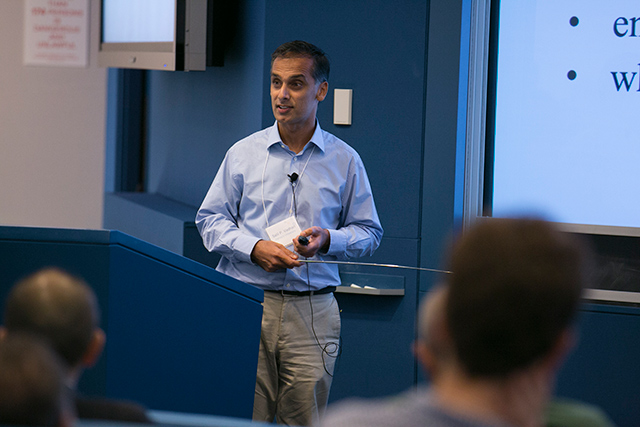
Emmanuel Candès is a professor of mathematics, statistics and electrical engineering, and a member of the Institute of Computational and Mathematical Engineering at Stanford University. Prior to his appointment as a Simons Chair, Candès was the Ronald and Maxine Linde Professor of Applied and Computational Mathematics at the California Institute of Technology. His research interests are in computational harmonic analysis, statistics, information theory, signal processing and mathematical optimization with applications to the imaging sciences, scientific computing and inverse problems. He received his Ph.D. in statistics from Stanford University in 1998.
Candès has received numerous awards throughout his career, most notably the 2006 Alan T. Waterman Medal — the highest honor presented by the National Science Foundation — which recognizes the achievements of scientists who are no older than 35, or not more than seven years beyond their doctorate. Other honors include the 2005 James H. Wilkinson Prize in Numerical Analysis and Scientific Computing awarded by the Society of Industrial and Applied Mathematics (SIAM), the 2008 Information Theory Society Paper Award, the 2010 George Pólya Prize awarded by SIAM, the 2011 Collatz Prize awarded by the International Council for Industrial and Applied Mathematics (ICIAM), the 2012 Lagrange Prize in Continuous Optimization awarded jointly by the Mathematical Optimization Society (MOS) and Society of Industrial and Applied Mathematics (SIAM), and the 2013 Dannie Heineman Prize presented by the Academy of Sciences at Göttingen. He has given over 50 plenary lectures at major international conferences, not only in mathematics and statistics, but also in several other areas including biomedical imaging and solid-state physics.
In 2014, Candès was elected to the National Academy of Sciences and to the American Academy of Arts and Sciences. This last summer, he gave an Invited Plenary Lecture at the International Congress of Mathematicians, which took place in Seoul. Additionally, one of his Stanford Math+X collaborators, W. E. Moerner, was one of this year’s Nobel Laureates in Chemistry.