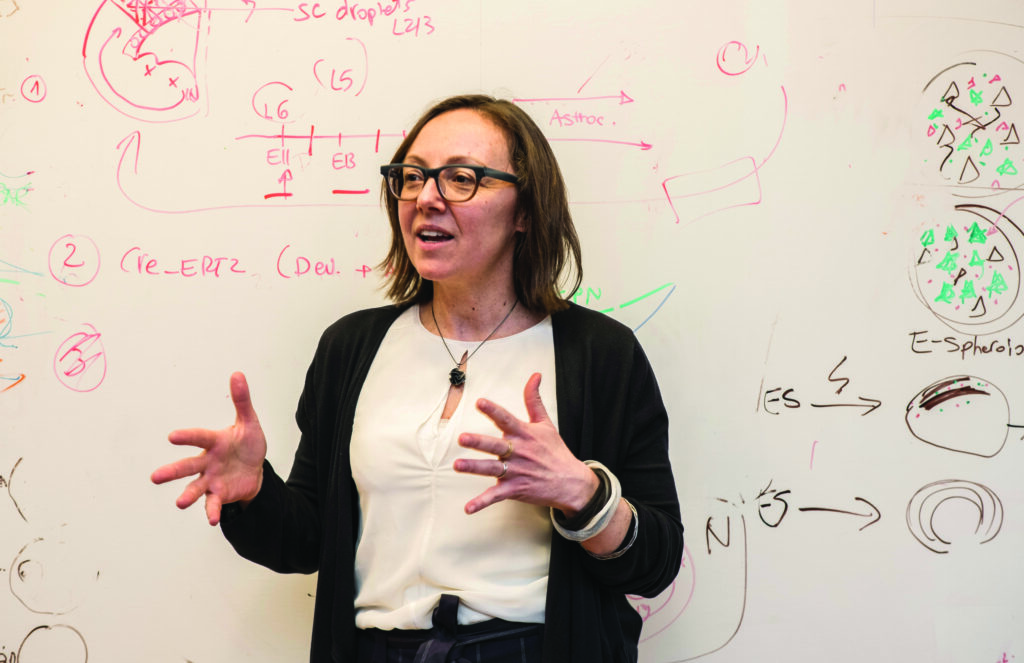
On 1 November 2017, Paola Arlotta focused on the cerebral cortex and presented the challenges and opportunities of modeling human brain development using pluripotent stem cells within 3D human brain organoids. Building on developmental work in mice, such organoids promise a better understanding of complex neurodevelopmental conditions such as autism spectrum disorder.
Her talk was part of the Simons Foundation Autism Research lecture series.
About the Lecture
The cellular and molecular processes that control brain development in mammals, as well as how neurodevelopmental disorders affect such processes, remain poorly understood. The recent advent of brain organoids (lab-grown clusters of living neurons) offers new ways to study the relationships between neurodevelopmental disorders and brain development.
In this lecture, Paola Arlotta focused on the cerebral cortex and presented the challenges and opportunities of modeling human brain development using pluripotent stem cells within 3D human brain organoids. Building on developmental work in mice, such organoids promise a better understanding of complex neurodevelopmental conditions such as autism spectrum disorder. She discussed her recent work on the generation and long-term development of human brain organoids and the study of their developmental trajectories, cellular diversities and neuronal network features.
Arlotta then showed that phenotypic abnormalities observed in patients carrying genetic mutations linked to autism spectrum disorder can be reproduced within brain organoids. This work serves as a proof-of-principle demonstration that selected aspects of human neurodevelopmental conditions can be modeled in vitro with the goal of better understanding disease genetics and pathology.
 Paola Arlotta Professor, Harvard University