Each summer, the Simons Foundation welcomes dozens of interns who contribute to cutting-edge research and become part of a vibrant community dedicated to advancing basic science. Through the Summer at Simons program, interns experience far more than a typical internship: They dive into meaningful projects that make a real impact, connect with leading researchers and enjoy a one-of-a-kind summer in New York City.
This summer, 64 interns contributed to projects, honed new skills and propelled their careers. Hear from the interns about their journeys into everything from tiny worm brains to entire galaxies, as well as how this experience has impacted what they plan to pursue in the future.
Paulina Salinas
Center for Computational Biology, Flatiron Institute
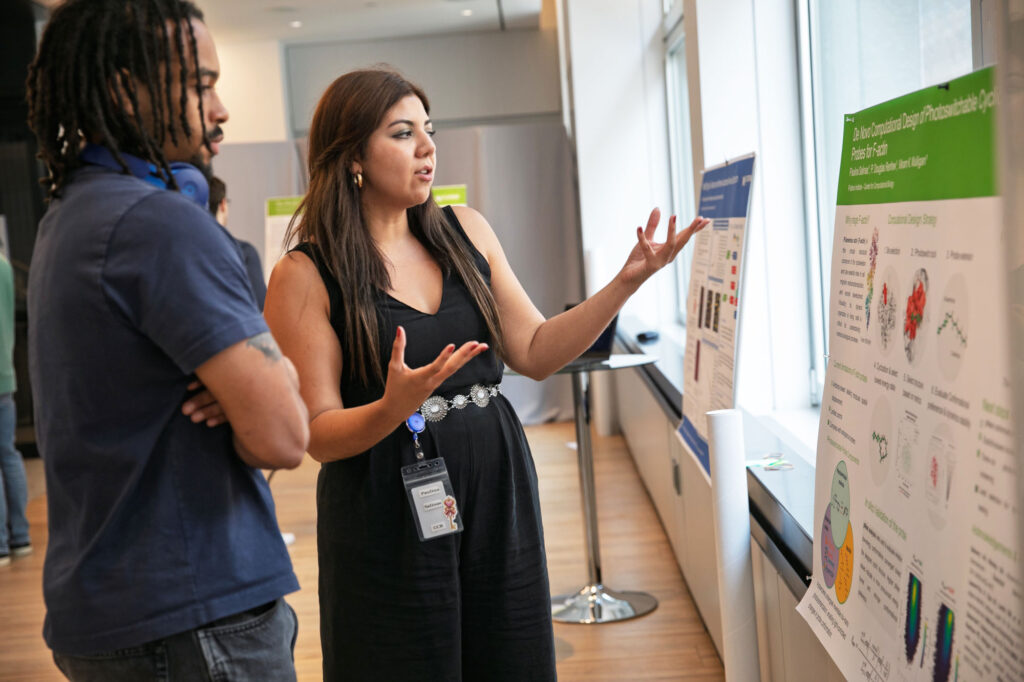
For Paulina Salinas, a graduate of the National Polytechnic Institute in Mexico and an incoming Ph.D. student at Aachen University in Germany, her summer at the foundation’s Flatiron Institute offered a glimpse into how research is done in a new setting.
“I’ve never had an international experience like this, so part of the reason I wanted to do this internship was to expose myself to how science is done outside of Mexico,” says Salinas, who interned in the Center for Computational Biology (CCB) at the Flatiron Institute. “My world opened up — comparing where I am now to where I came from, it’s very different. This opportunity means a lot to me.”
Salinas spent her summer designing tiny, light-sensitive molecules to attach to cellular “scaffolding.” Those molecules help scientists better see and track what happens inside cells under a microscope.
The internship also introduced her to new disciplines and sparked her curiosity in subjects she once avoided.
“I used to be pretty afraid of quantum physics — I understood the subject conceptually but wasn’t that familiar with it; I was more on the classical side,” says Salinas. “Now that I’m doing more of this kind of work, I’m starting to like it. Maybe it’s a possible direction for my Ph.D.”
Emre Alca
Center for Computational Biology, Flatiron Institute
As a previous recipient of funding through the NSF-Simons National Institute for Mathematics in Biology, Emre Alca was familiar with its work before interning at the CCB. “The Flatiron Institute is among the top research institutes in the world, especially in computational physics,” he says.
The University of Pennsylvania Ph.D. student spent his summer focused on the microscopic machinery that pulls chromosomes apart when a cell divides, aiming to understand how cells accurately split their contents and avoid errors that can lead to diseases like cancer.
“There are more cells in your body than there are stars in the known universe, and every minute more of those cells divide than there are galaxies in the universe,” he says. “Arguably, the purpose of every living cell is to divide, which is part of why studying cell division is one of the most fundamental questions in biology.”
For Alca, spending his summer at the Simons Foundation meant getting more hands-on mentorship from experts in the field.
“In graduate school, it’s hard to get much contact time with your advisers,” says Alca. “At a private research institute like this, senior scientists don’t have to spend their time applying for grants or teaching courses, which means we get a lot more contact time with them than we might elsewhere.”
Chiara Villanueva
Quanta Magazine
Before Chiara Villanueva interned for Quanta Magazine, she was a fan. Quanta, one of the Simons Foundation’s editorially independent publications, breaks down the latest advancements in basic research and offers insight into the biggest scientific discussions of the moment.
“I already loved Quanta because of how deep, technical and fundamental their science coverage is,” she says. “Being able to do that through video production is really fascinating to me.”
Villanueva is a graduate of the Science Communication program at the University of California, Santa Cruz, and has a strong interest in astrophysics. She always enjoyed making explainer videos for fun but had never pursued it professionally.
“My career in science writing and my hobby in video production were completely separate — I never let them interact,” she says.
Villanueva finally got to combine her career with her passion when she worked on physics-focused video projects for Quanta this summer.
“I have such an intimate relationship with video editing that, after this internship, I know this is exactly the kind of thing I want to pursue,” she says.
Chance Woodson
Initiative for Computational Catalysis, Flatiron Institute
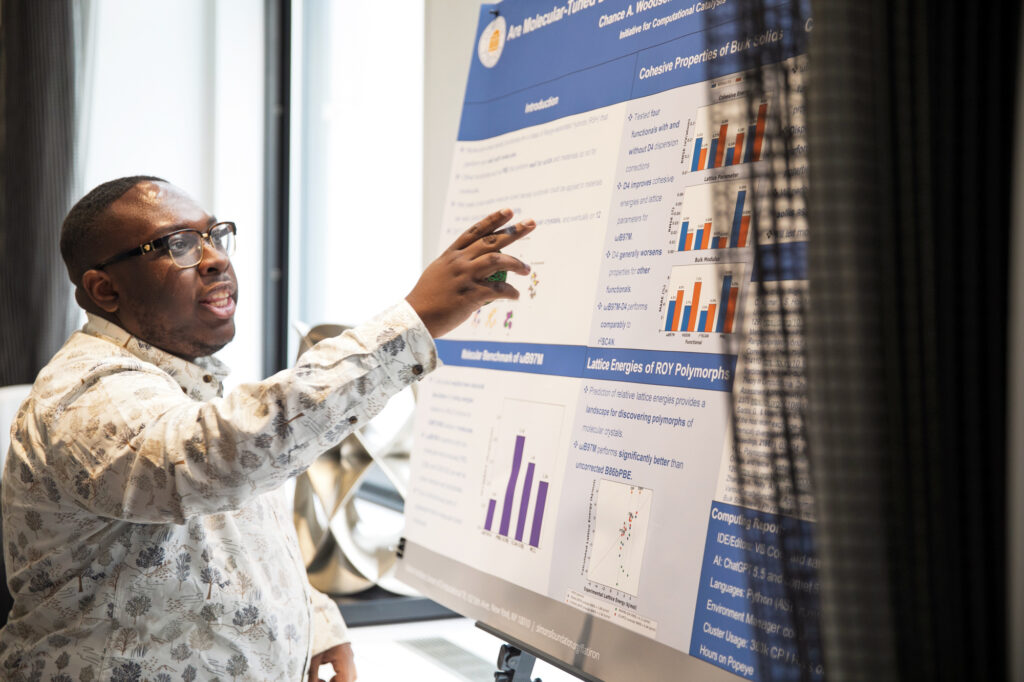
Chance Woodson’s internship with the Flatiron Institute’s Initiative for Computational Catalysis helped make his plans feel more concrete.
“I had always envisioned doing something like this, but it had never quite manifested into something tangible,” says the University of Virginia undergraduate student. “Now that I’ve seen a tangible version of it, it’s only confirmed my desire to stay in computational research.”
Woodson spent the summer leveraging advanced computer simulations to test and improve a method for predicting how different materials behave. These simulations can help scientists design better substances to speed up chemical reactions.
“One application I’m particularly excited about is pharmaceutical research — looking at possible molecules that could be applied to medicines and using computational research to discover the structure of those molecules,” he says.
Rafael Jacobsen
Center for Computational Biology, Flatiron Institute
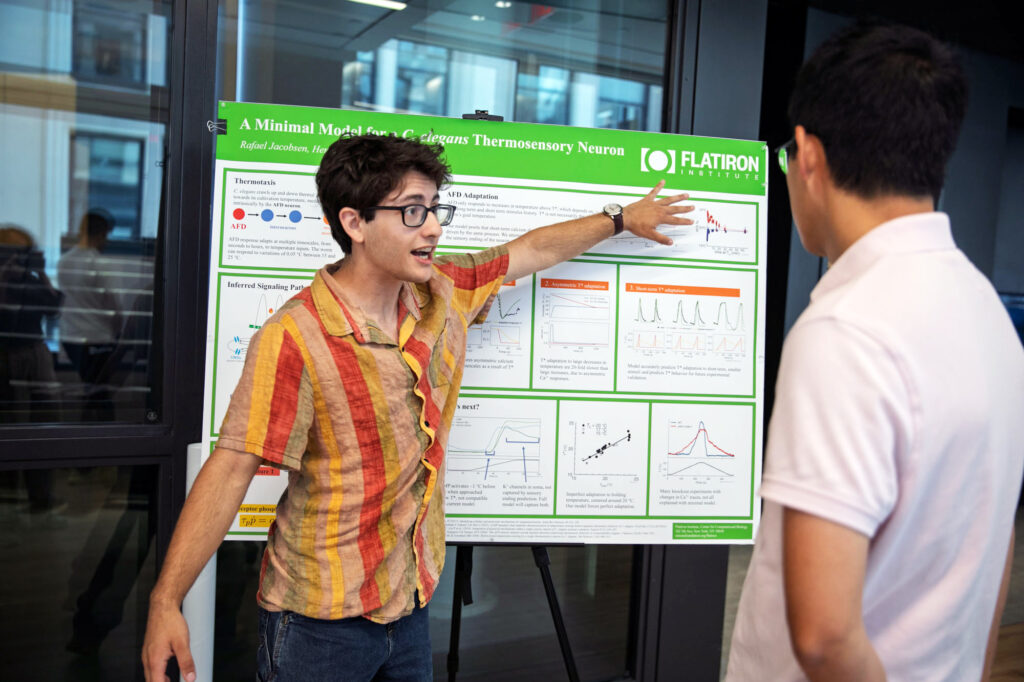
“I never thought something like this existed.” For Harvard University undergraduate student Rafael Jacobsen, the Flatiron Institute was a unique space, one that encompassed elements of both academia and industry, which offered him the chance to explore a new discipline.
At the CCB, Jacobsen spent his summer building a mathematical model of a single brain cell in a tiny worm, aiming to understand how it senses temperature and helps the animal move toward warmer or cooler places. He chose this internship, in part, because it covered a side of science he hadn’t spent much time on: theory.
“I’ve always been confident in wanting to be an experimentalist,” he says. “I realized I actually really like theory work — it’s a lot better than I expected.”
What changed his mind? One factor was the way he got to work together with Flatiron colleagues. “If you’re somewhere you can collaborate and talk to people all day, working on something you really care about, it’s not like being holed up alone in a room — it can be genuinely fun,” Jacobsen says. “Getting to interact with other kinds of scientists, not just academics, has been amazing.”
James Larsen
Center for Computational Quantum Physics, Flatiron Institute
For James Larsen, an intern at the Flatiron Institute’s Center for Computational Quantum Physics (CCQ) and Ph.D. student at the University of Michigan, the experience could best be described through science fiction.
“I’m reading a book right now called Anathem — it’s a fantasy book about an order of mathematicians that live in a monastery-like place where mathematicians shelter from the outside world with nothing to worry about except their research,” he says. “As I’m reading it, I keep thinking, ‘This is the Flatiron Institute!’”
The Flatiron Institute’s emphasis on creating reliable, free tools for research stood out to Larsen. He spent the summer writing code for an open-source software tool that helps scientists study the behavior of complex molecules.
“I’ve grown to really value the importance of open-source, reproducible, large-scale software here at Flatiron, and that’s something I’d love to continue producing and contributing to, even if it’s not at Flatiron,” he says.