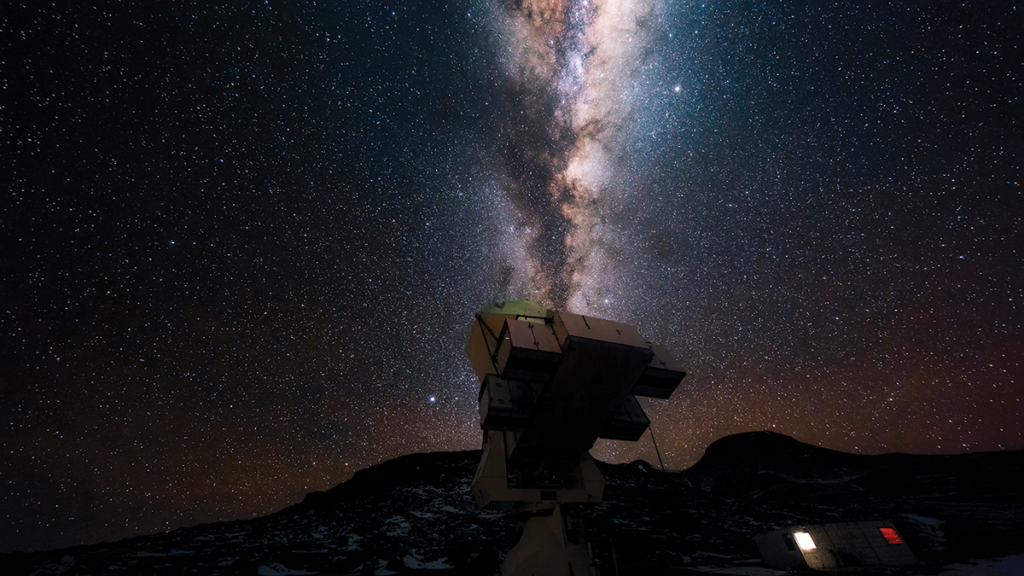
Now Fully Online, Simons Observatory Begins Probe of Universe’s Birth
Featuring
-
Suzanne Staggs
Co-Director, Simons Observatory

Seeing the Light
In a tiny fraction of a second after the Big Bang, some 13.8 billion years ago, physicists think the universe rapidly expanded. If true, the slice of the universe we can see today grew from smaller than a subatomic particle to larger than a marble — a massive leap in so short a time. This expansion, called ‘cosmic inflation,’ created ripples in the fabric of space-time, which would eventually have imprinted on the oldest light in the universe we can see. This light, known as the cosmic microwave background (CMB), originated 380,000 years after the Big Bang, when the universe had cooled enough for light to travel billions of light-years without interacting with matter.
Astronomers have been studying the CMB on large scales since the 1980s. CMB observations by different telescopes have led to many pivotal scientific discoveries, including early temperature fluctuations that revealed the seeds for galaxies and the universe’s basic composition, age and rate of expansion. The significance of the discoveries has been recognized by prestigious awards, including the Nobel Prize and the Breakthrough Prize in Fundamental Physics.
Yet despite decades of searching, the cosmic inflation signal in the CMB — which would appear as faint swirling patterns in its polarization — has remained elusive. But with greater sensitivity than ever before, the Simons Observatory hopes to see those swirls, known as ‘B-modes.’ Observations of B-modes, or lack thereof, will help sculpt scientists’ theories and understanding of the very early universe.
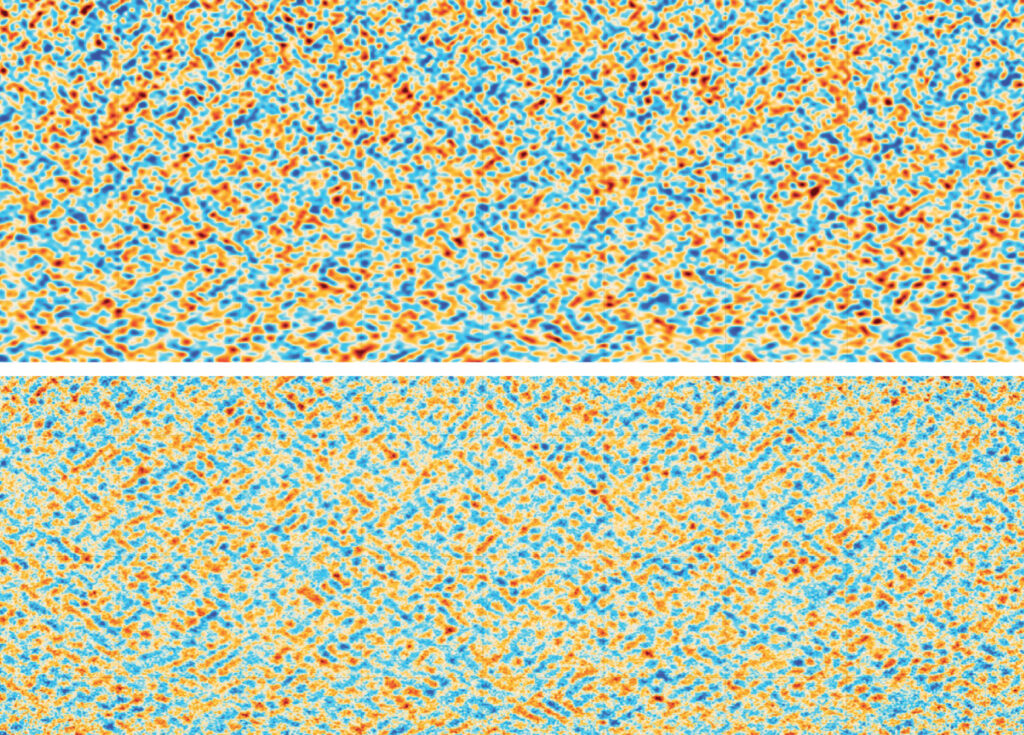
While it will be a few years before enough data are collected to reach the sensitivity to possibly detect B-modes, the first observations made by the Simons Observatory are demonstrating its potential. For example, the data collected are already competitive with the best CMB maps, including ones from the European Space Agency’s Planck satellite, which are considered the gold standard.
“The images that we’ve made with just a few months of data are already deeper and less noisy than Planck’s, which were collected over years,” says Simons Observatory Spokesperson Jo Dunkley of Princeton University.
A Better View
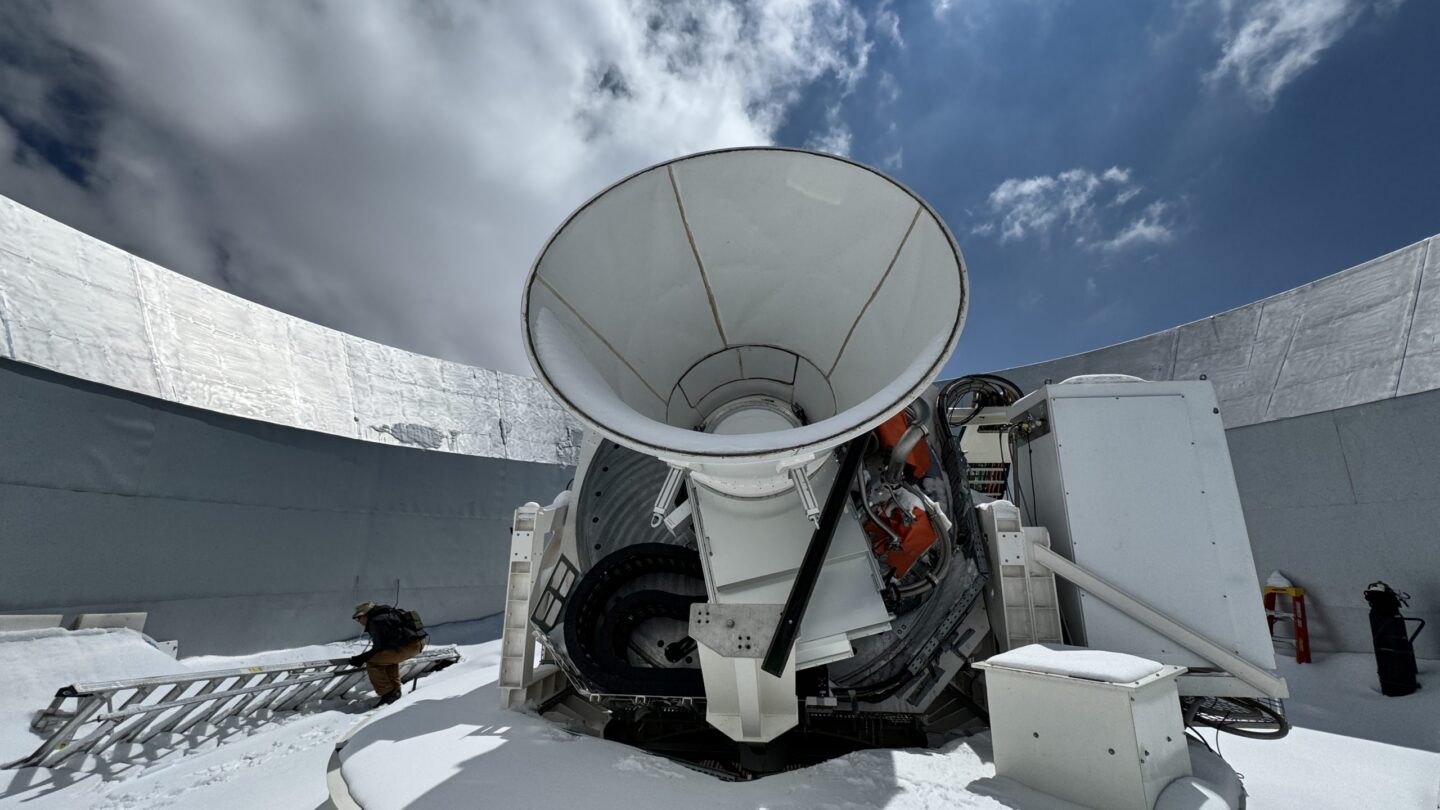
Part of the Simons Observatory’s unique ability comes from advances in instrumentation. Compared with one of its predecessors, the Atacama Cosmology Telescope, the new observatory incorporates more than 16 times as many detectors — 98,000 in total. And crucially, those detectors can map the sky several times faster than before.
“The scaling is phenomenal. It changes the whole game,” says Mark Devlin, observatory co-director and a cosmologist at the University of Pennsylvania. “Instead of waiting years, you’re getting things done in months, and it changes what we can accomplish by an enormous amount.”
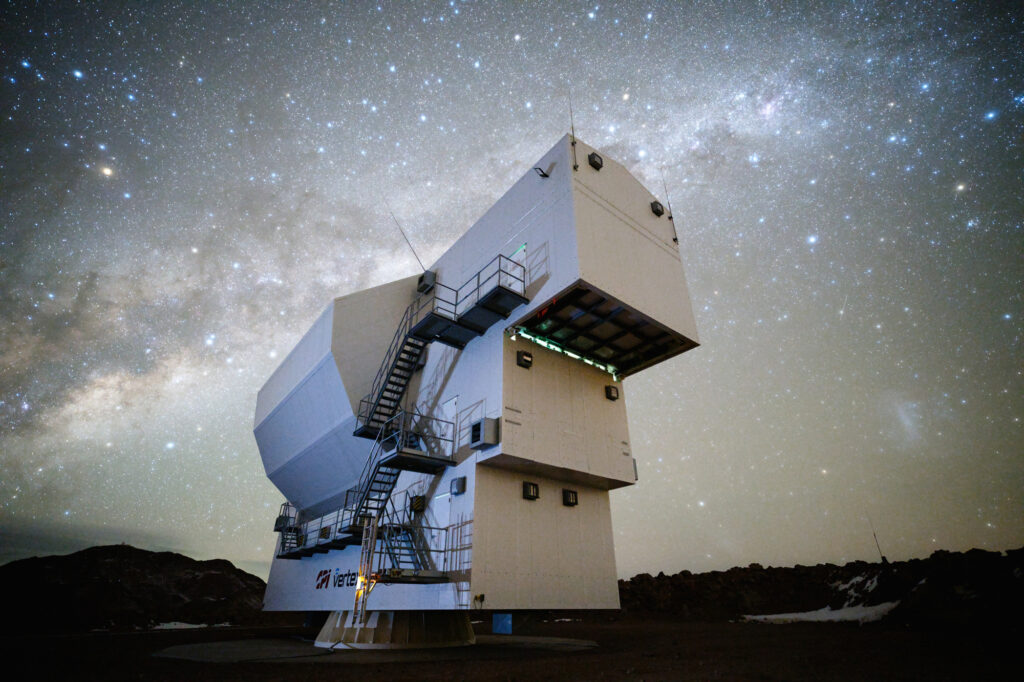
The Simons Observatory’s large telescope is also observing more of the sky at high resolution than previous CMB telescopes, scanning half the celestial sky every couple of days.
“It is incredibly satisfying to see the early maps, knowing that our initial data places us at the forefront of the field — and that we are poised to go much further,” says Jeffrey McMahon, observatory testing lead at the University of Chicago.
The observatory also aims to use its advanced imaging capabilities to study the evolution of galaxies on large scales, transient objects in the Milky Way and beyond, and elementary particles known as ‘neutrinos.’ By taking a wide-field view of the universe, the Simons Observatory will increase the cadence at which rare cosmic phenomena are captured.
“The instrument is now sensitive enough that we can see small changes in transients in only a few days, whereas ACT took months,” Devlin says. “This enables us to observe entirely new classes of objects.”
Even in the early stages of science operations, these rare events are showing up. Observations have caught activity around a supermassive black hole, giant flares from a star in the Milky Way and asteroids zipping across the solar system.
Panoramic Astronomy
This wide-field view isn’t unique to the Simons Observatory; it reflects a broader shift in astronomy toward panoramic observations. The Simons Observatory aims to collaborate with other wide-field observatories that focus on different wavelengths of light, such as the Rubin Observatory, which took its first ultraviolet-to-near-infrared images in 2025.
“There are a number of large surveys adding to our understanding of the universe,” Staggs says. “Our idea is that we can combine our data with theirs to further our discoveries.”
A fast pace of observations has already allowed the LAT to produce the most comprehensive images of the Milky Way in polarized microwave light. These types of images give scientists new information about magnetic fields in our galaxy, which is important for understanding star formation and galactic evolution.
“Essentially, right out of the box, just turning on the instrument, we’re making beautiful crisp images of the Milky Way,” Staggs says.
As more data are collected, the Simons Observatory will regularly release datasets to the astronomy community, making the information useful to an even wider range of people than the nearly 500 directly involved.
“We’ll be providing everything to the community through a data management tool, which we hope to have completed for the first data release,” Devlin says.
Taking Solar Power to New Heights
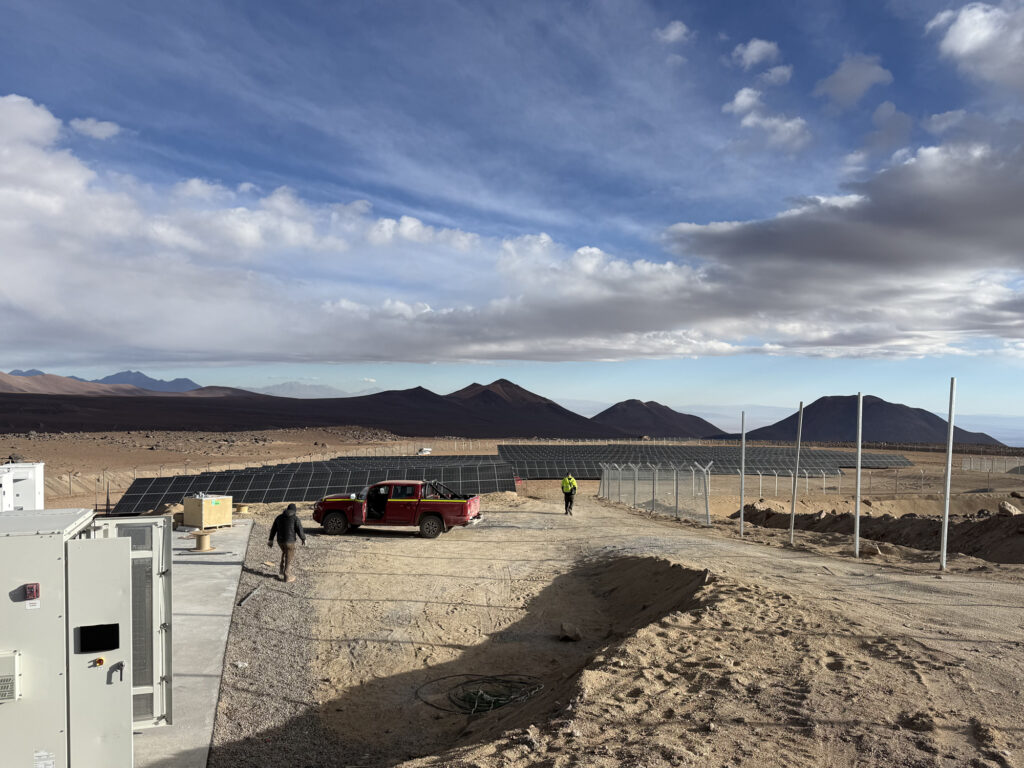
In addition to completing the Simons Observatory itself, the team has been working on an improved way to power the site: a megawatt-scale solar array.
Large remote astronomical observatories typically rely on diesel generators, which require fuel to be trucked in at great cost. The Simons Observatory’s new solar panel array, funded by the U.S. National Science Foundation and United Kingdom Research and Innovation, will supply most of the observatory’s power, helping reduce costs, improve power stability and limit emissions.
The Simons Observatory’s array serves as a model not only for other similar observatories but also for deploying such systems in extreme environments. The demonstration at the Simons Observatory could pave the way for the use of solar arrays in other high-elevation regions in the Andes, such as diesel-reliant mining operations.
Over the coming decade, the solar array will help power the entire observatory, including the three additional SATs in development. With these additions and the recent installation of NSF-funded instrumentation that doubles the LAT’s mapping speed, the observatory will be uniquely positioned to make groundbreaking measurements across the universe for years to come.
“This moment marks a major milestone in our effort to understand these big questions about the universe,” Devlin says. “I think there’s going to be so many scientific discoveries coming out in the next few years, it’ll be hard to keep up.”