Tiny Exons, Real Impact on Neurodevelopment
Featuring
-

Benjamin Blencowe
SFARI Investigator
Bringing people and ideas together to fund, conduct, and share transformative science.
Our grants advance knowledge and strengthen connections between science and society.
Discover the latest news, research, and updates.
We convene scientists, mathematicians, and thinkers to share ideas and explore new questions.
Founded by Jim and Marilyn Simons, we’re a private philanthropy advancing mathematics and basic science.
Work with us on the frontier of basic science research.
The Flatiron Institute is a research center that uses computational science to advance fields like physics, biology, and astronomy.
Search
SFARI Investigator
RNA splicing removes non-coding sequences from a newly made messenger RNA molecule (also called an RNA transcript, because it is a copy made from a gene). The remaining exons get stitched together into a message that the cell translates into protein. Depending on which combination of exons gets included, the same gene can make distinct versions of the same protein. Some of the smallest exons involved, known as microexons, range in size from just three to 27 nucleotides1,2.
These microexons occur mainly in neuronal transcripts, and the genes involved often play key roles in brain function. Their splicing is also disrupted in the brains of some people with autism spectrum disorder (ASD)1. It’s been unclear, though, whether that disruption is a direct result of a person’s genetic makeup, or more of a downstream side effect of altered neuronal activity3. This connects to a broader problem in autism research, which is that only about 15% of cases can be traced to a specific, identified genetic variant, leaving the rest unexplained4. Now, two new studies from a University of Toronto lab led by SFARI Investigator Benjamin Blencowe tackle these open questions from opposite directions. One asks what happens when a microexon is deleted in cells. The other asks whether natural variation in a person’s DNA disrupts microexon splicing in the first place.
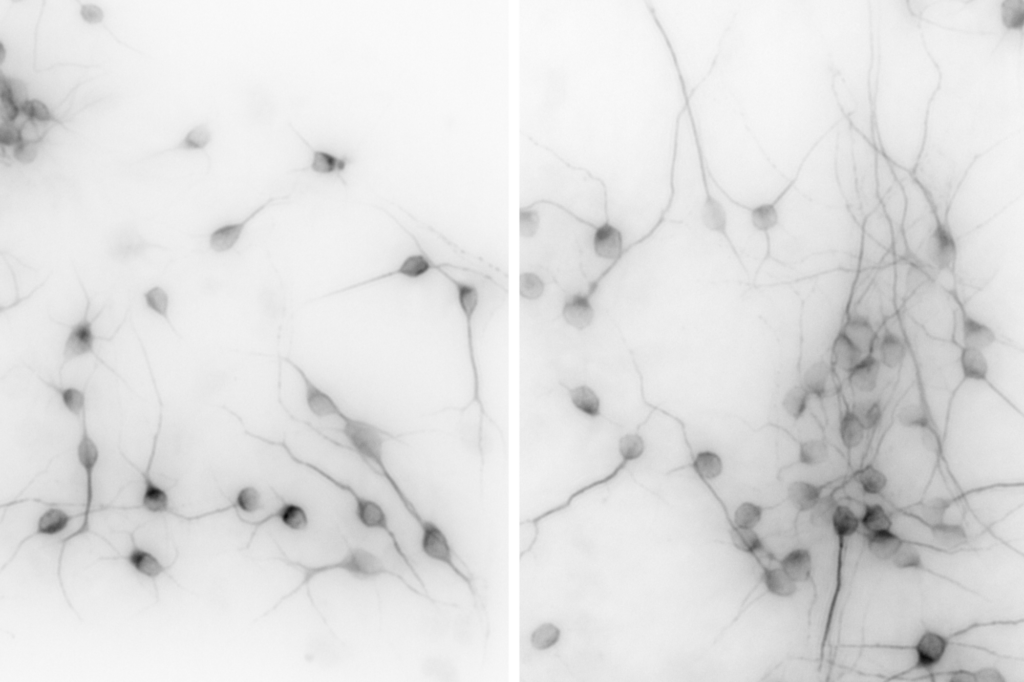
In the first study, using a redesigned CRISPR-based screening tool, a team led by Steven Dupas was able to streamline microexon analysis. Earlier approaches tested one microexon at a time. The scientists chose 37 microexons in genes associated with brain development and, often, with ASD. They introduced the gene-editing tool into a large batch of mouse stem cells, so that each cell received just one deletion, and then let the cells develop into neurons over the following days. At the end, they sequenced each cell to see which genes were active, and matched that activity back to the microexons that were missing. They found that deleting a subset of these microexons caused cells to switch on maturation genes ahead of schedule during neuronal development, suggesting these microexons act as molecular brakes on the process. This change in the pace of maturation is consistent with other reports on the function of autism-associated genes5,6.
The researchers zeroed in on one microexon that sits in Clasp1, a gene that helps neurons control the direction of their growth and is already linked to autism through rare mutations7. Removing this microexon triggered a signaling pathway tied to neuronal maturation earlier than is typical. Yet restoring it only partly reversed that effect, indicating the microexon fine-tunes maturation rather than acting as a simple on-off switch. Looking across the full set of microexons, the researchers also found that ASD-linked genes were disproportionately represented among the genes that switched on sooner. Separately, several of the same microexons showed unusual splicing patterns in postmortem brain tissue from people with bipolar disorder or schizophrenia, which may mean that the effect extends to psychiatric conditions, not just neurodevelopmental ones like autism.
The second study, led by Guillermo Parada and Hannes Bretschneider, asked how many microexons there actually are. Earlier catalogues mostly relied on bulk tissue sequencing, which can miss microexons that are rare or specific to just one kind of neuron. By reanalyzing a much larger collection of RNA sequencing data, including data from individual brain cells, the team identified more than 1,500 previously unknown human microexons, many of them active in just one type of neuron. These new microexons also turned out to work differently than expected. Earlier studies mostly described microexons as subtly reshaping a protein’s structure. Instead, a considerable number of the new ones flag the entire RNA message for destruction, which silences the gene altogether. The group then built a machine-learning model trained to recognize the DNA sequence patterns that determine whether a microexon gets spliced in correctly. With that model, they could predict whether a specific genetic variant would disrupt that process, a tool they then turned on real human genomes.
Across whole-genome sequencing data from thousands of individuals with ASD and their unaffected siblings in three independent studies, rare genetic variants had a far bigger predicted effect on splicing than common ones. Within the same families, siblings with ASD carried significantly more of these variants than unaffected siblings, a comparison that helps control for shared genetic and environmental background. The affected microexons were concentrated in genes active at synapses, the junctions where neurons communicate, including some never before linked to autism. This is the clearest evidence yet that human genetic variation itself, not just a downstream effect of the disorder, directly disrupts how these microexons get spliced.
These studies show how genetic variants present in a person’s DNA can, on their own, disrupt microexon splicing. Many of these variants turned up in genes essential to how neurons form and maintain their connections, adding to a growing body of evidence pointing to the influence of synaptic genes in autism. Importantly, most of these variants were found in people who didn’t already have an identified genetic cause for their autism, which raises the possibility that this kind of disruption helps account for many still-unexplained cases. The researchers have also made their prediction tool publicly available, so that other scientists can apply it to their own data. Taken together, the findings suggest that microexon splicing may be a meaningful piece of the biology behind autism, and potentially other brain disorders.