2014 MPS Annual Meeting
Conference
When
-
All Day
-
All Day


Meeting Report
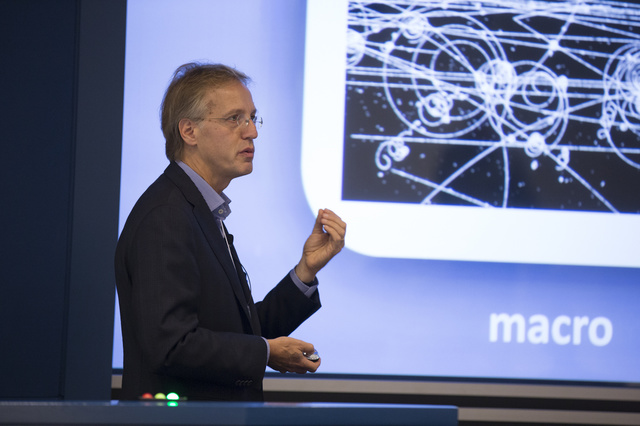
The meeting began with a keynote talk by Professor Robbert Dijkgraaf, a mathematical physicist who is the director of the Institute for Advanced Study as well as the Leon Levy Professor. Professor Dijkgraaf provided an overview on the connections between quantum field theories and mathematics, presenting many examples of how these theories have led to new concepts, uncovered hidden symmetries and provided insights into many long-standing mathematical questions, in particular, forming new bridges between algebra and geometry. Dijkgraaf concluded by observing that while there are many varieties of quantum field theories — topological, conformal, supersymmetric — giving rise to interesting mathematical structures, we currently lack an overarching understanding that would provide a unified mathematical foundation for modern-day physics.
The next speaker was Jon Kleinberg, a computer scientist at Cornell. Professor Kleinberg described methods for understanding social network interactions via a mathematical analysis of the underlying graph structure of the network. He discussed the notion of ‘contagion’ or how people are influenced to change an opinion or position by the opinions of their network contacts. He showed that people are more receptive to join a network if they are offered invitations from several independent sources. He also considered the possibility of creating a cascading effect that will produce a global change in the state of the network. Finally, Professor Kleinberg showed how to identify social relations by considering mathematical properties of graphs representing network connections. In particular, one can identify with reasonably good probability the spouse of a network member if the spouse is also an active member of the network. It also seems possible to predict with reasonable accuracy whether a new relationship will blossom or falter.
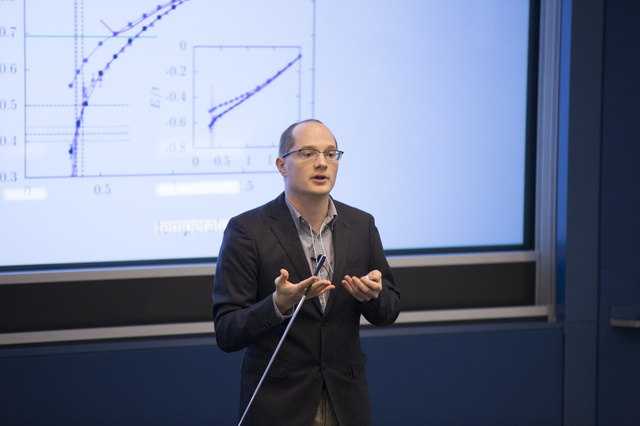
Emanuel Gull, a physicist from the University of Michigan and group director in the Simons Collaboration on the Many Electron Problem, discussed the current state of our understanding of the quantum mechanical problem posed by systems comprised of large numbers of interacting electrons and presented initial results emerging from the Simons Collaboration. He observed that while the equations describing the behavior of systems of interacting electrons have been known for many years, standard methods of solution become computationally intractable even for modest numbers of electrons, on the order of 40–50. Professor Gull presented an overview of new methods, focusing on the stochastic (Monte Carlo) exploration of abstract spaces defined by formal perturbation expansions and emphasizing the need for numerically controlled and reproducible (by different methods) results. Professor Gull concluded his talk by outlining recent results obtained by members of the Simons Collaboration concerning the Hubbard model, a canonical model in the field. Gull delineated regimes where the new approaches have solved the problem and regimes where new ideas are needed, and sketched what some of these ideas might be.
Larry Guth, a mathematician from the Massachusetts Institute of Technology, gave an overview of the field of incidence geometry. Problems in this field concern extremal relations between points, lines and circles and are therefore very easy to state. As an example, given a configuration of N lines in the plane, we can ask how many of their intersection points can lie simultaneously on R different lines. We can also ask about the structure of line configurations that give rise to many excess intersection points. Problems of this nature can be understood by high school students but are notoriously difficult to solve. Professor Guth explained how ideas from topology helped solve some basic problems in the field during the 1980s. He then presented a much more recent result, examining a more subtle problem of a similar nature which was solved using ideas from algebraic geometry. Such ideas have been used in the last decade to solve several fundamental problems that have resisted a solution for more than 50 years. He expressed hope that the incorporation of number theoretic techniques may provide further insight into the structure of extremal configurations.
Andrea Liu, from the University of Pennsylvania, concluded the first day of talks. She presented theoretical and numerical results giving new insights into the properties of ‘glasses’: materials that are solid (have rigidity against shear) but whose atoms are apparently arranged randomly, rather than in the periodically repeating patterns characteristic of crystals. She considered very simple classical mechanics models of spheres interacting with one another via short-range forces at zero temperature, showing that as the density of the objects increased, a ‘jamming’ transition occurred between a low-density liquid-like state that would flow in response to a weak force and a ‘jammed’ state, in which the positions of the particles are fixed relative to each other and which does not flow in response to a weak force. She showed that the jamming transition was continuous, characterized by mean-field critical exponents. Remarkably, the jammed state, although possessing a shear rigidity, has properties unlike other rigid solids: an infinitesimal change in pressure generates a non-infinitesimal rearrangement of the particles, and there is an extraordinarily high density of very low energy excitations. Liu argued that this feature provides a geometric explanation of a long-standing mystery, namely that in glasses — but not in ordered solids — the lattice contribution to the heat capacity is linear in temperature at low temperature. Professor Liu also drew connections between these results and random matrix theory and reported on recent analytic progress by another group, based on an infinite dimensional limit. She expressed hope that with the new understanding of these two extreme states, one might be able to obtain a much better grasp of bulk conditions leading to a better understanding of glassy states in nature.
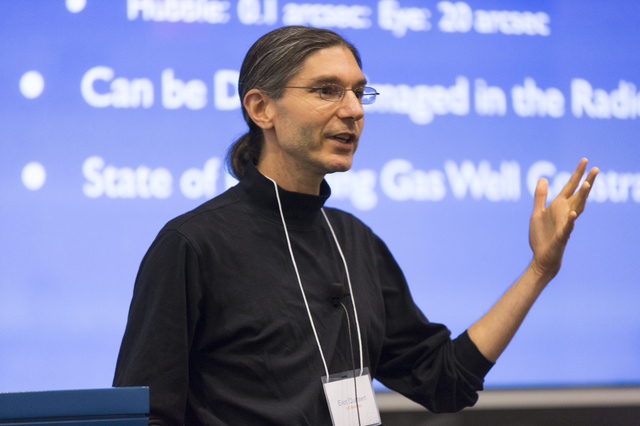
The second day of the meeting began with a talk by Eliot Quataert, an astrophysicist from the University of California at Berkeley. The talk discussed the central role played by black holes in modern astrophysics. Inflow of matter into a black hole liberates an extraordinary amount of energy, powering many astrophysical processes and playing a crucial role in large-scale dynamics associated with the structure and formation of galaxies. Professor Quataert reviewed some of the theoretical challenges arising from attempts to simulate the dynamics of plasma that forms around black holes as intergalactic gas swirls around the hole, ultimately falling into it. A key difficulty is that while the particles in this plasma couple to each other electromagnetically, inter-particle collisions are so infrequent that the plasma cannot be modeled as a fluid, and concepts such as temperature and pressure are not relevant. Quataert concluded with a discussion of the possibilities that will be enabled when the gravitational wave observatory Advanced LIGO begins taking data, and gravitational signals of black hole mergers can be compared to information from conventional telescopes operating in the radio, infrared, visible and x-ray regimes.
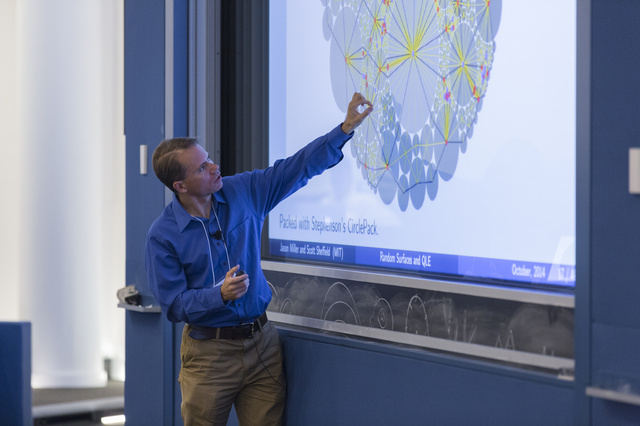
Scott Sheffield a mathematician from the Massachusetts Institute of Technology, talked about models of random trees, non-intersecting curves, surfaces, growth processes and their interactions. The talk began with beautiful pictures and videos that described fractals coming from complex dynamics, known as Julia sets, and the process of gluing Julia sets together to form a sphere. After reviewing the definitions and basic properties of random trees, curves, surfaces and growth processes, Professor Sheffield explained that they can also be glued together, and that the gluing procedure exposes relations between these concepts. These gluing procedures have been studied extensively in the last five years. For example, the interface between two glued random surfaces produces a random non-intersecting curve. Random growth processes can be applied to random surfaces instead of the usual flat plane, and in some cases these processes can be well understood. Apart from producing beautiful pictures, these studies are intimately related to a better understanding of conformal field theories, considered in the first talk of the meeting, and will provide a mathematically rigorous analysis of basic physical systems.
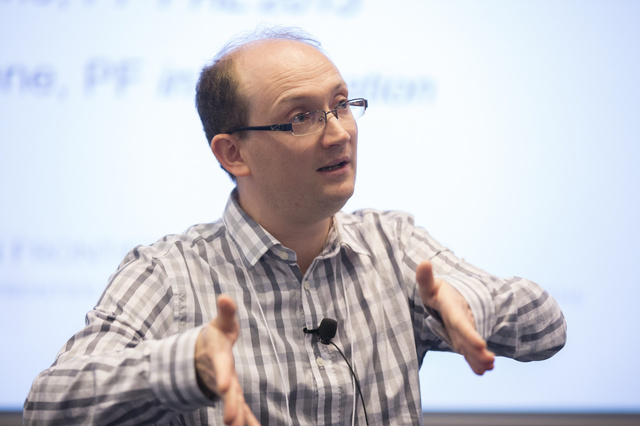
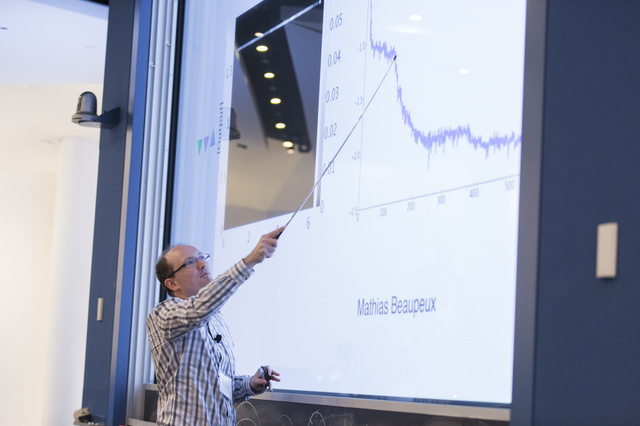
Paul François, faculty member at McGill University and one of the inaugural group of investigators in the recently established Mathematical Modeling of Living Systems program, talked about insights into the immune system obtained from in silico (i.e., computational) experiments in which populations of theoretical models of immune systems were allowed to evolve in a computer, with random ‘mutations’ changing the structure of the equations, the survival of a given equation determined by measures of fitness derived from biological immune responses. The method produced previously unanticipated equations that accounted for key features of immune response, including the ability to sense and react to a very small density of ‘non-self’ molecules in the presence of a high density of other stimuli, and may be more generally applicable in gaining insights into complex phenomena.
Assaf Naor, a mathematician from Princeton University and the director of the Simons Collaboration on Algorithms and Geometry, gave the final talk of the MPS Annual Meeting. He discussed metric spaces, simple mathematical abstractions of the notion of distance, in which the only requirement is that the triangle inequality holds. Among metric spaces, there is a class of doubling metric spaces — a notion that attempts to capture the idea of finite dimensionality. Professor Naor discussed the basic problem of whether or not such abstract spaces can be approximated by the N-dimensional space with its usual Euclidean metric. Surprisingly, similar problems arise in the analysis of basic algorithms in graph theory. Professor Naor presented evidence that the Heisenberg group, which is central in the study of quantum mechanics, also plays a key role in understanding such questions.
More Events
2026 MPS Annual Meeting
ConferenceOctober 15–16, 2026
October 22–23, 2026
November 5–6, 2026
Speakers
Ofer Aharony, Aleksey Cherman, Gabriel Cuomo SISSA, Davide Gaiotto, Jaume Gomis, + 3 more