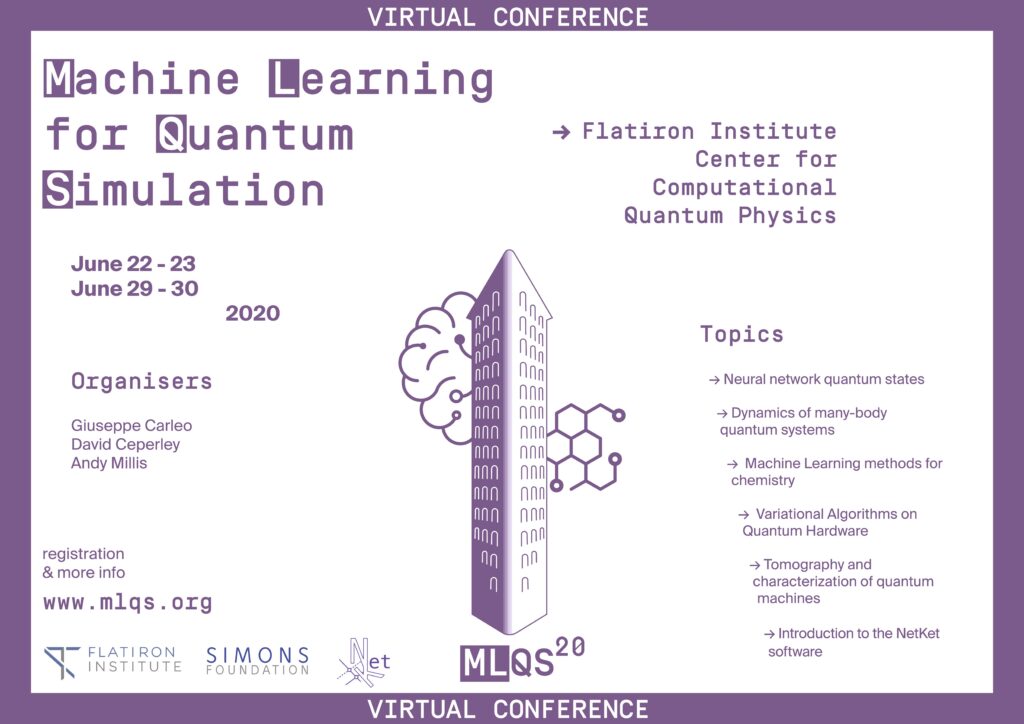
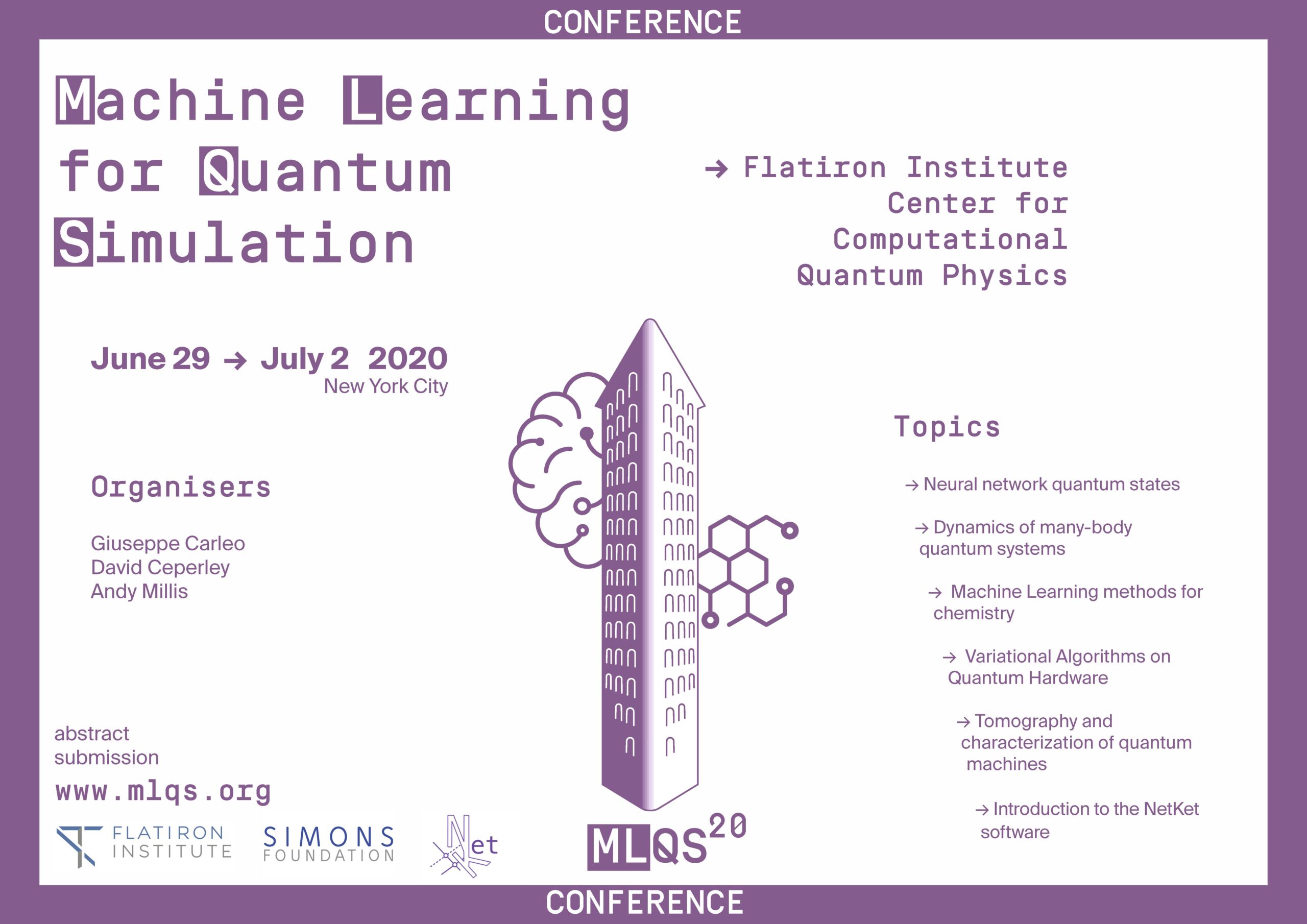
Machine Learning for Quantum Simulation: Virtual Conference
Conference
When
-
All Day
-
All Day
Where
Virtual
160 Fifth Avenue
New York, NY 10010
Invited Speakers
| Ryan Babbush | |
| Federico Becca | University of Trieste |
| George Booth | King’s College London |
| Kieron Burke | University of California, Irvine |
| Roberto Car | Princeton University |
| Juan Felipe Carrasquilla | Vector Institute |
| Kenny Choo | University of Zurich |
| Bryan Clark | University of Illinois at Urbana-Champaign |
| Weinan E | Princeton University |
| Sophia Economou | Virginia Tech |
| Markus Heyl | Max-Planck-Institute for the Physics of Complex Systems |
| Markus Holzmann | Laboratoire de Physique Théorique de la Matière Condensée |
| Roger Melko | University of Waterloo |
| Antonio Mezzacapo | IBM |
| Johan Mentink | Radbound University |
| Frank Noe | Freie Universitaet Berlin |
| Marivi Fernandez Serra | Stony Brook University |
| Sandro Sorella | Scuola Internazionale Superiore di Studi Avanzati |
| James Spencer | DeepMind |
| Frank Verstraete | Ghent University |
| Nobuyuki Yoshioka | RIKEN |
| Pan Zhang | Chinese Academy of Sciences |
Agenda
Monday, June 22
*All times are in EDT
| 9:20 – 9:30 AM | Welcome message | |
| 9:30 – 10:05 AM (25+10) | James Spencer (DeepMind) | Ab-Initio Solution of the Many-Electron Schrödinger Equation with Deep Neural Network |
| 10:05 – 10:40 AM (25+10) | Roberto Car (Princeton University) | Molecular simulation with the deep potential method |
| 10:40 – 11:10 AM | Break | |
| 11:10 – 11:45 AM (25+10) | Frank Noé (Freie Universitaet Berlin) | PauliNet – deep learning the electronic Schrödinger equation |
| 11:45 – 12:20 PM (25+10) | Kieron Burke (University of California, Irvine) | Adventures in Machine Learning of density functionals |
| 12:20 – 2:00 PM | Break | |
| 2:00 – 2:35 PM (25+10) | Marivi Fernandez Serra (Stony Brook University) | Machine learning accurate exchange and correlation functionals of the electronic density |
| 2:35 – 3:10 PM (25+10) | Markus Holzmann (Laboratoire de Physique Théorique de la Matière Condensée) | Iterative backflow renormalization: a non-linear network for quantum many-body wave functions in continuous space |
| 3:10 – 3:45 PM (25+10) | Weinan E (Princeton University) | Developing meta-universal generalized density functional theory models and solving ground state Schrodinger equation for many-electron systems |
Tuesday, June 23
*All times are in EDT
| 9:30 – 10:05 AM (25+10) | Sandro Sorella (Scuola Internazionale Superiore di Studi Avanzati) | Unified approach for Variational and Auxiliary Field quantum Monte Carlo |
| 10:05 – 10:40 AM (25+10) | Kenny Choo (University of Zurich) | Frustrated magnets and fermions with neural network quantum states |
| 10:40 – 11:10 AM | Break | |
| 11:10 – 11:45 AM (25+10) | Bryan Clark (University of Illinois – Urbana Champaign) | VMC in the era of ML: From wave-functions for Fermions to supervised wave-function optimization |
| 11:45 – 12:20 PM (25+10) | George Booth (King’s College London) | Gaussian Process States: Explicitly Data-driven wave functions |
| 12:20 – 2:00 PM | Break | |
| 2:00 – 2:15 PM (15) | Giacomo Torlai (Flatiron Institute) | Quantum process tomography with unsupervised learning and tensor networks |
| 2:15 – 2:30 PM (15) | Robert Huang (CalTech) | Predicting Many Properties of a Quantum System from Very Few Measurements |
| 2:30 – 2:35 PM | Q & A | |
| 2:35 – 2:50 PM (15) | Attila Szabó (Cambridge University) | Neural network wave functions and the sign problem |
| 2:50 – 3:05 PM (15) | Christian Mendl (Technische Universität München) | Real time evolution with neural-network quantum states by approximating the implicit midpoint method |
| 3:05 – 3:10 PM | Q & A | |
| 3:10 – 3:25 PM (15) | James Stokes (Flatiron Institute) | Quantum Information Geometry |
| 3:25 – 3:40 PM (15) | Yusuke Nomura (RIKEN) | Application of machine learning beyond benchmarks reveals Dirac-type nodal spin liquid in the J1-J2 Heisenberg model |
| 3:40 – 3:45 PM | Q & A |
Monday, June 29
*All times are in EDT
| 9:30 – 10:05 AM (25+10) | Juan Felipe Carrasquilla (Vector Institute) | Neural autoregressive toolbox for many-body physics |
| 10:05 – 10:40 AM (25+10) | Frank Verstraete (Ghent University) | From Boltzmann Machines to Tensor networks for simulating quantum many body systems |
| 10:40 – 11:10 AM | Break | |
| 11:10 – 11:45 AM (25+10) | Federico Becca (University of Trieste) | Low-energy spectrum of frustrated spin models (from a human-learning process) |
| 11:45 – 12:20 PM (25+10) | Roger Melko (University of Waterloo) | Machine Learning for Quantum Error Correction |
| 12:20 – 2:00 PM | Break | |
| 2:00 – 2:35 PM (25+10) | Sophia Economou (Virginia Tech) | Toward efficient variational quantum algorithms |
| 2:35 – 3:10 PM (25+10) | Ryan Babbush (Google) | Quantum Chemistry on the Google Sycamore Quantum Processor |
| 3:10 – 3:45 PM (25+10) | Antonio Mezzacapo (IBM) | Neural-network estimators and locally-biased classical shadows for Quantum Chemistry |
Tuesday, June 30
*All times are in EDT
| 9:30 – 10:05 AM (25+10) | Nobuyuki Yoshioka (RIKEN) | Solving dissipative many-body system by neural quantum states |
| 10:05 – 10:40 AM (25+10) | Pan Zhang (Institute of Theoretical Physics, Chinese Academy of Sciences) | Solving Statistical Mechanics: From Mean Field to Neural Networks, then to Tensor Networks |
| 10:40 – 11:10 AM | Break | |
| 11:10 – 11:45 AM (25+10) | Markus Heyl (Max-Planck-Institute for the Physics of Complex Systems) | Quantum many-body dynamics in two dimensions with artificial neural networks |
| 11:45 – 12:20 PM (25+10) | Johan Mentink (Radboud University) | Simulating ultrafast dynamics in two-dimensional Heisenberg antiferromagnets with artificial neural networks |
| 12:20 – 2:00 PM | Break | |
| 2:00 – 2:15 PM (15) | Fabien Alet (Laboratory of Theoretical Physics, IRSAMC) | Combining RBM and Reptation QMC: application to a 2d bosonic model |
| 2:15 – 2:30 PM (15) | Marta Mauri (Zapata Computing) | Neural Nets for Quantum Spin Systems Kets |
| 2:30 – 2:35 PM | Q & A | |
| 2:35 – 2:50 PM (15) | Tom Westerhout (Radboud University) | Wavefunction sign structure generalization in frustrated magnets |
| 2:50 – 3:05 PM (15) | ShengHsuan Lin (Technical University Munich) | Symmetries with Neural Autoregressive Quantum States |
| 3:05 – 3:10 PM | Q & A | |
| 3:10 – 3:25 PM (15) | Filippo Vincentini (Flatiron Institute) | Variational Neural Network Ansätze for Open Quantum Systems |
| 3:25 – 3:45 PM | Damian Hofmann (Max Planck Institute for the Structure and Dynamics of Matter) | Unitary quantum dynamics in driven spin systems with neural-network quantum states |
More Events
2026 MPS Annual Meeting
ConferenceOctober 15–16, 2026
October 22–23, 2026
November 5–6, 2026
Speakers
Ofer Aharony, Aleksey Cherman, Gabriel Cuomo SISSA, Davide Gaiotto, Jaume Gomis, + 3 more