Quark Matter Under Pressure: Novel Probes of Hot and Cold Quark Soup

Lecture

Speaker

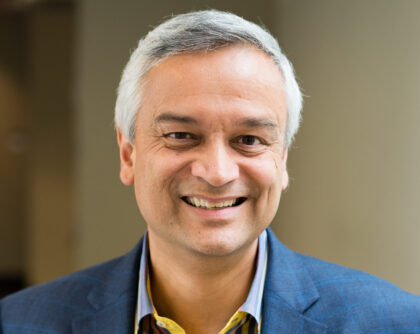
  • Smiling man with short gray hair wearing a blue blazer and a collared shirt, standing indoors with a blurred background.
    Krishna Rajagopal William A. M. Burden Professor of Physics, Massachusetts Institute of Technology

When

  • – ET

Where

Gerald D. Fischbach Auditorium

160 5th Ave

New York, NY 10010, United States

At Long Island and Geneva laboratories, nuclei collide at speeds incredibly close to the speed of light. The collisions create tiny droplets of quark soup with temperatures of around 1 trillion degrees and pressures 10 million trillion trillion times Earth’s atmospheric pressure at sea level. This hot quark soup is the same stuff which filled the universe microseconds after the Big Bang, and these tiny droplets of it promptly explode. Over the last twenty years, data from these “Little Bangs” have shown that this primordial fluid is the most liquid liquid in the universe. In this Presidential Lecture, Krishna Rajagopal will sketch how we have learned this and look ahead to upcoming measurements that will use jets to probe the microstructure of hot quark soup and see how each droplet ripples after being probed.

Cold quark soup, at pressures almost as high, can be found at the centers of the heaviest neutron stars, where the inward pressure of the surrounding star prevents it from exploding. Cold quark soup is expected to be the quark analog of a superconductor, a prediction that may be within reach of coming astrophysical observations of neutron stars and their mergers.

About the Speaker

After growing up in Toronto, Rajagopal did his undergraduate work at Queen’s University in Kingston, Canada. He obtained his doctorate at Princeton University in 1993 and spent three years at Harvard University as a junior fellow. He then spent one year at Caltech before coming to MIT in 1997. He became the associate head of the Department of Physics in 2009, served as chair of the MIT faculty from 2015 to 2017 and as MIT’s dean for digital learning from 2017 to 2021. Rajagopal’s work probing hot and cold quark matter under intense pressure links disparate strands of theoretical physics, including particle and nuclear physics, cosmology, astrophysics, condensed matter physics and string theory.

A softly shaded, grainy blue circle with a glowing center sits on a light beige background, creating a subtle gradient and halo effect.

Event Series

Presidential Lectures 2025

Free public talks that spotlight groundbreaking research.

This series spotlights groundbreaking research across neuroscience and autism, physics, biology, and mathematics and computer science. Featuring leading scientists and mathematicians, these talks foster discussion and discovery within the New York City research community.

See events

More Events

October 12–14, 2026

October 14, 2026

6–7 p.m. ET

Speaker

Shep Doeleman

A man in a checked shirt and dark blazer faces the camera, wearing a pin on his jacket and a pen in his pocket, against a plain background.

October 15–16, 2026