A Pipeline for Functional Assessment of Autism-Associated Missense Mutations in C. Elegans
Featuring
-

Paul Sternberg
SFARI Investigator
Bringing people and ideas together to fund, conduct, and share transformative science.
Our grants advance knowledge and strengthen connections between science and society.
Discover the latest news, research, and updates.
We convene scientists, mathematicians, and thinkers to share ideas and explore new questions.
Founded by Jim and Marilyn Simons, we’re a private philanthropy advancing mathematics and basic science.
Work with us on the frontier of basic science research.
The Flatiron Institute is a research center that uses computational science to advance fields like physics, biology, and astronomy.
Search
Paul Sternberg and colleagues establish an initial pipeline in C. elegans to screen autism-associated missense mutations for functional effects.
SFARI Investigator
Missense mutations represent one of the greatest interpretive challenges in autism genetics, given the difficulty in determining whether a particular variant is not just functional but also pathogenic. A range of statistical and functional approaches are likely to be needed to inform genetic counselors and clinicians.
Now, SFARI Investigator Paul Sternberg and colleagues have established a pipeline and a suite of assays in C. elegans that can be used to screen and prioritize missense mutations identified in human genetic studies of autism.
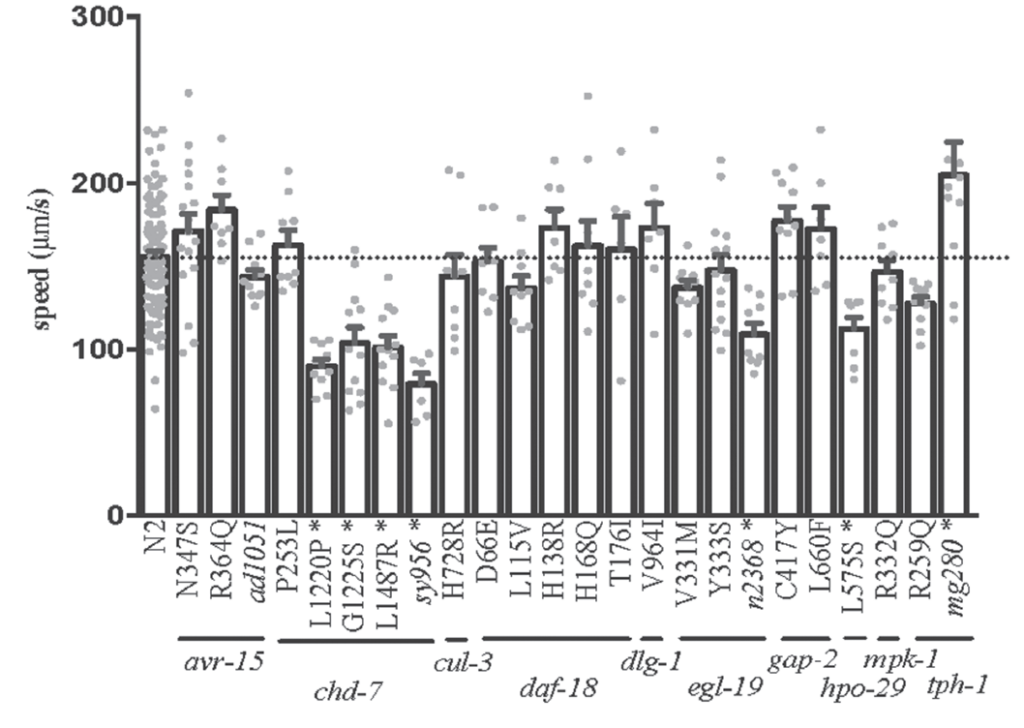
In the new work — partly funded by a SFARI targeted award — Sternberg’s team tested 20 autism-associated missense changes in 11 genes (CACNA1D, CHD7, CHD8, CUL3, DLG4, GLRA2, MAPK3, NAA15, PTEN, SYNGAP1 and TPH2). A range of quantitative assays were developed to test for functional defects imparted by these variants, including body morphology (length, width and area), movement (speed, reversal rate and sinusoidal wavelength and amplitude) and fecundity. While all 20 of the missense variants were predicted to perturb protein function, only 14 showed a detectable phenotype in one of the functional assays, suggesting that they should receive priority for follow-up.
Undoubtedly, a larger range of assays in multiple species will have the greatest predictive power, and additional studies by SFARI Investigators Kurt Haas (McDiarmid et al., bioRxiv, 2019) and Haiyuan Yu (Chen et al., Nat. Genet., 2018) are contributing to this effort.

