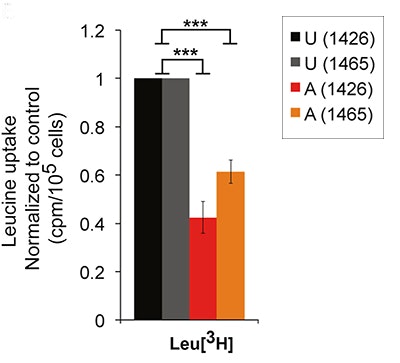
SFARI Investigators Gaia Novarino and Joseph Gleeson previously reported that reductions in the brain levels of branched-chain amino acids (BCAAs) can lead to autism spectrum disorder (ASD) (Novarino et al., 2012). BCAAs, comprising valine, leucine and isoleucine, need to be constantly taken up from the periphery to ensure proper brain functioning. Here, Novarino, Gleeson and their colleagues asked whether the amino acid transporter LAT1, located at the blood brain barrier, plays a critical role in transporting BCAAs into the brain. To do this, the researchers studied a mouse model in which SLC7A5, the gene encoding LAT1, was deleted from the blood brain barrier. Both newborn and adult mice exhibited decreases in brain BCAA levels and displayed behavioral alterations, including motor delays and ASD-related phenotypes. Injection of BCAAs into the brains of adult mice was found to rescue some of these behaviors. Novarino and Gleeson had previously identified mutations in BCKDK — a gene whose encoded protein is responsible for the production of BCAAs — in several individuals with ASD (Novarino et al., 2012). In the current study, they identified two independent families with multiple children affected by ASD and who harbored function-disrupting mutations in SLC7A5. Combined, these findings suggest that restoring appropriate brain levels of BCAAs could potentially improve outcomes in a subset of individuals with ASD.

