A Role for SHANK3 in Social Reward
Featuring
-

Christian Lüscher
Past, SFARI Investigator
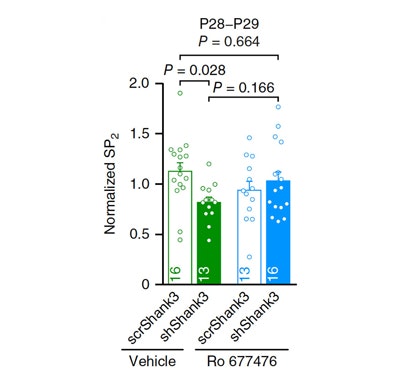
Impaired function of the reward circuitry has been suggested to contribute to social deficits in autism. In the current study, SFARI Investigator Christian Lüscher and his colleague Camilla Bellone examined mice in which expression of the autism risk gene SHANK3 was downregulated in the ventral tegmental area — a key brain region involved in reward. These mice exhibit altered excitatory synapse transmission that converges to reduce dopaminergic neuron activity and generates impaired social behaviors. Importantly, the synaptic, circuit and behavioral deficits in these mice are ameliorated by administration of a type 1 metabotropic glutamate receptor (mGluR1) agonist during early postnatal development. These results provide further support for the importance of reward circuit function in the control of social behaviors, and suggest mGluR1 modulation as a potential therapeutic strategy for some forms of autism.