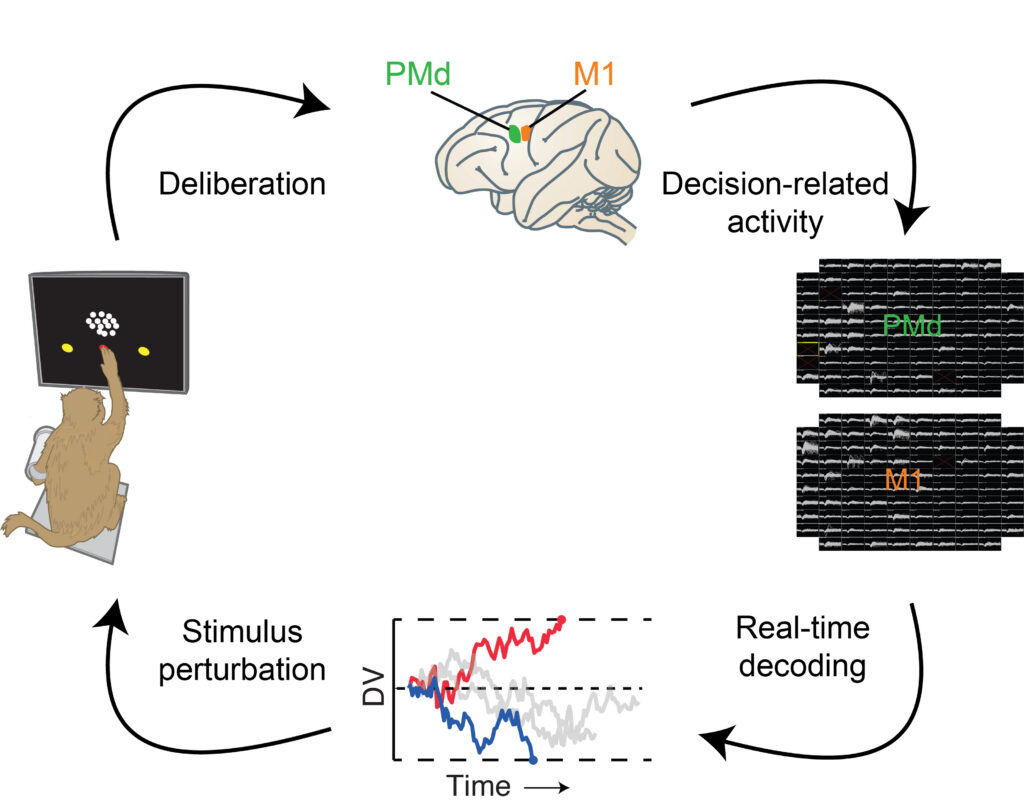
A Step Toward Mind Reading: Decoding Perceptual Decisions as They Unfold
Featuring
-

Bill Newsome
Investigator, Simons Collaboration on the Global Brain
-

Krishna Shenoy
Investigator, Simons Collaboration on the Global Brain
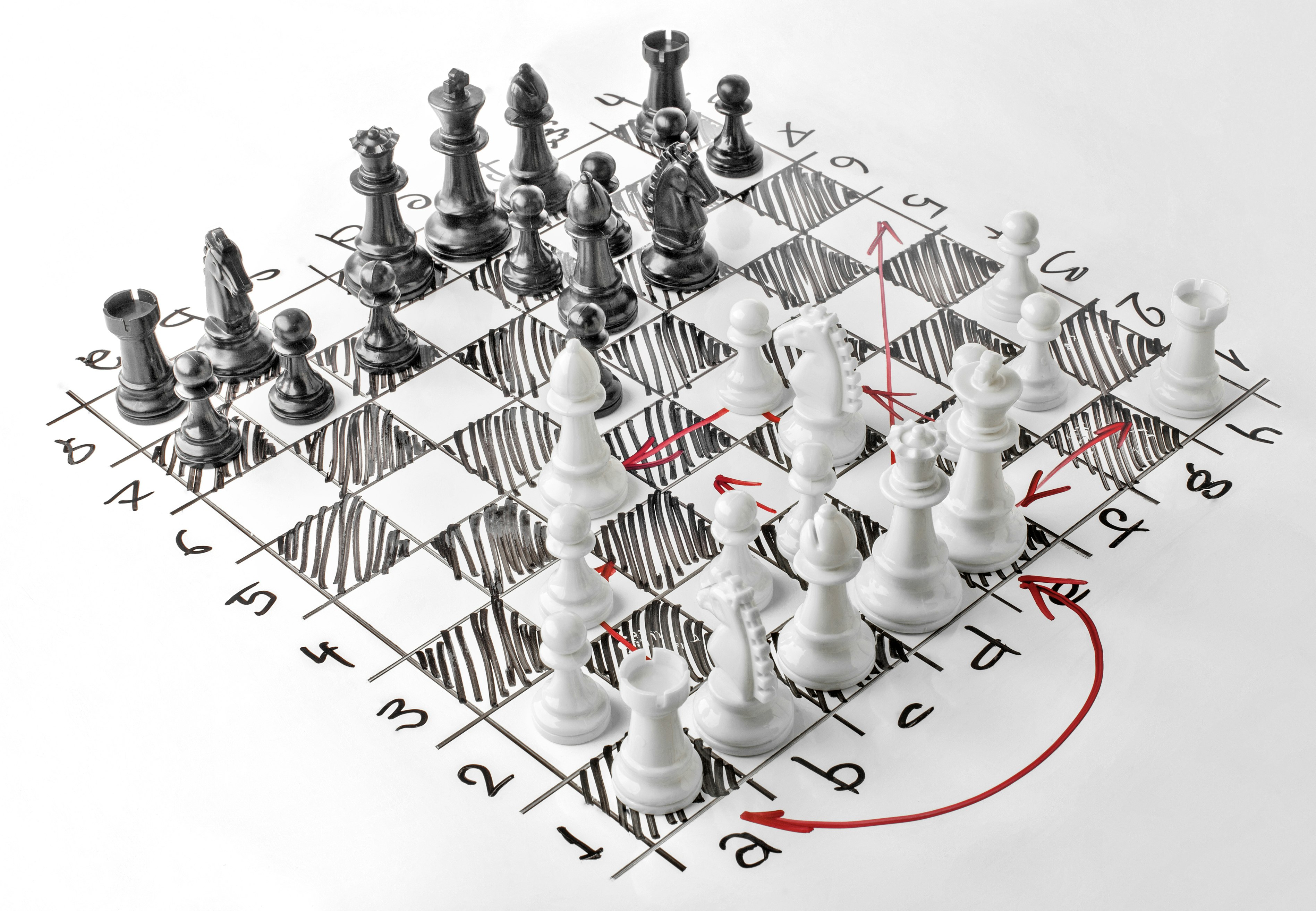
Imagine a chess player at a tournament deliberating on her next move. She is likely weighing the optimal strategy given her prior experience, her opponent’s style and many other variables. During that thought process, she might cycle through a series of possible decisions, with each choice quickly updated as she considers new information — a memory of a previous move by this opponent, for example.
Scientists would like to understand how the brain makes these kinds of calculations. But it’s a challenging problem. The decision states are all reflected in the player’s neural activity. But they’re difficult to study given that these patterns are not tied to any outward behavior — the outcome of her deliberation becomes clear only when she finally moves the piece.
Neuroscientists typically study decision making in the lab using highly constrained tasks — an animal might have to match two similar images or decide on the dominant color or motion of a set of moving dots. Even these simple tasks are unexpectedly complex, however. The brain can respond differently to the same image because of fluctuations in the animal’s state of mind, such as whether it’s paying attention to the image. That variability in turn can influence behavior. If the stimuli are ambiguous enough — if roughly half the dots are red and half green when the goal is to report the dominant color — subjects will make different choices on different trials even if the stimulus is exactly the same.
For several decades, systems neuroscience, and decision-making research in particular, dealt with this variability by repeating the same or nearly identical stimuli over and over. Averaging neural responses from one or a few neurons across many such trials isolates the consistent responses. This approach has had great success and has vastly improved our understanding of the neural underpinnings of many phenomena, including vision, attention, decision making and spatial navigation. But it discards variability across trials and even within trials. That information is crucial for understanding non-repeatable processes, such as the internal deliberation that both the lab subject and the chess player go through before reaching a decision.
In fact, we know from our own subjective experience that most of our cognitive life is not repeatable or necessarily dependent on external events. To understand these cognitive processes, we must leave the trial-averaging approach behind and build tools to decode and probe internal cognitive states.
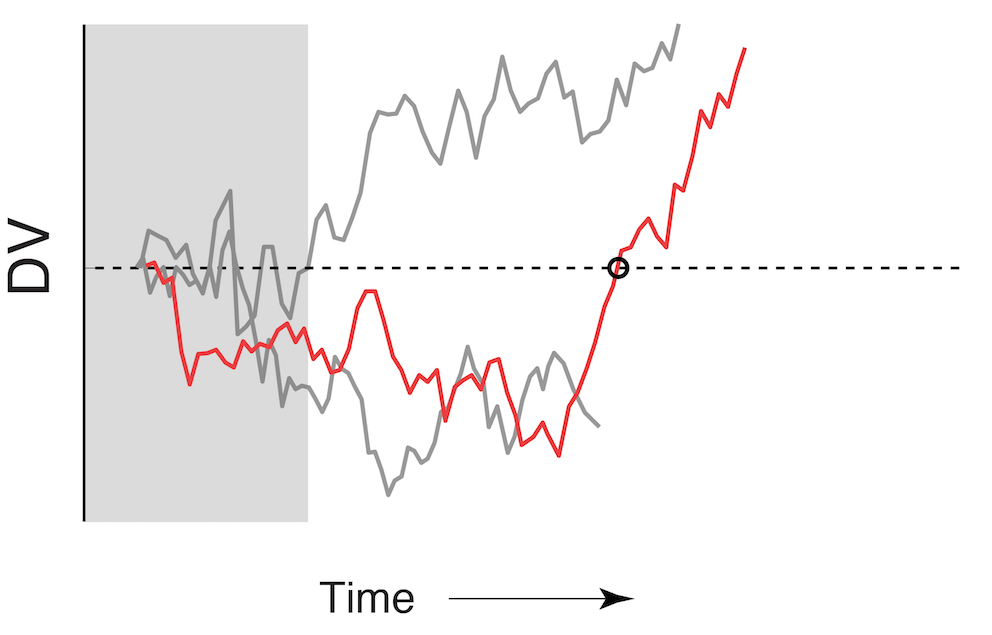
In the last five to 10 years, multiple research groups have taken on this challenge.1-4 The most common approach has been to simultaneously record from large populations of neurons and use that information to predict what an animal will decide well before it reveals its choice. The animal’s decision state can be defined as the likelihood at that point in time of its choosing each of the options available.