Adult reversal of select autism-like phenotypes in SHANK3 mutant mice

Using SHANK3 conditional knock-in mice, Guoping Feng shows that adult re-expression of SHANK3 improves cellular and behavioral abnormalities, including ASD-like deficits.


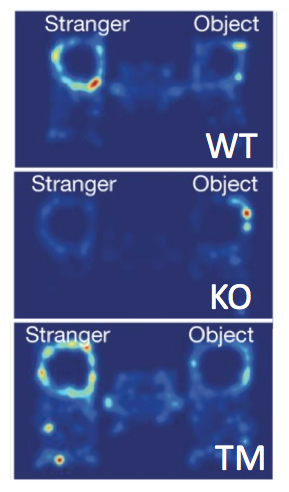
Heatmaps showing mouse exploration patterns for three groups (WT, KO, TM) in a test with a stranger and an object. Color intensity indicates time spent near each area, with differences among groups.
Social interaction restored: Representative heat maps illustrate that wildtype (WT) control mice prefer an unfamiliar mouse over a novel object, while SHANK3 knockout (KO) mice display no such preference; this behavior is rescued in mice in which SHANK3 expression is restored in adulthood (TM). Image from Mei Y. et al. (2016).
SHANK3 is a postsynaptic protein that plays a role in synaptic development and function. In humans, mutations in SHANK3 have been associated with autism spectrum disorders (ASDs). SFARI Investigator Guoping Feng and his colleagues now show, using a novel SHANK3 conditional knock-in mouse model, that re-expression of the SHANK3 gene in adult mice leads to improvements in synaptic protein composition, spine density and neural function in the striatum. Select behavioral abnormalities, including deficits in social interaction and repetitive grooming, could be rescued in the adult.  By contrast, anxiety-like behaviors and motor coordination deficits are irreversible in the adult but can be improved by early postnatal intervention. Combined with previous studies showing adult rescue of select cellular and behavioral phenotypes in other genetic mouse models of ASDs, these data provide hope that a certain degree of improvement may be achievable in individuals with ASDs, even after early developmental milestones are completed.