Allelic Imbalance in ASD-Associated Gene Expression
Featuring
-

Michael Gandal
SFARI Investigator
-

Daniel Geschwind
SFARI Investigator
Bringing people and ideas together to fund, conduct, and share transformative science.
Our grants advance knowledge and strengthen connections between science and society.
Discover the latest news, research, and updates.
We convene scientists, mathematicians, and thinkers to share ideas and explore new questions.
Founded by Jim and Marilyn Simons, we’re a private philanthropy advancing mathematics and basic science.
Work with us on the frontier of basic science research.
The Flatiron Institute is a research center that uses computational science to advance fields like physics, biology, and astronomy.
Search
Daniel Geschwind, Michael Gandal and colleagues reported that allelic imbalance in gene expression in ASD shows a surprising preference for the minor allele and implicates a family of snoRNAs at 15q11-13.
SFARI Investigator
SFARI Investigator
One possible explanation for the differential expressivity of autism spectrum disorder (ASD)-associated phenotypes is allele-biased gene expression. That is, an allele carrying a mutation may have a greater or lesser effect depending on the relative level of expression of that allele. Despite this theoretical possibility, there are few documented examples of allelic imbalance in ASD.
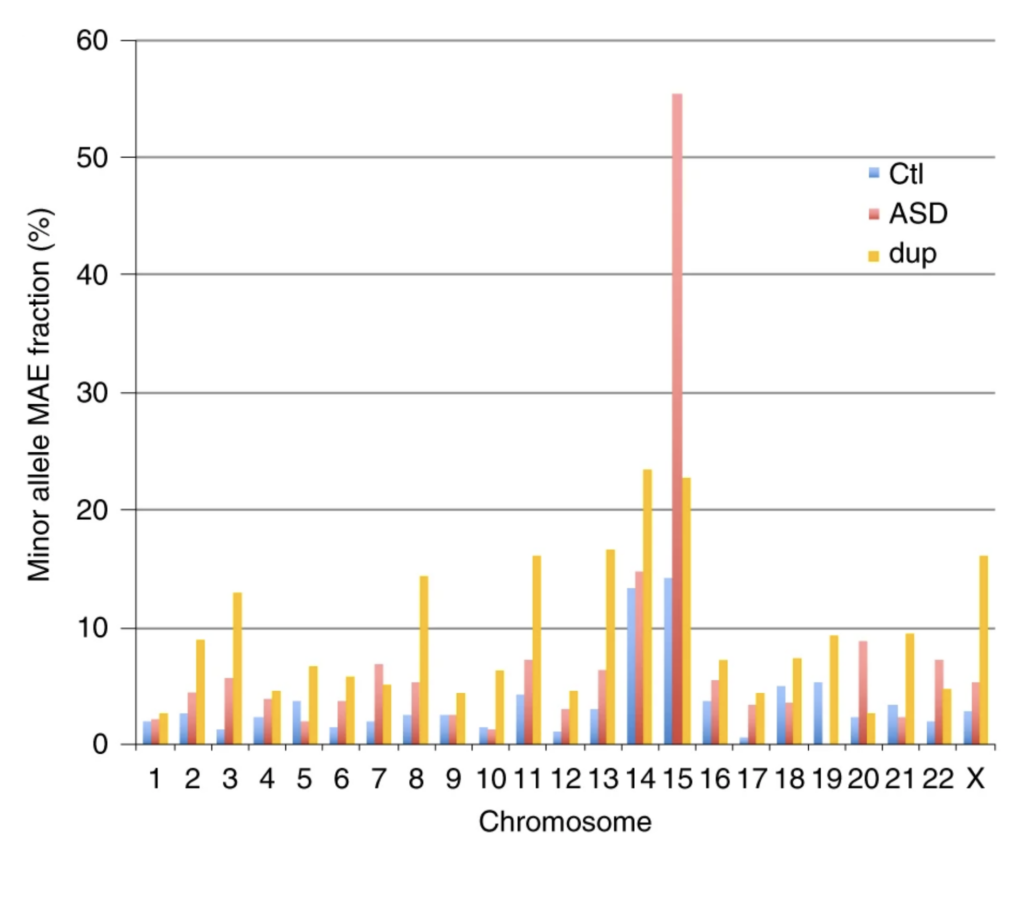
A recent study by SFARI Investigators Daniel Geschwind and Michael Gandal, and their colleagues, sheds new light on the impact of allelic imbalance in ASD. Using a set of postmortem brain tissue samples from frontal cortex and cerebellum, the authors showed that allelic imbalance in gene expression occurs less often in ASD, but when it does occur, it exhibits preferential expression of the minor allele. In other words, the allele carrying the rare mutation shows higher expression in ASD more often than is the case for neurotypical controls. This phenomenon would add to the vulnerability of the ASD brain, since a greater proportion of the gene expression at a given locus would be affected by the mutation. Indeed, loci with allelic imbalance of gene expression are enriched for genes that are known to harbor de novo ASD risk variants.
One of the genomic regions showing a very strong shift to predominant expression of the minor allele is at the ASD-associated 15q11-q13 duplication interval (dup15q syndrome). In particular, their analysis highlights the orphan C/D box small nucleolar RNA (snoRNA) genes in this region, which preferentially target alternatively spliced junctions of downstream ASD risk genes. These results implicate a common set of alternatively spliced targets of snoRNAs in both idiopathic ASD and dup15q-associated ASD and suggest that a careful examination of allelic imbalance may help to explain some of the phenotypic variability in individuals carrying mutations in the same risk gene.

