Bringing people and ideas together to fund, conduct, and share transformative science.
Our grants advance knowledge and strengthen connections between science and society.
Discover the latest news, research, and updates.
We convene scientists, mathematicians, and thinkers to share ideas and explore new questions.
Founded by Jim and Marilyn Simons, we’re a private philanthropy advancing mathematics and basic science.
Work with us on the frontier of basic science research.
The Flatiron Institute is a research center that uses computational science to advance fields like physics, biology, and astronomy.
Search
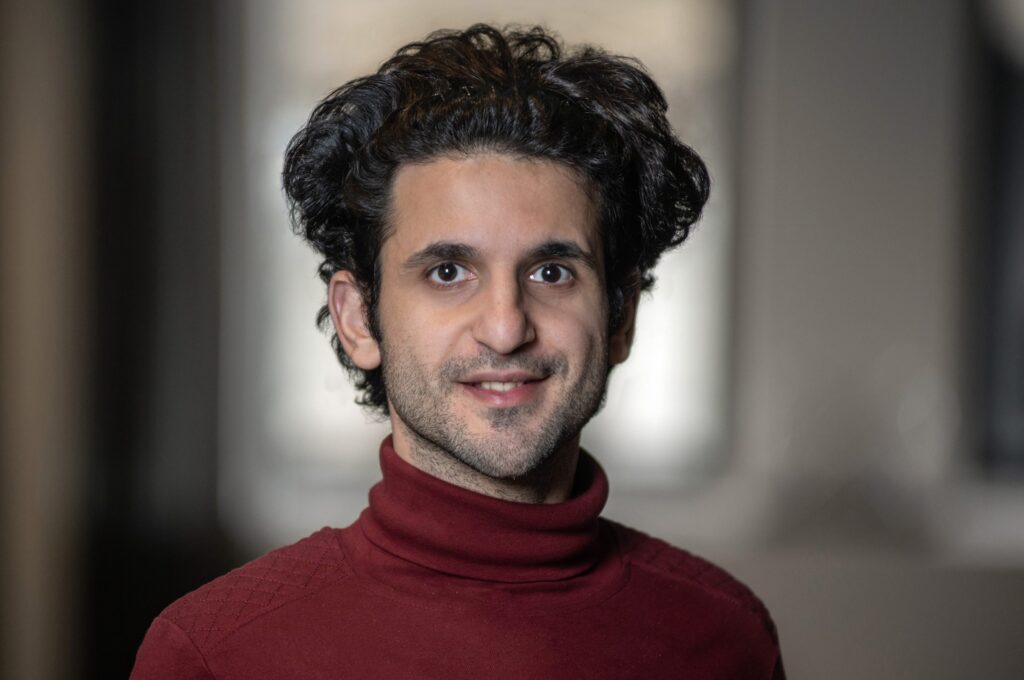
The New York Academy of Sciences and the Leon Levy Foundation have named Flatiron Research Fellow Amin Nejatbakhsh a 2024 Leon Levy Scholar in Neuroscience. He received the honor in recognition of his “statistical modeling of neural data to causally understand biological and artificial neural networks and the mechanisms therein.”
Amin Nejatbakhsh is a researcher in the Flatiron Institute’s Center for Computational Neuroscience (CCN). His research interests include machine learning, statistics, causal inference, dynamical systems, neuroscience and computer vision. He received his Ph.D. in theoretical neuroscience from Columbia University in 2022 and joined CCN that same year.
The Leon Levy Scholars program is an initiative that supports young postdoctoral researchers in New York City as they as they pursue innovative neuroscience research and continue their training to become independent principal investigators. Awarded for three years, it provides honorees with professional development opportunities such as structured mentorship by distinguished senior scientists, and workshops on grant writing, leadership development, communications, and management skills. Nejatbakhsh is among the nine members selected for the program’s 2024 cohort.
Nejatbakhsh has studied a broad array of processes and phenomena, including applied optimal transport, partial information decomposition, switching linear dynamical systems, causal dynamical systems, and covariance estimation. In his work, he has built automated tools for the segmentation, detection, and tracking of cells in microscopy images and videos; developed statistical atlas construction methods for capturing structural variability across a population of animals; and developed and applied functional and interventional connectivity estimation techniques. He is currently investigating representational similarity analysis for comparing neural representation across animals, species, and neural networks.
The Leon Levy Scholars program is an initiative of the Leon Levy Foundation, which supports the preservation, understanding and expansion of knowledge, with a focus on the ancient world, arts and humanities, nature and gardens, neuroscience, human rights, and Jewish culture.

