ASD Risk Genes and Homeostatic Plasticity
Featuring
-

Graeme Davis
SFARI Investigator
Bringing people and ideas together to fund, conduct, and share transformative science.
Our grants advance knowledge and strengthen connections between science and society.
Discover the latest news, research, and updates.
We convene scientists, mathematicians, and thinkers to share ideas and explore new questions.
Founded by Jim and Marilyn Simons, we’re a private philanthropy advancing mathematics and basic science.
Work with us on the frontier of basic science research.
The Flatiron Institute is a research center that uses computational science to advance fields like physics, biology, and astronomy.
Search
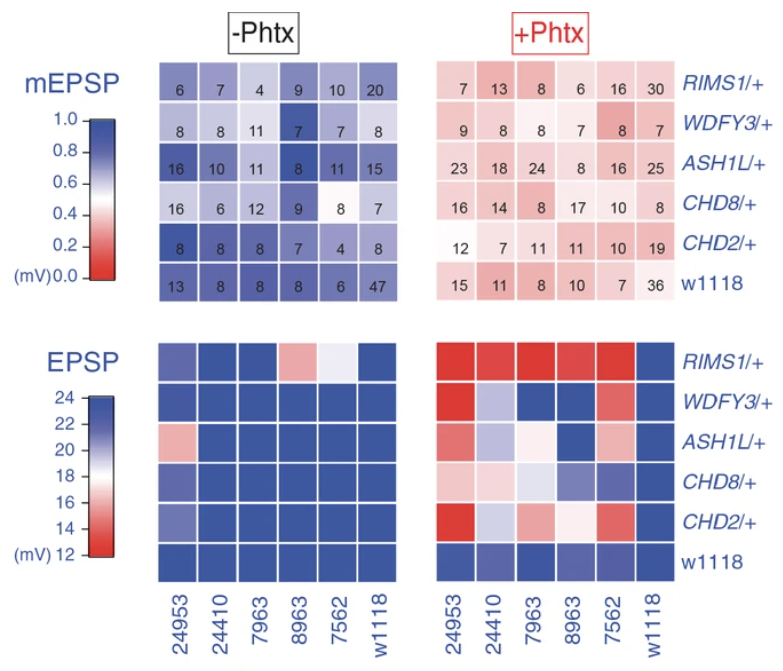
Graeme Davis and colleagues showed that ASD risk genes genetically interact with a class of common modifiers of presynaptic homeostatic plasticity at the Drosophila neuromuscular junction.
SFARI Investigator
SFARI is funding a number of efforts to determine if at least some of the genes implicated in autism spectrum disorder (ASD) risk via de novo mutation converge on particular biological pathways or processes. A new study identifies presynaptic homeostatic plasticity (PHP) as one possible point of biological convergence of ASD risk genes, which seem to sensitize the organism to the effects of a group of common modifiers of PHP.
The work was supported in part by a Pilot Award to SFARI Investigator Graeme Davis. For their assay of PHP, the authors examined the Drosophila neuromuscular junction, at which PHP can be induced by the application of sub-blocking concentrations of a postsynaptic glutamate receptor antagonist. Heterozygous loss-of-function mutations in the orthologs of five different ASD risk genes—RIMS1, CHD8, CHD2, WDFY3 and ASH1L—showed no effect on PHP, but compound heterozygous mutations in RIMS1 and either CHD8, CHD2 or ASH1L significantly impaired PHP. A forward genetic screen using small chromosomal deficiencies covering about 6,000 genes in the Drosophila genome further identified a surprisingly large number of double-mutant combinations affecting PHP. Fine mapping of two of these deficiency strains revealed PDPK1 and PPP2R5D as two of the genes conferring this interaction effect on PHP. Interestingly, the CHD8-PPP2R5D double-mutant interaction showed altered presynaptic membrane trafficking as a possible cellular mechanism underlying the diminished PHP.
Of note, neither the ultrastructural differences seen in the CHD8-PPP2R5D double-mutant, nor the gene expression analyses, nominated a mechanism for the altered PHP that was common to a significant number of gene pairs. These findings suggest that the role of ASD risk gene mutations in sensitizing neurons to altered PHP is likely to be complex. The authors also suggest that these interaction-based mechanisms may underlie some degree of resilience to ASD in unaffected individuals who carry mutations that are typically associated with a diagnosis.

