Cell-Type-Specific Effects of Loss of Autophagy in the Striatum
Featuring
-
David Sulzer
SFARI Investigator
Bringing people and ideas together to fund, conduct, and share transformative science.
Our grants advance knowledge and strengthen connections between science and society.
Discover the latest news, research, and updates.
We convene scientists, mathematicians, and thinkers to share ideas and explore new questions.
Founded by Jim and Marilyn Simons, we’re a private philanthropy advancing mathematics and basic science.
Work with us on the frontier of basic science research.
The Flatiron Institute is a research center that uses computational science to advance fields like physics, biology, and astronomy.
Search
David Sulzer and colleagues used conditional knockout mice of Atg7, a protein involved in autophagy, to study the effects of loss of autophagy on the structure and function of striatal spiny projection neurons, as well as on behaviors relevant to ASD.
SFARI Investigator
Previous work (Tang et. al., Neuron, 2014) showed that mTOR-dependent autophagy is required in mice for dendritic spine pruning in the cortex and is associated with reduced sociality in animal models of autism spectrum disorder (ASD). Whether autophagy in other regions of the developing brain is also involved in ASD — via similar or distinct mechanisms — has not been addressed. A new study focusing on the striatum, which has been implicated in ASD pathophysiology, identified new molecular and cellular roles for autophagy in the regulation of additional ASD-relevant behaviors.
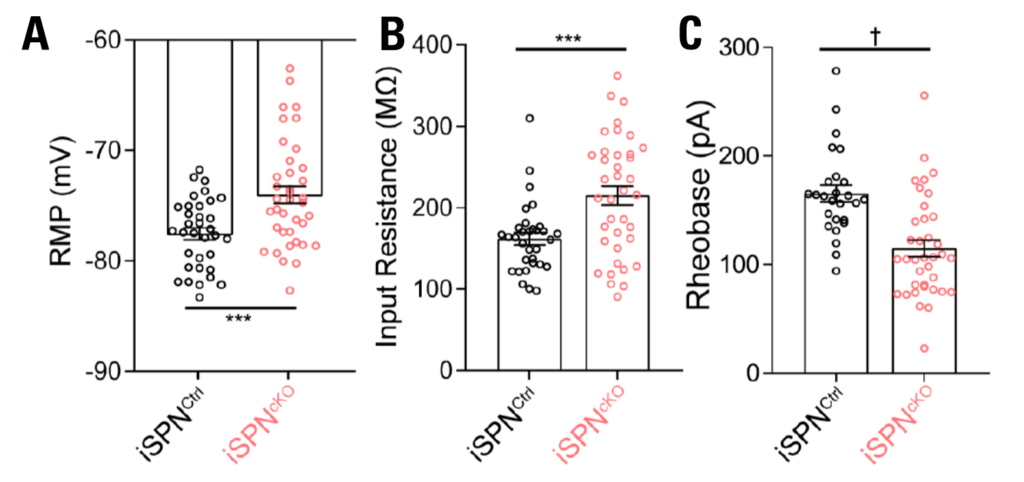
The new work was supported in part by a Pilot Award to SFARI Investigator David Sulzer. Using lines of mice that lacked essential molecular components of the autophagic machinery in spiny projection neurons (SPNs) of the direct and indirect striatum pathways, the authors uncovered new roles for autophagy in neurotransmission. They found that elimination of the Atg7 protein in SPNs of the direct pathway resulted in changes in dendritic structure and spine density, while loss of Atg7 in SPNs of the indirect pathway led to intrinsic hyperexcitability, owing to reduced function of the inwardly rectifying potassium channel, Kir2. This reduced function of Kir2 channels was the result of increased acetylation of the channels, which presumably inhibits their function. Together, these results highlight the novel and cell-type-specific roles of autophagy in different neuronal cell types of the striatum.
Sulzer and colleagues also ran a series of behavioral tests, which showed reduced motor learning, hyperactivity and increased frequency of stereotypies in mice lacking Atg7 compared to wild-type mice. It will no doubt be of interest to explore whether there is evidence of reduced striatal autophagy in postmortem brain tissue from individuals with an ASD diagnosis.

