Deep brain stimulation suppresses excessive self-grooming in autism mouse models

Irving Reti assesses, in two ASD mouse models, the utility of targeted, subthalamic nucleus, deep brain stimulation to treat severe forms of self-injurious behavior.


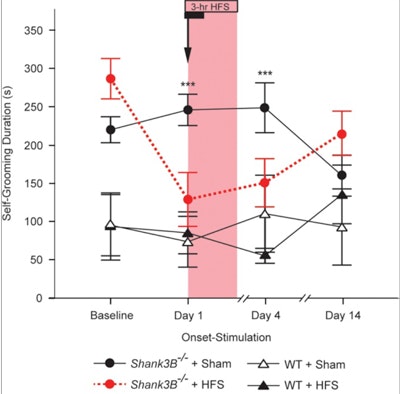
Line graph showing self-grooming duration over time for four mouse groups. Shank3B-/- + HFS shows a significant increase on Day 1, indicated by *** and a shaded area marking 3-hr HFS. Error bars show variability.
Excessive self-grooming suppressed: High-frequency stimulation (HFS) at the subthalamic nucleus suppresses excessive self-grooming in SHANK3B knockout mice. Image from Chang A.D. et al. (2015).
Restricted, repetitive and stereotyped behavior is associated with autism spectrum disorders (ASDs). Such behavior can manifest as self-injurious behavior, including head banging and self-directed biting and punching. Electroconvulsive therapy (ECT) can be effective for the most severe forms of self-injurious behavior that are unresponsive to traditional pharmacological and behavioral therapies. However, ECT has a number of drawbacks that make it a less-than-ideal treatment strategy. Here, SFARI Investigator Irving Reti and his colleagues assessed whether a more targeted brain stimulation strategy would prove beneficial. They found that high-frequency stimulation at the subthalamic nucleus significantly suppressed excessive self-grooming in two genetic mouse models of ASD, with the effects persisting for several days after the stimulation was stopped. These results raise the possibility that deep brain stimulation may be effective as a treatment for intractable self-injurious behavior associated with ASDs. Further studies may lead to the identification of other brain pathways that are amenable to modulation by non-invasive stimulatory techniques.