Ni and her collaborators next plan to test whether other ways of improving vision use the same mechanism. They will treat animals with medications prescribed for attention disorders, such as methylphenidate (commonly marketed as Ritalin), to see if the drug also changes correlated variability. “Are the drugs using this common mechanism, altering how independently neurons encode information?” Ni says.
The answer could have important implications for how to treat attention and other cognitive conditions, Cohen says. “Maybe we should look for drugs that have that specific effect on variability in neural populations,” she says. “It might help us understand the underlying mechanism for how these drugs work.”
Optimal decoding:
The new findings contribute to an ongoing debate over the role that correlated activity plays in information processing. These correlations can be divided into specific forms, and a theoretical study published in 2014 found that only a very specific subset limit how much information a population of neurons can encode.
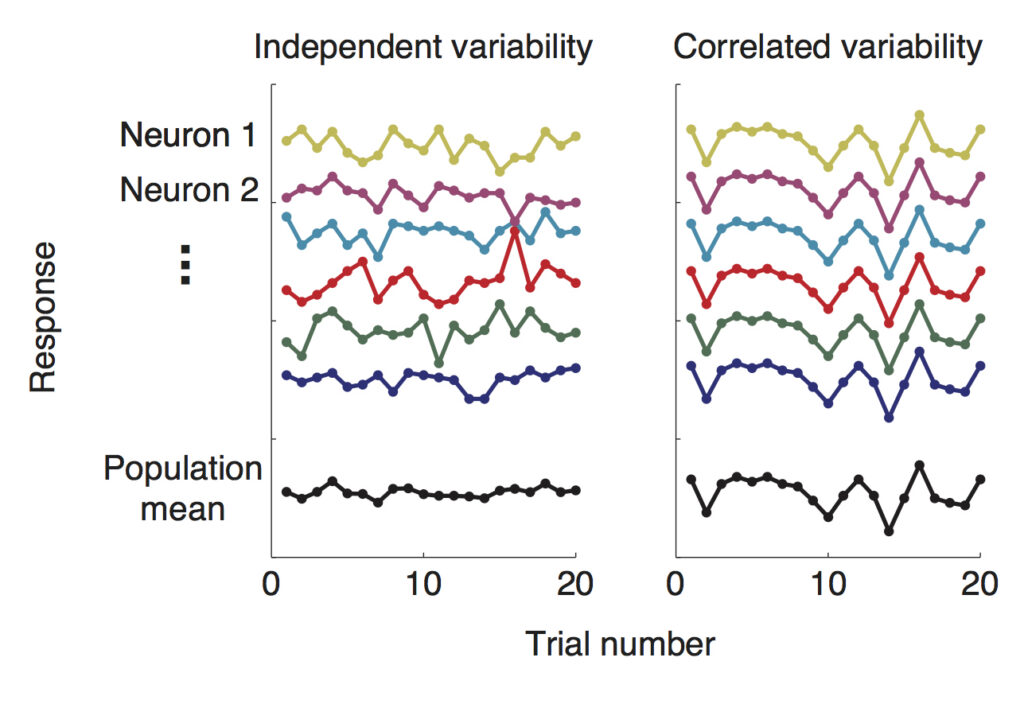
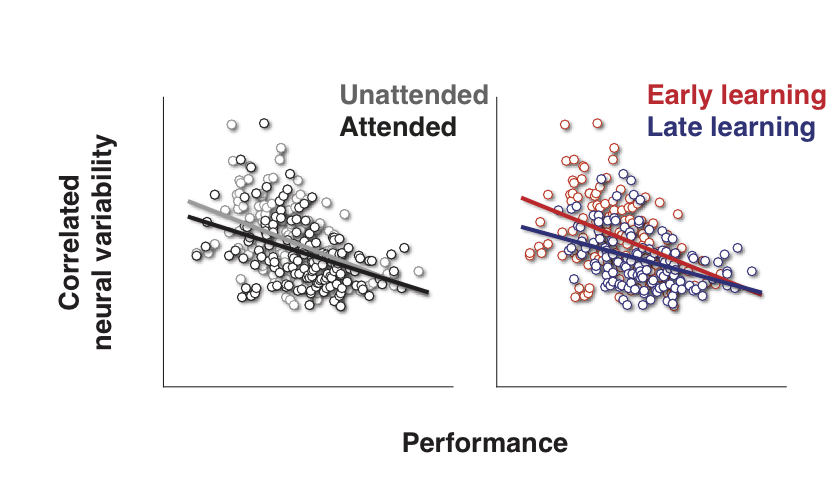
That raised the possibility that this measure may be a side effect rather than the mechanism by which attention and learning improve vision. However, the Science study found that an overall measure of correlation, rather than a specific subset, predicts performance. In other words, “mean correlations are a functionally important variable,” Kohn says. Such a conclusion does not invalidate the theoretical framework, he says. Instead, “it suggests there is a great deal we don’t know about how population responses are used in the animal.”
One potential limitation of the theoretical studies is that they employed a specific algorithm — known as an optimal decoder — to extract information from visual cortex neurons about what the animal was looking at. But in reality, the brain doesn’t make decisions based on this set of information. Rather, neurons in the visual cortex send information to different brain areas, which perform additional computations that ultimately drive our reaction to what we see. “There is mismatch between the clean, elegant theoretical framework and the way population responses are used in the brain,” Kohn says.
Indeed, Cohen and Ni’s work suggests animals don’t decode information optimally. “Instead, animals appear to be suboptimal in a way that makes changes in correlated variability have an outsized impact on the behavior,” Cohen says. “The key question is not how attention or learning affects the amount of information that’s there if you could decode optimally but how they affect the information that’s actually used to guide behavior.”
Cohen will attempt to address this question in her new SCGB project, a collaboration with Kohn and several theorists, including SCGB investigator Alexandre Pouget, who authored the 2014 theoretical paper. To better understand how the brain uses sensory information to guide behavior, the researchers will study brain activity underlying more complex behaviors and record from multiple brain areas simultaneously. “We plan to spend the next four to five years duking that out,” Cohen says.