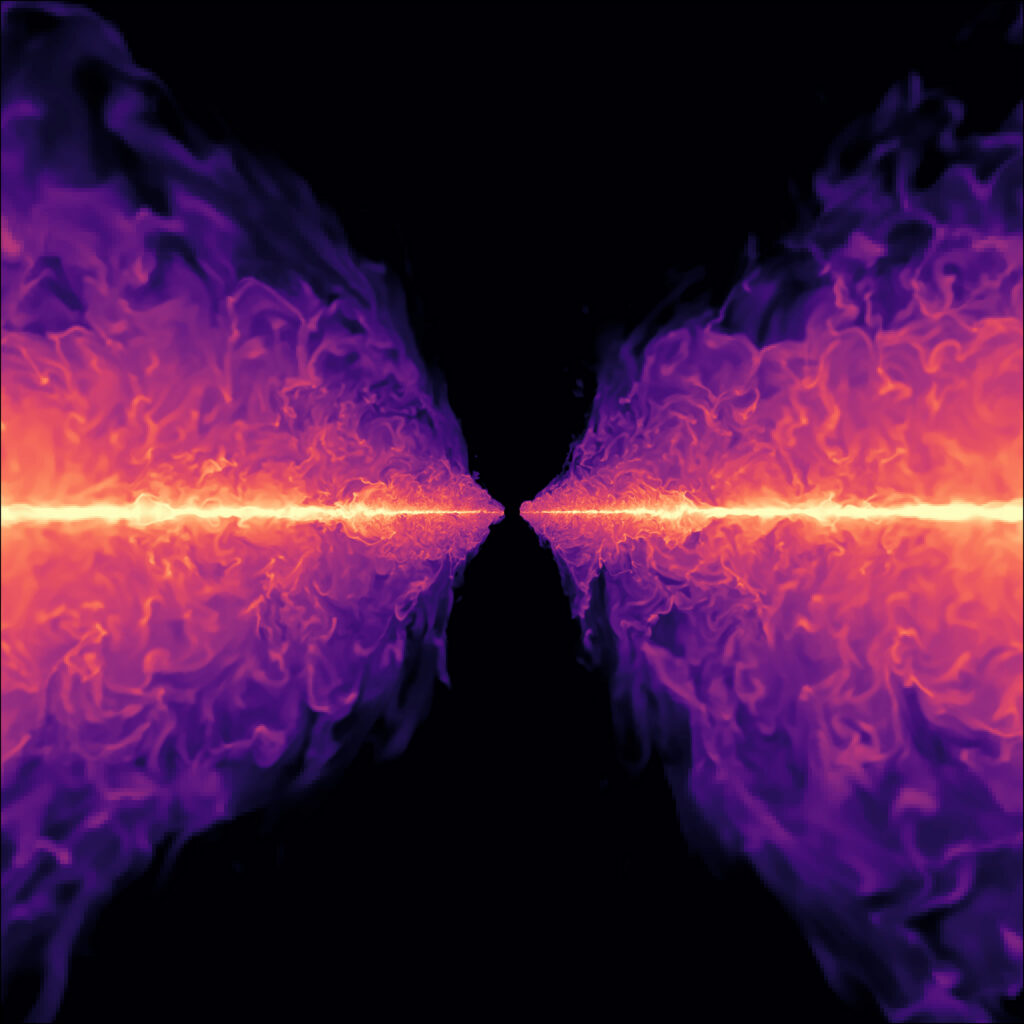
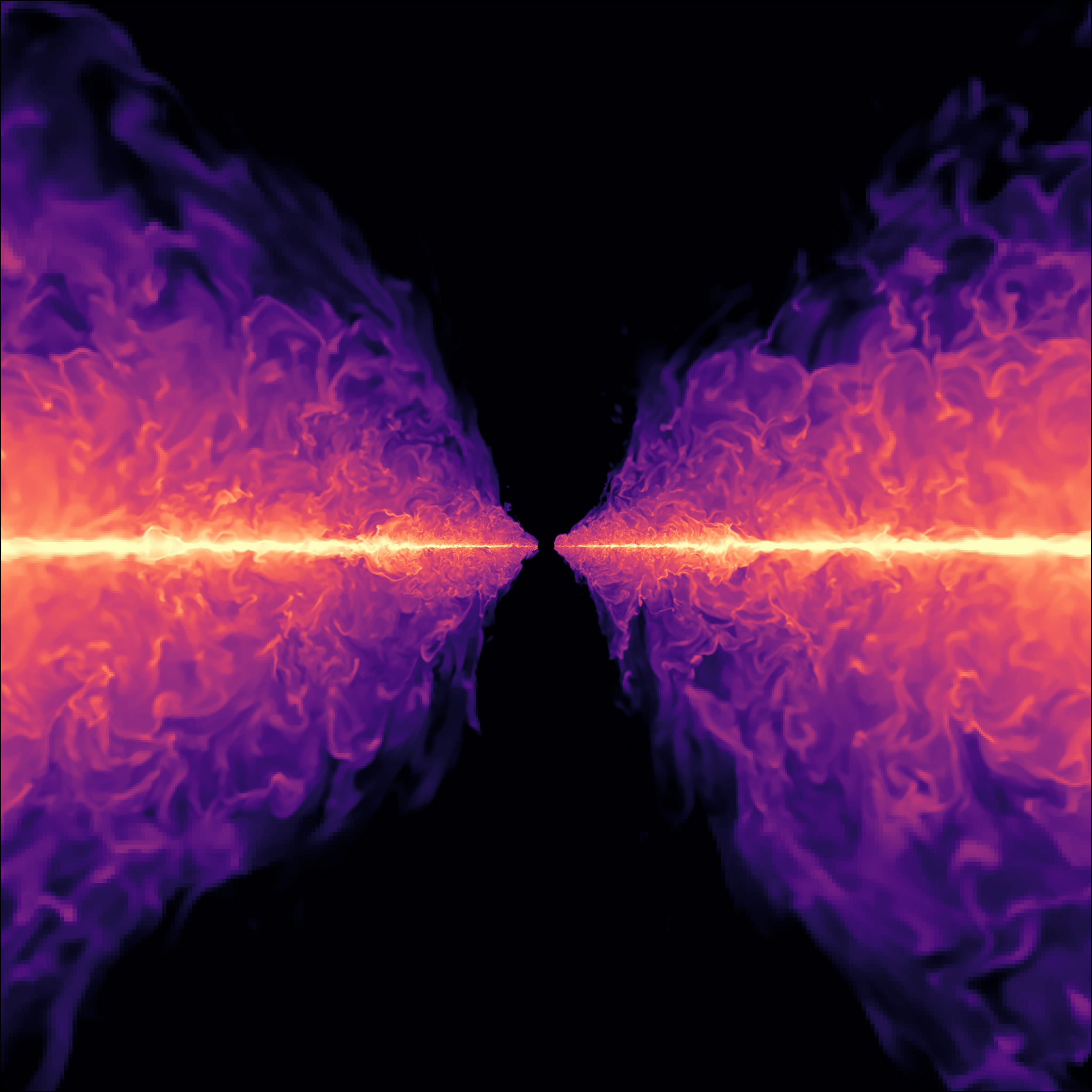
Surprisingly, some of the universe’s brightest objects are black holes. As scorching gas and dust flow around and into a black hole, they glow with fierce intensity across the light spectrum. Now, a team of computational astrophysicists has developed the most comprehensive simulations ever made of how black holes create these dazzling light shows.
Using supercomputers, the researchers calculated the behavior of material zipping around black holes. Unlike all previous studies that relied on simplifying approximations, the researchers utilized a full treatment of how light moves and interacts with matter within Albert Einstein’s general relativity.
Their results could help explain the hundreds of strange, faintly luminous objects known as little red dots (LRDs) spotted in the early universe by the James Webb Space Telescope. A leading theory, supported by the new results, proposes that these dots are black holes that are consuming material through a process called ‘super-Eddington accretion’ in the hearts of primordial galaxies.
The researchers present their groundbreaking simulations in a paper published December 3 in The Astrophysical Journal.
“This is the first time we’ve been able to see what happens when the most important physical processes in black hole accretion are included accurately,” says Lizhong Zhang, lead author of the study and a research fellow at the Simons Foundation’s Flatiron Institute in New York City. “Any oversimplifying assumption can completely change the outcome. What’s most exciting is that our simulations now reproduce remarkably consistent behaviors across black hole systems seen in the sky, from ultraluminous X-ray sources to X-ray binaries. In a sense, we’ve managed to ‘observe’ these systems not through a telescope, but through a computer.”
Zhang is a joint postdoctoral research fellow in the Institute for Advanced Study (IAS) in Princeton, New Jersey, and the Flatiron Institute’s Center for Computational Astrophysics (CCA). Zhang co-authored the new study with collaborators at IAS, the CCA, Los Alamos National Laboratory and the University of Virginia. The study is the first in a series of papers that will present the team’s novel computational approach and its applications to several classes of black hole systems.
Due to their extreme gravity, no model of black holes would be considered complete without the incorporation of Einstein’s theory of general relativity, which describes how the most massive bodies distort the fabric of space-time. That space-time distortion shapes how the light created by the infalling material moves and interacts with the surrounding material.
Those full general relativistic equations are tough to solve, even for powerful computers. Previous simulations took shortcuts by simplifying the calculations of radiation. “Previous methods used approximations that treat radiation as a sort of fluid, which does not reflect its actual behavior,” Zhang explains.
By combining insights gained over decades of work, the team developed new algorithms that can directly solve the equations without sacrificing accuracy or requiring unreasonable amounts of computational power. “Ours is the only algorithm that exists at the moment that provides a solution by treating radiation as it really is in general relativity,” says Zhang.
Their paper addresses accretion onto stellar mass black holes, which are approximately 10 times the mass of the sun, though relative lightweights compared to Sagittarius A*, the supermassive black hole at the center of our galaxy, which has a mass more than 4 million times that of our sun.