Hubble Telescope’s Jaw-Dropping New Photo Mosaic Traces Andromeda Galaxy’s History
Featuring
-

Julianne Dalcanton
Director, Center for Computational Astrophysics
Bringing people and ideas together to fund, conduct, and share transformative science.
Our grants advance knowledge and strengthen connections between science and society.
Discover the latest news, research, and updates.
We convene scientists, mathematicians, and thinkers to share ideas and explore new questions.
Founded by Jim and Marilyn Simons, we’re a private philanthropy advancing mathematics and basic science.
Work with us on the frontier of basic science research.
The Flatiron Institute is a research center that uses computational science to advance fields like physics, biology, and astronomy.
Search
Director, Center for Computational Astrophysics
On a chilly, crystal-clear autumn night, you can see the farthest object visible in the universe without the aid of a telescope or binoculars. Just to the northeast of the Great Square of Pegasus, it appears as a spindle-shaped patch of haze with a bright center. It is the nearest galaxy to our Milky Way, the magnificent Andromeda Galaxy. The faint light you are seeing left the spiral galaxy 2.5 million years ago to cross the immense gulf in intergalactic space toward Earth.
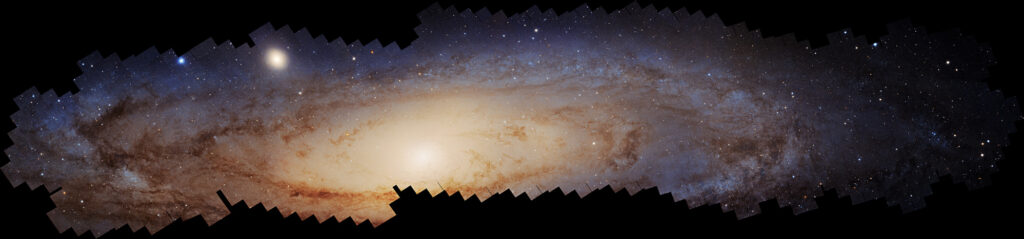
Fast forward to the 21st century, when one of the most powerful science tools ever conceived by humans – NASA’s Hubble Space Telescope – took over 10 years to make a photomosaic portrait of the galaxy’s ancient light using more than 600 snapshots. Why such a monumental task? The galaxy is so close to us that in angular size, it is six times the apparent diameter of the full Moon. For Hubble’s pinpoint view, that’s a lot of celestial real estate to cover. This stunning, colorful mosaic captures the glow of 200 million stars. That’s still a fraction of Andromeda’s population. And the stars-dotted images are crammed into more than 2.5 billion pixels. Try framing that portrait! Hubble’s detailed look at the resolved stars will help astronomers piece together the galaxy’s past history, such as its mergers with smaller satellite galaxies.
Julianne Dalcanton, director of the Flatiron Institute’s Center for Computational Astrophysics, led the work that captured the galaxy’s northern half.
More information about the mosaic — and the incredible science behind it — is available on NASA’s website.

