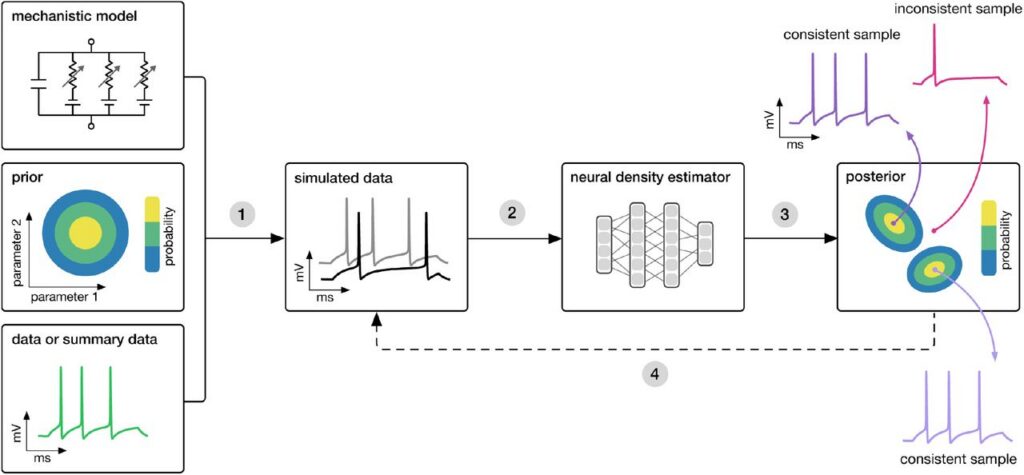
By finding an approximation of the posterior, the SNPE method can, once trained, provide a fuller picture of which sets of parameters can reproduce the data and which can’t. It both automates the process of parameter search that is normally done by hand and identifies all possible parameter regimes that replicate the data.
To check that their method was working as anticipated, the authors applied it to a problem where it was possible to directly calculate the posterior. Comparing their method with this ground truth, they found that SNPE is indeed capable of efficiently finding an accurate approximation of the posterior. Macke presented the research at the Neuromatch 2.0 virtual conference in May.
Cunningham’s study, with first author Sean Bittner, introduced a complementary method: emergent property inference, or EPI. In EPI, a desired ‘emergent property’ of the model, such as a certain pattern of firing rates or a specific response to input, is defined mathematically. Aiming to capture emergent properties — rather than trying to replicate all the details of a full dataset — is common in computational modeling of neural circuits. This is because emergent properties may better capture the features of the data that are relevant for computation. In addition, because the same emergent property can be realized in many different ways in a full dataset, a focus on emergent properties lets the model builder ignore these presumably irrelevant differences. Furthermore, limitations in the way data are reported or how the model is constructed may make emergent properties the most reasonable option for model fitting.
As with SNPE, many simulations of the model are run using different parameters in order to identify those that replicate the emergent property and those that don’t. This information is used to train a deep neural network to produce a probability distribution over the parameters of the model. Without further assumptions put in, this distribution will identify all possible parameter regimes that can replicate the emergent property. Researchers can then see which sets of model parameters will create the behavior they wish to see in their model.
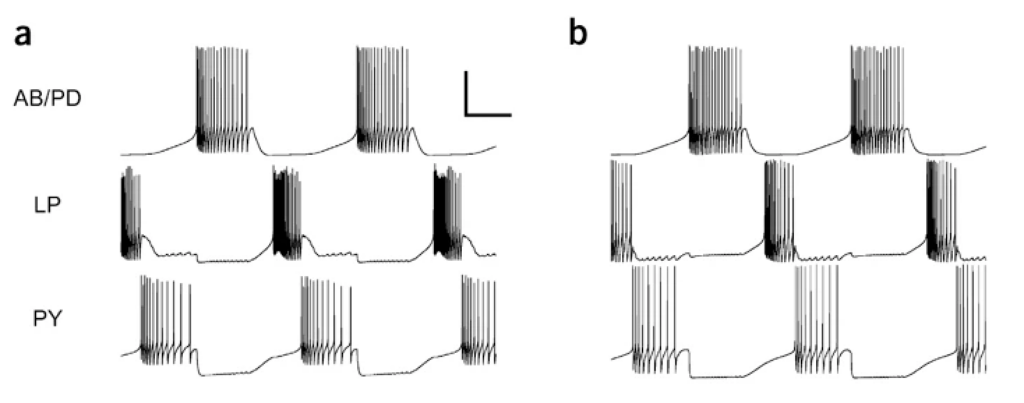
To demonstrate their methods’ abilities, both teams applied their method to the classic STG circuit model. Cunningham and colleagues defined their desired emergent property for this model as ‘network syncing,’ a phenomenon in which the neurons in the network oscillate at the same defined frequency. By analyzing the probability distribution produced by EPI, they identified changes in parameters that would inhibit network syncing and those that would keep it intact.
Macke’s group used SNPE on their model of the ganglion and found that the same rhythmic pattern can be produced using very different sets of parameters — a result in line with the large parameter sweep performed by the Marder lab. What’s more, through their method they were able to find paths between these different parameter regimes that preserve the rhythmic activity throughout.
The results from both methods support the idea that circuits with very different properties can still produce the same behaviors. But, crucially, these methods can reach that conclusion with far fewer simulations than the standard trial-and-error approach.
Parameter fitting’s diverse potential
Both groups also showcased what their methods can do on a host of other problems.
EPI, for example, was applied to a multi-neuron type model of primary visual cortex, a task-based model of superior colliculus, and a recurrent neural network model that performs a mathematical task. In addition, SNPE was used to understand the functioning of ion channels and a Hodgkin-Huxley model of neural firing. Such an array of applications shows the diverse potential of these methods; the mathematical and biological details of the model are largely irrelevant to the parameter-fitting procedure. “They’re both very remarkable results,” says Acerbi. “Solving such a technical problem is a massive contribution.”
The ability of these methods to deal with high-dimensional parameter spaces is particularly notable. While previous methods worked well when fitting fewer than 10 parameters, the current approaches can scale to more than three times as many. Because the amount of time it takes to perform parameter sweeps through trial and error increases combinatorially with the number of parameters, efficient methods for exploring parameter space are particularly important in high dimensions.
Though the two methods address similar needs in computational neuroscience, they each arise from different lines of work from their respective labs over several years. As a result, they differ under the hood in ways that may impact their performance on different models. For example, while SNPE can also be used to fit summary statistics rather than full datasets, EPI was specifically designed for fitting simple emergent properties. What these differences mean in practice is yet to be explored.
As with all new methods, it’s not yet clear how these new approaches for parameter exploration will hold up against the challenges circuit modelers can throw at them. “It’s hard to tell how they will fare in the wild,” says Acerbi. One important consideration is the amount of hand-tuning required to get them to work. Because these methods involve training deep neural networks, users need to choose hyper-parameters associated with this learning, for example. Another question is how robustly these methods will work under different modeling and data assumptions. Both will be important factors in how widely these methods are used.
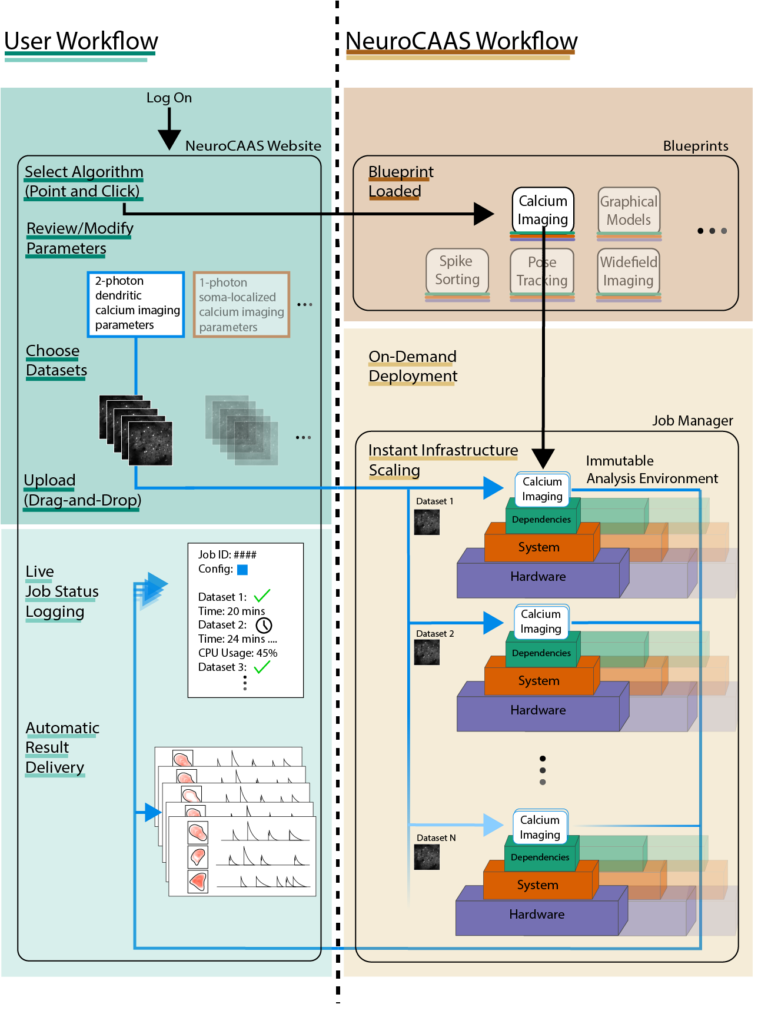
Of course, these methods can only have an impact if people can readily use them. To help users get started, Macke and his team have released a Python toolbox to implement their SNPE method. EPI is available through the Cunningham lab’s GitHub page. In addition to sharing their code, Cunningham debuted a new platform for sharing and executing methods like EPI in an invited lecture at Cosyne in February. The platform, called Neuroscience Cloud Analysis as a Service or NeuroCAAS, aims to bring the infrastructure and efficiency of production-level data science to neuroscience.