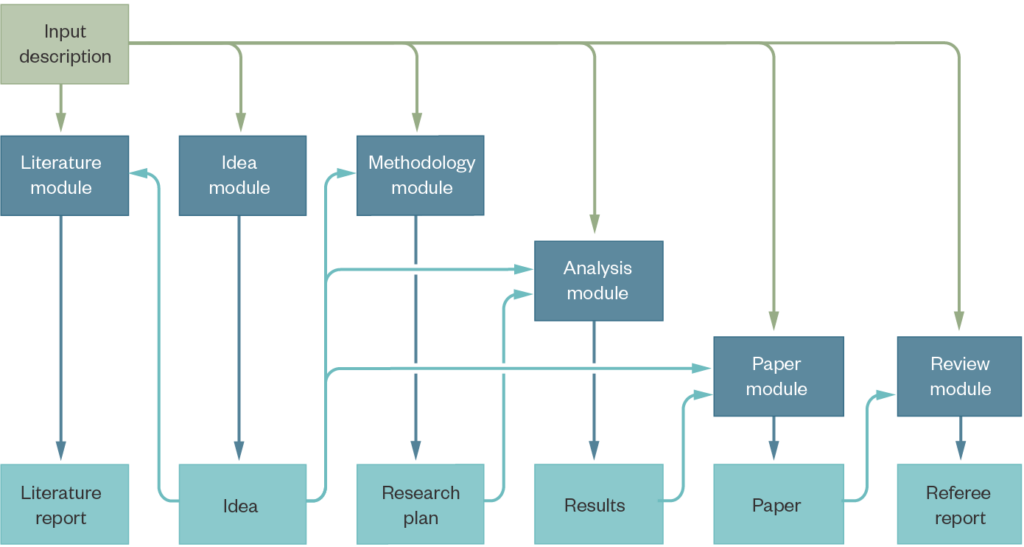
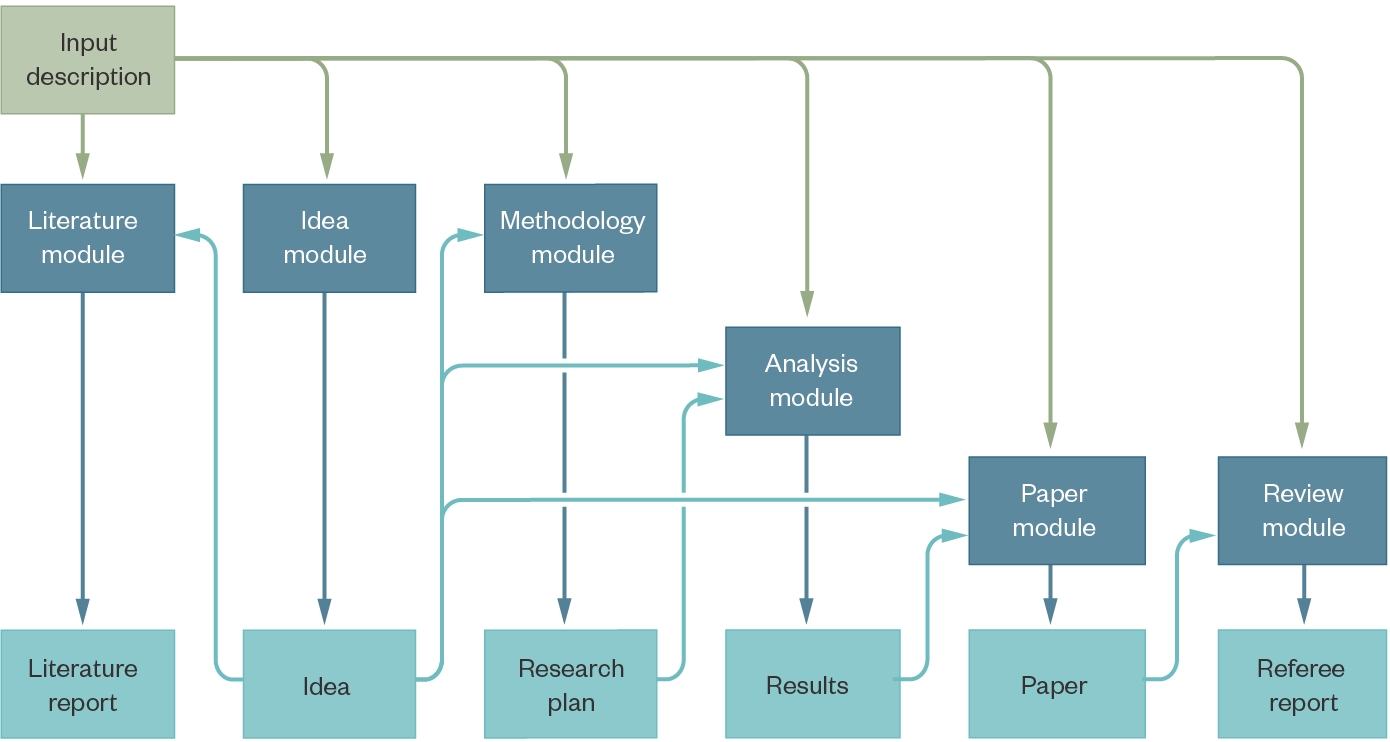
“The agents all work together to make it possible,” Villanueva Domingo says, emphasizing that scientists can easily check each module’s work and, if desired, run the agents individually.
So far Denario has been tested end-to-end hundreds of times on datasets from across 12 different disciplines, including astrophysics, neuroscience, chemistry, biology and materials science. Most of its outputs, Villaescusa-Navarro admits, aren’t worth pursuing. Most were deemed unsuitable in reviews by experts in the subject areas where Denario generated results. However, about 10 percent of the output raised an intriguing question or finding.
“I think Denario is especially useful when it comes to trying out many ideas,” Villaescusa-Navarro says. “You can look at the different research documents from each output and decide if any are intriguing and worth exploring more.” And because Denario can draw from multiple disciplines, the team is hopeful that it can identify new research questions that a scientist highly specialized in a particular field might never think to ask.
“Denario can pull ideas from other fields that maybe a scientist is less familiar with and would never have considered,” Villanueva Domingo says. “That interdisciplinary nature is very exciting.”
For example, work Denario generated on malaria demonstrated expert-level knowledge of the disease’s biology and put forth several creative approaches to unanswered research questions.
For an astrophysics dataset, Denario applied a mathematical method for data compression known as tensor trains. This approach is extensively used in quantum physics, but largely unheard of in astrophysics. Denario utilized these tensor trains, along with machine learning, to track the temporal evolution of dark matter halos — the environments in which galaxies reside. This is a new method that can potentially be applied to many other problems in cosmology and astrophysics, Villaescusa-Navarro says.
The team also anticipates that Denario will help scientists win back a bit of their most valuable resource: their time.
“I hope that Denario will help accelerate science by providing researchers with tools that will help them to spend less time on menial tasks — like scrolling the arXiv, formatting their images, summarizing their analysis — and more time for deep creative thinking,” says Bolliet.
Denario’s Future
In its next iteration, the scientists aim to make Denario more efficient and help it produce better quality work (including identifying and weeding out low-quality outputs automatically).
“Maybe in the next few years or so, we can develop another agent that Denario can use to analyze ideas and filter them so that it just continues to improve on the good ones,” says Villanueva Domingo.
Tools like Denario still have challenges ahead. From a writing standpoint, some of the final write-ups it produced did not adequately convey the uncertainty found in the results. Additionally, Denario struggled when referencing previous studies and specifying its methods clearly, even though it could write about their content with mastery.
Villaescusa-Navarro recognizes that there are also technical and ethical considerations at play, including the risk of Denario drawing from “hallucinations” (products of generative AI that carry misleading or false information) as well as questions around copyright and authorship.
“Hallucinations are always a concern,” says Villaescusa-Navarro. “We use a model called Perplexity to make sure the papers Denario cites from really exist, but there are still ways hallucinations can get in, even through the code.” The researchers had to add a line of text instructing Denario not to make up “dummy data,” for instance, after the tool generated fake data.
The team looks forward to an open discussion about how best to utilize Denario and similar projects in the scientific process and as well as prevent potential misuse. They also emphasize that Denario was only possible thanks to its large team of collaborators across academia and industry.
“It has been wonderful to work with such talented people from so many different fields all over the world,” Villaescusa-Navarro says. “Even just here within the Flatiron Institute, we’ve had input from people in every center. Creating that community has been amazing.”