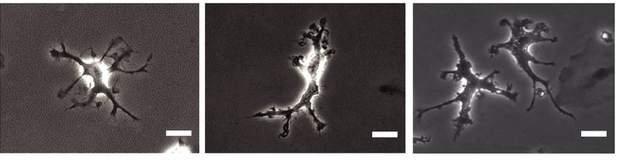
Microglia are the resident immune cells of the central nervous system. They are involved in multiple important functions during brain development, including synapse development and circuit refinement. In addition, microglia dysfunction has been suggested to contribute to neurodevelopmental and neuropsychiatric disorders, including Rett syndrome and schizophrenia. Detailed assessments of the functional roles of human microglia have, however, remained largely unexplored because efficient and robust protocols to isolate and characterize these cell types have been lacking. SFARI Investigator Rudolf Jaenisch and his colleagues have developed a method that enables the generation of microglia-like cells from both human embryonic stem cells and induced pluripotent stem cells. These cells recapitulate many key characteristics of microglia in vivo. The researchers also differentiated microglia from an embryonic stem cell model of Rett syndrome, which had previously been genetically engineered with a loss-of-function MeCP2 allele (Li et al., 2013). Their preliminary analyses indicate that MeCP2-mutant microglia are significantly smaller than isogenic control cells. This new differentiation method will allow for more detailed studies of the roles played by human microglia in health and disease states.

