Neuroimmune Mechanisms in Autism Mouse Models
Featuring
-

Gloria Choi
Samuel A. Goldblith Career Development Assistant Professor of Applied Biology Picower Institute
-

Jun Huh
SFARI Investigator
Bringing people and ideas together to fund, conduct, and share transformative science.
Our grants advance knowledge and strengthen connections between science and society.
Discover the latest news, research, and updates.
We convene scientists, mathematicians, and thinkers to share ideas and explore new questions.
Founded by Jim and Marilyn Simons, we’re a private philanthropy advancing mathematics and basic science.
Work with us on the frontier of basic science research.
The Flatiron Institute is a research center that uses computational science to advance fields like physics, biology, and astronomy.
Search
Gloria Choi, Jun Huh and colleagues showed that postnatal administration of IL-17a can rescue some of the anatomical and behavioral deficits observed in a maternal immune activation (MIA) mouse model of autism spectrum disorder.
Samuel A. Goldblith Career Development Assistant Professor of Applied Biology Picower Institute
SFARI Investigator
One striking, if perplexing, observation has been the finding that a subset of individuals with autism spectrum disorder (ASD) show some improvement when they have a fever. A new study using mouse models of infection provides some insight into the mechanistic basis of the fever response.
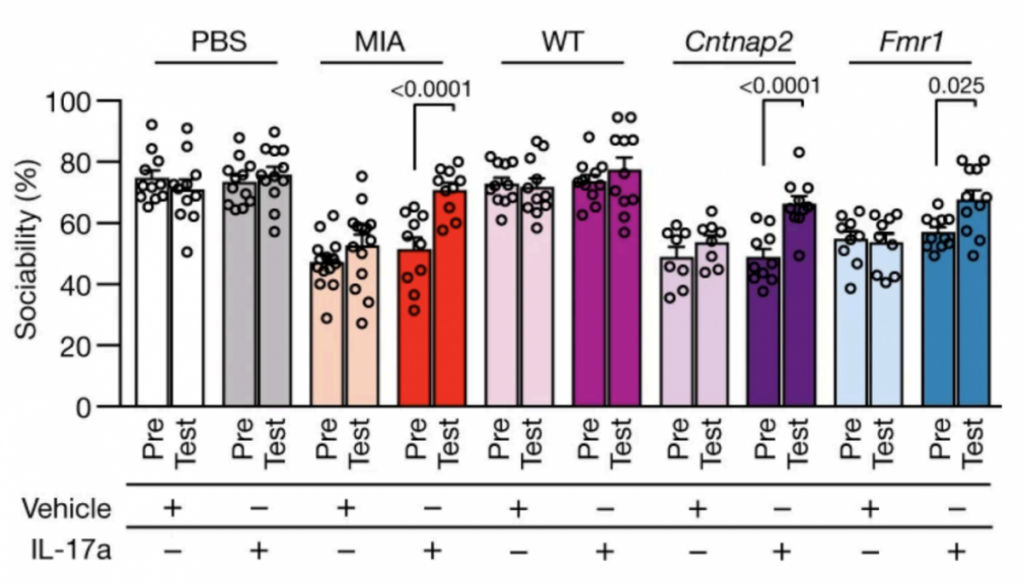
The work was supported in part by a Pilot Award and an ongoing Research Award to SFARI Investigators Gloria Choi and Jun Huh. The authors used lipopolysaccharide (LPS) to induce a transient fever in mouse offspring born to mothers that had been exposed to infection while pregnant — the so-called ‘maternal immune activation’ (MIA) model, which they had already characterized (Choi et al., Science, 2016) in a series of papers (Yim et al., Nature, 2017; Kim et al. Nature, 2017). They found that LPS injections rescued the deficits in social approach and interaction that had been observed in the offspring of the MIA mice, a response that they showed was independent of the increase in body temperature. Of note, LPS did not rescue social behavior deficits in a series of monogenic models of ASD (Cntnap2, Fmr1 or Shank3). Choi, Huh and colleagues went on to show that LPS reversed other known features of MIA offspring, including abnormalities in cortical anatomy and activity in a dysgranular subregion of the primary somatosensory cortex, S1DZ, which the authors previously showed to be affected in adult MIA offspring (Yim et al., Nature, 2017). Moreover, the LPS rescue depended on the induction of increased levels of the cytokine interleukin-17a (IL-17a), which acted on neurons in the S1DZ that express IL-17a receptors.
The authors closed by noting a paradox: previous data suggest that IL-17a in pregnant mice is a risk factor for subsequent neurodevelopmental abnormalities in their offspring, but the present data suggest a protective role for IL-17a in the adult offspring themselves. Dissecting the time-dependent roles of IL-17a in modulating behavioral outcomes is a clear direction for future research.

