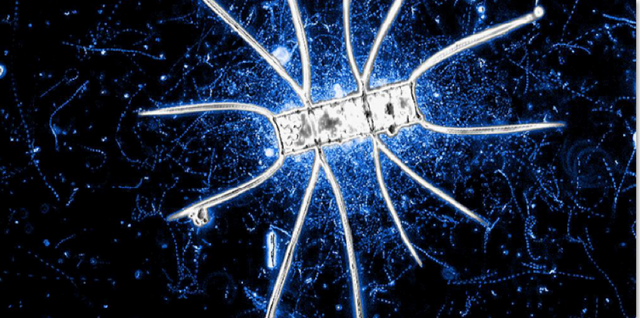
The Simons Foundation has established a new collaboration investigating the mysteries of nature’s smallest communities. Called the Simons Collaboration on Theory of Microbial Ecosystems, or THE-ME, it is an at least five-year undertaking that will investigate how microbial ecosystems in the oceans form and function.
The microscopic members of those communities produce more than half of Earth’s oxygen, form the base of the marine food web and cycle nutrients through the ecosystem. Microbiologists Otto Cordero of MIT and Roman Stocker of ETH Zurich will co-direct the new collaboration, which will in part illuminate how those microbial communities respond to Earth’s ever-changing environment.
Most previous studies investigated a single species at a time, such as E. coli or varieties of yeast. But that kind of purity rarely exists in nature. “We have a solid understanding of how one organism behaves in the lab,” Cordero says. “But when you have a community with multiple species, they don’t have a conductor. There is no centralized regulation, so it’s all relying on self-organization. A shift we hope to accelerate in biology is to move from the understanding of pure cultures to understanding collectives and communities. Intellectually, it’s a huge step.”
The new collaboration will seek answers to three main questions: How are functions distributed in a microbial ecosystem? How does resource supply shape microbial ecosystem structure and function? And how do environmental gradients and fluctuations impact microbial ecosystem structure and function?
Cordero, Stocker and their colleagues will spy on marine microbes in the laboratory and watch how communities assemble and operate. One particular interest is the trade-off between speed and efficiency when microbes chow down on food. When food is abundant, individual microbes often only partially consume their food, leaving scraps behind that other organisms can eat. When food is scarce, microbes are more likely to clean their plates. The researchers are curious how the speed-efficiency trade-off applies to a community as a whole, not just an individual microbe.
More information about the new collaboration can be found here.