Perceptual Impairments and Altered Excitatory–Inhibitory Activity in Cntnap2 Knockout Mice
Featuring
-
Bilal Haider
SFARI Investigator
Bringing people and ideas together to fund, conduct, and share transformative science.
Our grants advance knowledge and strengthen connections between science and society.
Discover the latest news, research, and updates.
We convene scientists, mathematicians, and thinkers to share ideas and explore new questions.
Founded by Jim and Marilyn Simons, we’re a private philanthropy advancing mathematics and basic science.
Work with us on the frontier of basic science research.
The Flatiron Institute is a research center that uses computational science to advance fields like physics, biology, and astronomy.
Search
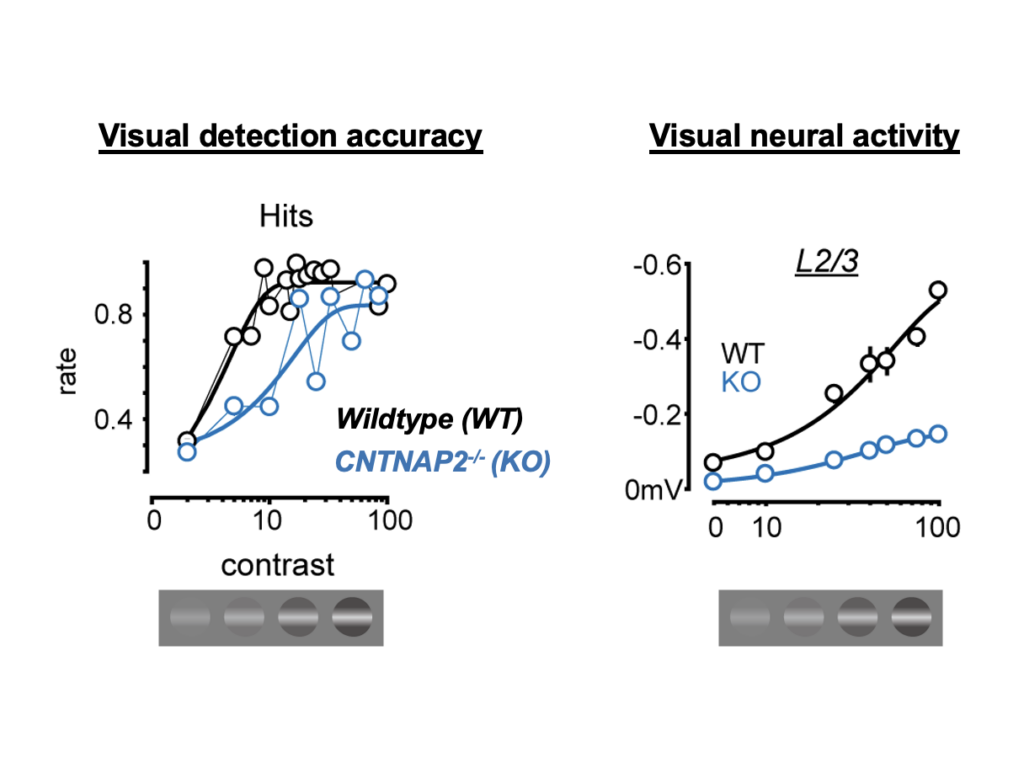
Bilal Haider and colleagues found that Cntnap2 knockout mice exhibited deficits in visual perception and that these were associated with diminished excitation and elevated inhibition in the visual cortex.
SFARI Investigator
The ‘excitation/inhibition (E/I) hypothesis’ of autism spectrum disorder (ASD) has been highly influential in the field (Rubenstein and Merzenich, Genes Brain Behav., 2003). It proposes that an imbalance in the ratio of excitatory-inhibitory activity underlies behavioral changes. While several recent studies have attempted to provide direct evidence to support or refute this hypothesis, none thus far have measured activity from excitatory and inhibitory neurons while simultaneously measuring impairments during performance of a behavioral task.
SFARI Investigator Bilal Haider and colleagues decided to address this by using a well-controlled head-fixed visual detection task, which allowed them to record putative excitatory and inhibitory neuron population activity in the primary visual cortex (V1) while simultaneously measuring visual perception behavior in a genetic mouse model of ASD (Cntnap2 knockout mice). These studies were supported in part by a SFARI Explorer Award.
The researchers observed quantifiable impairments in the speed, accuracy and contrast sensitivity of visual perception in the mutant mice. These deficits were accompanied by reduced excitatory and elevated inhibitory neuron activity. In addition, reduced contrast sensitivity and abnormal network rhythms in superficial layers 2/3 of V1 (i.e., low-frequency oscillations in the 3–10 Hz range) were found to be correlated with the perceptual impairments.
While the current findings are correlational only, a recent study in primates demonstrated a causal link between low-frequency oscillations in the visual cortex and visual perceptual impairments (Nandy et al., Elife, 2019). As Haider and his colleagues note, future studies should directly test whether attenuating low-frequency synchronization in the visual cortex of ASD mouse models can restore altered excitatory-inhibitory activity and attenuate perceptual changes.

