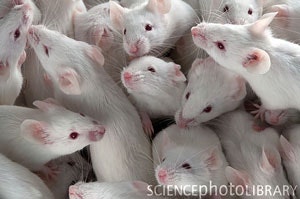
Mouse models of human disorders are typically considered ‘valid’ based on three criteria. They have construct validity if they carry a mutation in a gene that has some support in the human genetics literature. Second, face validity reflects the fact that the mouse bears some physical or behavioral resemblance to the human disorder. Finally, predictive validity indicates a similar response to a therapy that is known to be effective in people.
The mouse models we consider here tend to have some degree of construct and face validity, and occasionally have predictive validity. Specifically, the mutations are in genes with substantial support from human genetics, and in some cases the mouse mutations precisely mimic the human risk mutations.
Face validity is considered strong if the mouse exhibits many of the core and ancillary features of autism spectrum disorders, but especially deficits in social cognition. In this regard, it is important not to set the bar too high.
In their excellent review of mouse models of psychiatric disorders, Alexander Arguello and Joseph Gogos note the uncertain path between the mutation and the observable traits when it comes to the complexities of behavior1. They argue that it will often be difficult to recapitulate all of the features of a human syndrome in a mouse carrying a single-gene mutation.
With these general caveats in mind, we note that the number of autism mouse models that deserve attention from the research community is growing rapidly.
Reference
- Arguello P.A. and J.A. Gogos Neuron 52, 179-196 (2006) PubMed ↩︎
- Tsai P.T. et al. Nature 488, 647-651 (2012) PubMed ↩︎
- Nakatani J. et al. Cell 137, 1235-1246 (2009) PubMed ↩︎
- Horev G. et al. Proc. Natl. Acad. Sci. USA 108, 17076-17081 (2011) PubMed ↩︎
- Zhou J. et al. J. Neurosci. 29, 1773-1783 (2009) PubMed ↩︎
- Peñagarikano O. et al. Cell 147, 235-246 (2011) PubMed ↩︎
- Won H. et al. Nature 486, 261-265 (2012) PubMed ↩︎
- Han S. et al. Nature 489, 385-390 (2012) PubMed ↩︎
- Balemans M.C. et al. Behav. Brain Res. 208, 47-55 (2010) PubMed ↩︎
- Peça J. et al. Nature 472, 437-442 (2011) PubMed ↩︎
- Horev G. et al. Proc. Natl. Acad. Sci. USA 108, 17076-17081 (2011) PubMed ↩︎
- Peñagarikano O. et al. Cell 147, 235-246 (2011) PubMed ↩︎
- Nakatani J. et al. Cell 137, 1235-1246 (2009) PubMed ↩︎
- Crabbe J.C. et al. Science 284, 1670-1672 (1999) PubMed ↩︎
- Chao H.T. et al. Nature 468, 263-269 (2010) PubMed ↩︎
- Sigurdsson T. et al. Nature 464, 763-767 (2010) PubMed ↩︎
- Yizhar O. et al. Nature 477, 171-178 (2011) PubMed ↩︎
- Kelleher R. and M.F. Bear Cell 135, 401-406 (2008) PubMed ↩︎
- Premsrirut P.K. et al. Cell 145, 145-158 (2011) PubMed ↩︎

