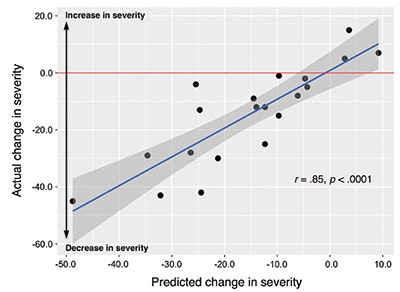
Progress in the development of new treatments for autism has been hampered by a lack of sensitive and objective ways to benchmark treatment success. SFARI Investigator Pamela Ventola and colleagues now report on their identification of functional magnetic imaging (fMRI) biomarkers that allow accurate predictions of intervention success. Ventola and colleagues imaged 20 high-functioning children with autism while they viewed video clips of individuals performing natural movements relevant to early childhood experiences, such as playing pat-a-cake, or scrambled video clips. The brain imaging data was then related to the children’s responses after they had participated in 16 weeks of pivotal response treatment (PRT), an evidence-based behavioral intervention that is focused on social communication skill development. In doing this, the researchers identified a number of fMRI signatures in brain regions supporting social information processing and social motivation that predicted the success of PRT, providing key predictive biomarkers for treatment intervention in young children with autism. In a related SFARI-funded project, Ventola and colleagues are studying whether responses to this treatment can also be accurately assessed using eye-tracking tools.

