Dena Dubal’s interest in sex differences in aging started early. Growing up in rural India, she was surrounded by great-grandmothers, great-aunts and others who far outlived the men in the family. Her family wasn’t unusual. Across the world, women typically outlive men by approximately five years and experience slower rates of age-related cognitive decline.
Now, as a neuroscientist at the University of California, San Francisco, Dubal is starting to uncover why those differences occur. In videos of aging mice wandering through a maze, she points out how some animals appear confused, meandering much like people trying to find their cars in a parking garage. Others take quicker, more focused routes through the maze, as if they remember exactly where they left their vehicle. Dubal recently discovered that the difference between these animals stems, in part, from a protein made by a gene on the X chromosome. Over the last several years, her research has homed in on sex chromosomes as a vital contributor to how our brains age.
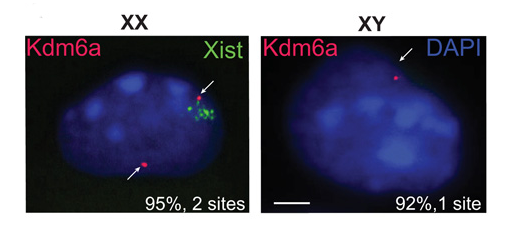
Two X chromosomes lead to female hormones and features, while an X and Y lead to male traits. These differences affect glucose metabolism, cellular energy production and much more, according to Dubal, an investigator with the Simons Collaboration on Plasticity and the Aging Brain. “Sex chromosomes and gonadal hormones alter fundamental biology in ways that we are just beginning to understand,” she says. “The X chromosome is 5 percent of our genome, and it has the largest density of brain-related genes compared to any individual autosome. I don’t think it’s coincidence that variations or human mutations in these different X factors affect brain function.”
Understanding these differences will be important for developing new treatments. In 2003, the National Institute on Aging (NIA) launched a program to help assess drugs or dietary interventions that could safely extend the life span of mice — and eventually humans. This Intervention Testing Program supports studies of approximately 10 to 15 treatments each year, and researchers test interventions in both male and female animals. In 2015, researchers reviewed 14 interventions that had been tested over the previous decade. They found that only five appeared to actually extend life span — and four of those worked differently in male and female animals. “That suggests there’s a fundamental difference in the way we age,” said Bérénice Benayoun, a biologist at the University of Southern California, in a 2020 podcast.
Dubal and Benayoun are now probing the mechanisms underlying these observations, examining how steroid hormones and sex chromosomes alter the trajectory of cognitive decline with age in different sexes.* Their studies, part of an SCPAB project on sex differences in aging, will help reveal why women are on average more resilient to cognitive decline, memory loss and other brain functions that erode as we grow old. Identifying these factors could inspire interventions that benefit everyone — improving not just a person’s life span but their quality of life as they age. “The things that help us live longer also tend to be the things that help us live better,” Dubal says.
Dissimilar mechanisms
The link between longevity and ‘better’ aging is apparent in the brain: Women’s longer life spans appear to correlate with slower rates of cognitive decline. In one 2016 study, for instance, researchers tracked people between the ages of 50 and 96 over a period of nine years using tests of memory, verbal learning and other cognitive tasks. Over time, men’s performance declined more rapidly on some of these tests compared to women, hinting that women had more resilience to age-related decline. Researchers seeking the underlying mechanisms have unearthed clues in gene regulation, cellular energy production and how hormones control energy production.
Seeking clues as to why a 70-year-old woman is likely to appear far more youthful than a man of the same age, Steve Horvath, a geneticist at the University of California, Los Angeles, and his colleagues looked for changes in DNA methylation, also known as epigenetic markers, that control gene expression. They examined blood, brain, lung, liver and other tissues across the human life span and found many sex-associated differences. Samples from older adults showed signs of demethylation, particularly at enhancers and regulatory elements in the genome, which control when a particular gene produces protein and how much. Men typically appeared ‘older’ and showed more signs of such loss compared to women of the same age. The contrast was most pronounced in liver and blood, and to a lesser extent in brain tissues.
Methylation hints at the cellular mechanisms underlying female cognitive resilience as well as their longer life spans, Horvath says. “It’s a very consistent finding that women age more slowly than men in several different organs, so on some level methylation reflects that mortality advantage,” he says. “It could easily be part of the explanation for cognitive resilience — but I would never say it explains it all.”
In 2019, another clue emerged from studies of how the brain consumes glucose. Manu Goyal, a neuroradiologist at Washington University in St. Louis, found that younger brains use a mix of two cellular pathways, oxidative and non-oxidative metabolism, to break glucose down and fuel their activity. Some older brains shift mostly to oxidative. When Goyal and his colleagues imaged glucose metabolism in the brains of 205 cognitively normal adults aged 20 to 82, they found that female brains on average appeared younger than those of age-matched males by approximately three years.
Clues from chromosomes
To uncover the source of these differences, Dubal and her team developed a mouse model that allows them to differentiate the effects of sex chromosomes and sex hormones on aging. Researchers moved the gene in mice and humans that determines male sex, called SRY, from the Y chromosome to an autosome. Once unhitched, the gene expressed itself in progeny that bore this autosome, independent of their sex chromosomes. Some were XX and carried the SRY gene and thus formed testes. Others were XY and lacked the gene, forming ovaries instead.