Dopamine: Beyond the Rush of a Reward
Featuring
-

Adrienne Fairhall
Investigator, Simons Collaboration on the Global Brain
-

Vanessa Ruta
Investigator, Simons Collaboration on the Global Brain
-
Naoshige Uchida
Investigator, Simons Collaboration on the Global Brain
-

Ilana Witten
Investigator, Simons Collaboration on the Global Brain
If you put enough money into a vending machine to buy one candy bar and the machine accidentally gives you two, the unexpected reward triggers a burst of dopamine in your brain. This is a classic example of learning through reinforcement; you’ll probably go back to that vending machine, hoping to repeat the windfall. Dopamine serves as a teaching signal, tracking the difference between a predicted and an actual reward — a discrepancy known in the field as reward prediction error — reinforcing behaviors thought to yield a future reward.
“The canonical view is that dopamine neurons send reward prediction error signals to teach other areas how to memorize the value of different things,” says Nao Uchida, a neuroscientist at Harvard University and an investigator with the Simons Collaboration on the Global Brain.
The reward prediction error model has a lot going for it. Besides being simple, it’s supported by extensive experimental and theoretical evidence. Dopamine neurons become active when animals get an unexpected reward. And activating dopamine neurons in response to a certain behavior mimics the effect of an unexpected reward, positively reinforcing that behavior. Conversely, inhibiting dopamine neurons prevents animals from learning these associations. “That’s nicely aligned with it being a teaching signal,” says Ilana Witten, a neuroscientist at Princeton University and an investigator with the SCGB.
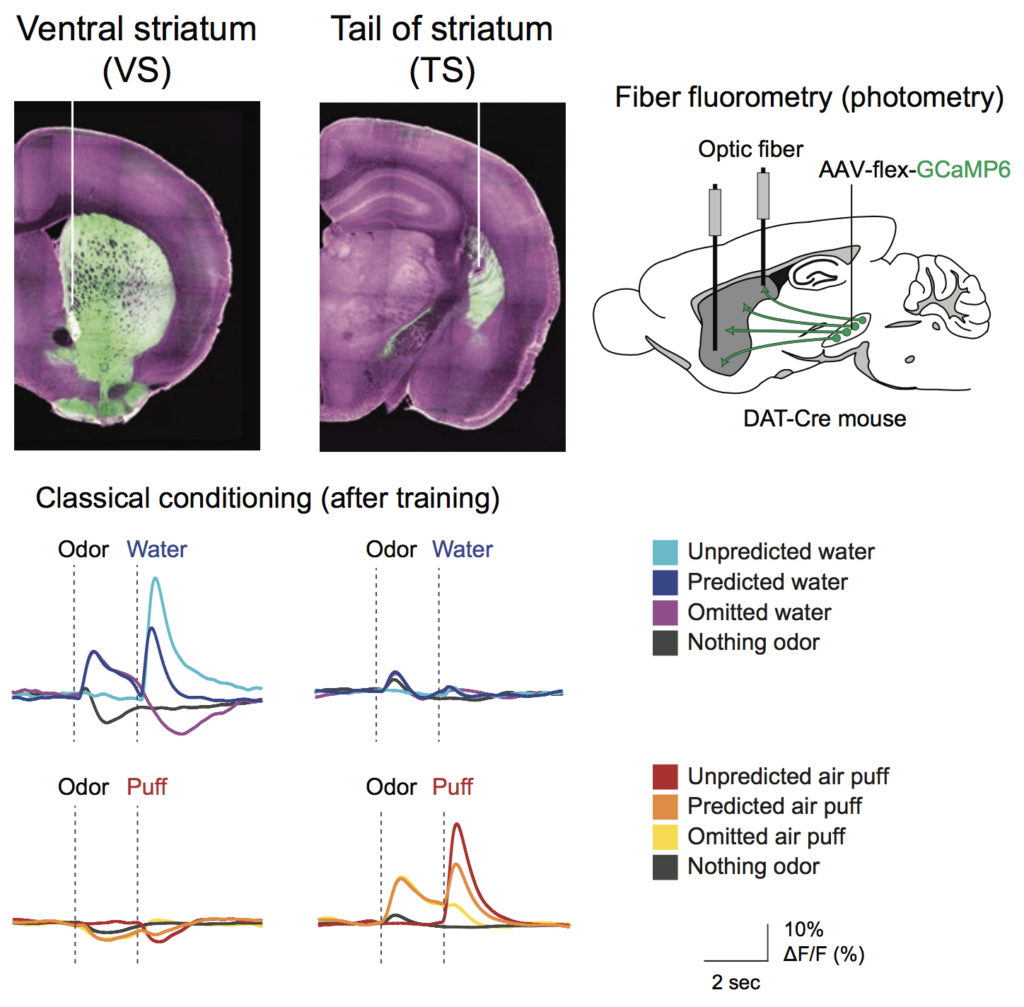
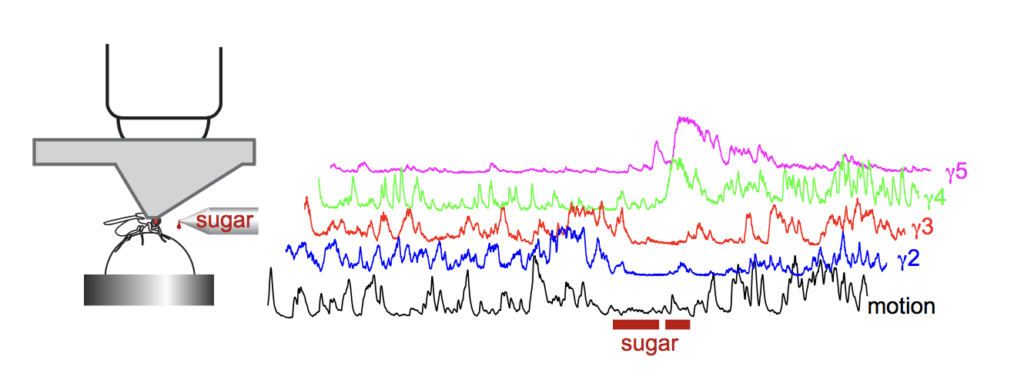
But growing evidence from Witten, Uchida and others suggests that not all dopamine neurons fit this picture. Some dopamine neurons respond to movement, novelty or even aversive stimuli, activity that isn’t easily explained by the reward prediction error model. “The idea that dopamine is simply a signal of reward prediction error is worth revisiting,” says Adrienne Fairhall, a theoretical neuroscientist at the University of Washington and an investigator with the SCGB. “The story is more complicated.”
Diversifying dopamine
Much of the new information on dopamine relies on researchers’ relatively newfound ability to study different subpopulations of dopamine neurons independently. Their work has revealed that different cells can play different roles.