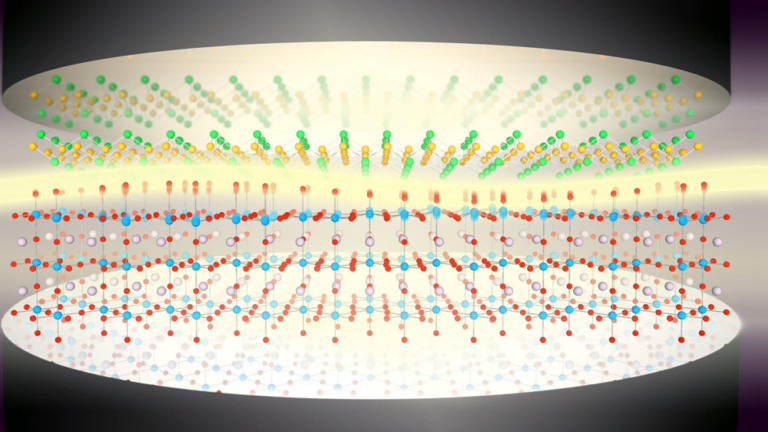
The center’s scientists will study quantum materials that aren’t settled into a stable state. Scientists can perturb materials through methods such as electric currents, heat pulses, barrages of photons or by embedding them in quantum cavities. Once out of equilibrium, a material may exhibit new properties such as magnetism, ferroelectricity or superconductivity.
If scientists could carefully control this process, they could design materials for wide-ranging and potentially revolutionary applications, including quantum computing.
“We want to create programmable properties on demand,” says Andy Millis, co-director of the Flatiron Institute’s Center for Computational Quantum Physics (CCQ) and a professor of condensed matter physics at Columbia University. “We want to develop the understanding needed to create recipes where you take a material, stick it in a cavity, irradiate it with a light beam and get the property you want.”
The center is a research collaboration among teams that will transcend institutional and geographic boundaries. It will leverage the theoretical and computational expertise of scientists at the Flatiron Institute alongside the experimental capabilities of Columbia University, the Max Planck Institute for the Structure and Dynamics of Matter in Hamburg and the Max Planck Institute for Polymer Research in Mainz, Germany. Joint research positions across the institutions will further cultivate collaborations across the center.
Close interaction between theory and experiment will be a hallmark of the center. “It’s much more interesting to have theory embedded inside an experimental network,” says Angel Rubio, Director of the Max Planck Institute for the Structure and Dynamics of Matter and distinguished research scientist at CCQ. “We can develop experimental tools to realize and demonstrate the theoretical predictions. That will be the hallmark of the center: the realization of these outside-the-box concepts and ideas.”