Bringing people and ideas together to fund, conduct, and share transformative science.
Our grants advance knowledge and strengthen connections between science and society.
Discover the latest news, research, and updates.
We convene scientists, mathematicians, and thinkers to share ideas and explore new questions.
Founded by Jim and Marilyn Simons, we’re a private philanthropy advancing mathematics and basic science.
Work with us on the frontier of basic science research.
The Flatiron Institute is a research center that uses computational science to advance fields like physics, biology, and astronomy.
Search
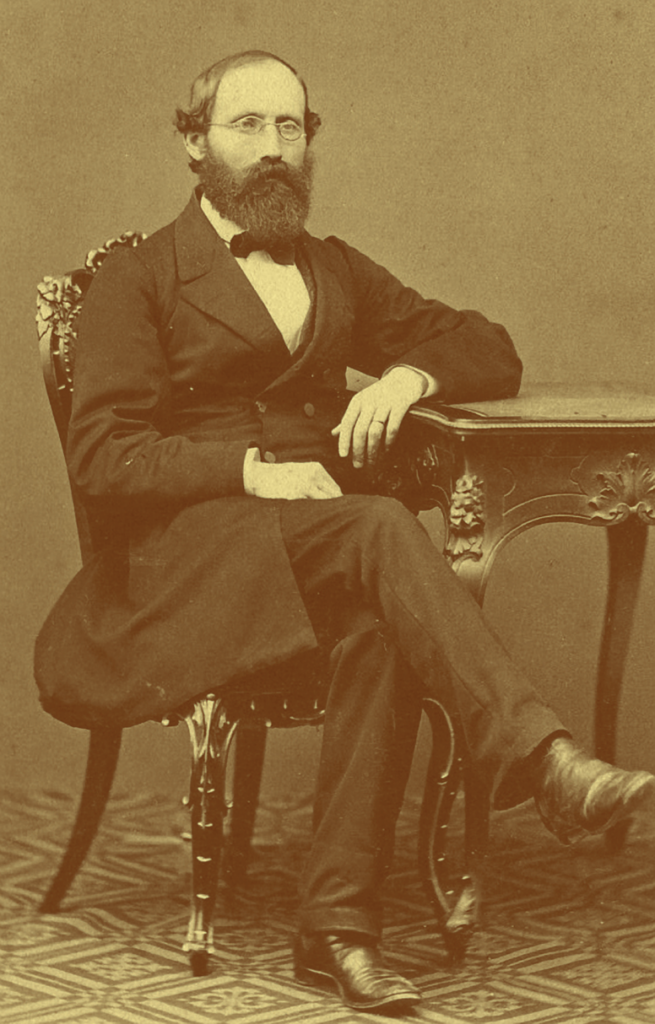
BERNARD RIEMANN was not even 40 years old when he died, but in his short life, he made an indelible imprint on vast swaths of mathematics. Riemann sums, used to approximate the areas of functions, are the backbone of integral calculus. The Cauchy-Riemann equations, which describe the relationships between imaginary and real parts of some complex functions, are essential to complex analysis. Riemannian geometry applies techniques of calculus to study problems in geometry and set the stage for Einstein’s theory of general relativity. And, of course, the Riemann hypothesis still enthralls number theorists. Because of his far-ranging contributions, he is considered one of the greatest mathematicians in history.
Born into a poor family in 1826 in the Kingdom of Hanover (now part of Germany), Riemann went to the University of Göttingen, intending to follow in the footsteps of his father, a Lutheran pastor, and study theology. (He remained a devout Christian throughout his life.) But he found himself drawn to mathematics. After a year in Göttingen, he moved to the University of Berlin to pursue his studies.
The short paper in which Riemann formulated his famous hypothesis in 1859, <em>On the Number of Primes Less Than a Given Quantity</em>, was the only article he published in number theory. In that paper, he described his famous zeta function, related to the distribution of prime numbers, but he was probably introduced to the function, a version of which had first appeared in the work of Swiss mathematician Leonhard Euler, by his mentor Lejeune Dirichlet. In all of his work, including on the Riemann zeta function, he was guided by his strong geometric intuition.
Riemann was not a healthy man. He suffered bouts of depression throughout his life, in addition to other medical problems. He died in 1866 of tuberculosis on a trip to Italy with his wife and young daughter.