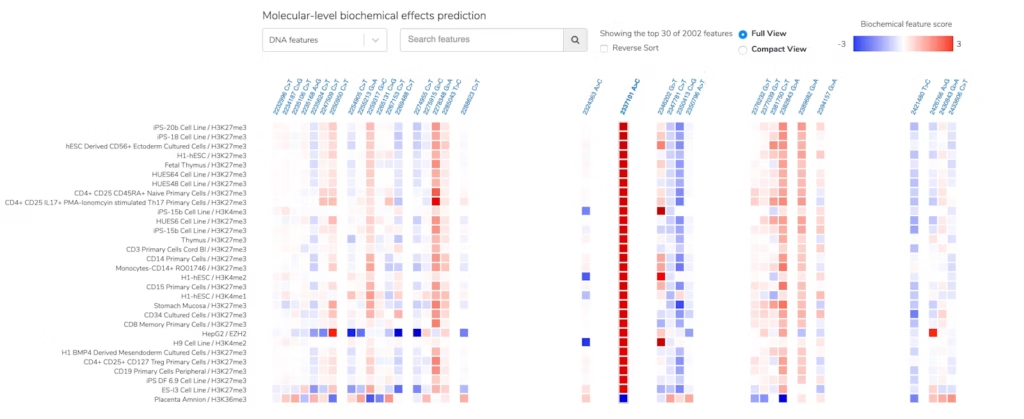
Since its launch, HumanBase has radically changed biologists’ ability to unearth discoveries from data. “When I started as a biologist, I preferred model organisms because humans were too hard to study. Because of the data we have and the ability to study it with HumanBase, humans are now more like model organisms,” says Chandra Theesfeld, a research scientist in Troyanskaya’s lab.
HumanBase’s capacity to make sense of complex human molecular data with the same level of precision achievable with model organisms represents a significant boon to the field of genetics. HumanBase has also bridged the gap between computational and experimental biology — two disparate areas of research that often remain siloed from each other. This is reflected in the collaborative approach exhibited by the representatives from both camps who make up the HumanBase team. For example, while the HumanBase computational scientists don’t need to know how to perform experiments, many have found this knowledge to be a critical tool for building HumanBase. Chris Park, a research scientist in the genomics group at CCB, became a postdoctoral fellow in an experimental biology lab at Rockefeller University after completing his doctorate in computer science at Princeton under Troyanskaya’s supervision. “I wanted to see how data is generated in the lab, to ultimately make better models using computational and statistical tools,” says Park. “I had to learn a specific way to wash my hands, and I was dissecting my own mouse brains.”
Others on the team are primarily experimental biologists, like Theesfeld. “I’m often the first user of any HumanBase method,” says Theesfeld. “I ask, ‘How can we help biologists? What would I do once I had this prediction?’ and that helps inform interface and feature development.”
The researchers agreed HumanBase could not have been developed anywhere but the Flatiron Institute. “We knew we needed top-notch machine learning and industrial-quality software that was professionally maintained,” says Troyanskaya, “and at the same time, we think a lot about how biologists ask questions, which is nontrivial. Flatiron is the unique place [where] you can do something like this.”
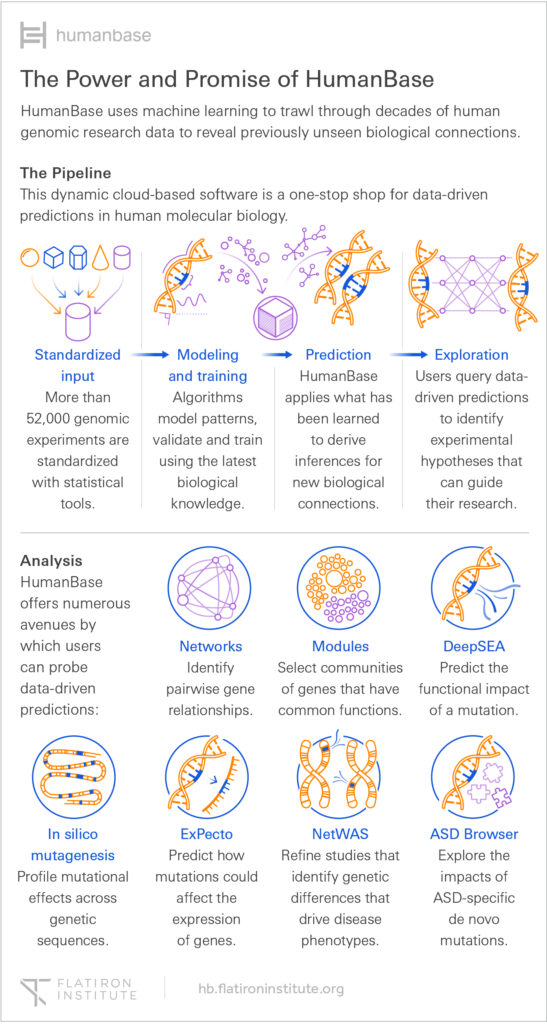
Indeed, the recent explosion in machine learning capabilities laid the foundation for HumanBase’s success. Machine learning methods are uniquely equipped to handle large datasets and to leverage the recent profusion of human genomic data. They can comb through data in ways that scientists cannot, in record time, and home in on connections that may be faint in any one dataset but stand out clearly across myriad datasets. By viewing individual data points as part of a network, machine learning can, in essence, see both the forest and the trees. This is how machine learning identifies biological associations from raw data, rather than relying on existing knowledge, for example, that a particular gene is associated with a disease. “We are not mining PubMed,” says Troyanskaya, referring to the centralized database of scientific and medical research publications, “but instead digging through mountains of data to uncover new knowledge.”
The machine learning algorithms and deep learning neural networks employed by computational biologists have long been inaccessible to biologists working in the lab, but Wong hopes that, with platforms like HumanBase, this will not always be the case. “There’s a huge unmet need to translate machine learning into something you can use at the bench,” he says.
Ultimately, the developers are optimistic that HumanBase will serve as a central resource for biologists, who can use the results to generate hypotheses for the next round of lab experiments. “We hope using HumanBase becomes standard practice,” says Theesfeld. “In the same way you wouldn’t publish a paper without consulting PubMed, you wouldn’t do an experiment without HumanBase. Thirty minutes of work on HumanBase can save you months, if not years, in the lab.”
COVID-19 and Kidney Disease: An Unexpected Connection
Since its launch, HumanBase has proved strikingly adept at navigating biology’s thorniest problems. Most recently, it was used in a study investigating why people with diabetic kidney disease (DKD) show increased susceptibility to infection with SARS-CoV-2, the virus responsible for the deadly COVID-19 pandemic.
Since the virus was first identified last year, there has been a rush of activity to understand how it wreaks such havoc on the human body. Researchers made some headway early on when they discovered that a cell-surface protein called ACE2 binds with SARS-CoV-2, allowing the virus to enter cells — like a key unlocking a door. Researchers set out to investigate what was different about kidney cells with increased ACE2 expression. In cells from patients with DKD and from patients hospitalized with COVID-19, the researchers found thousands of genes that showed increased expression in tandem with ACE2 expression — hinting at a potential connection. They reported these findings last month in Kidney International.
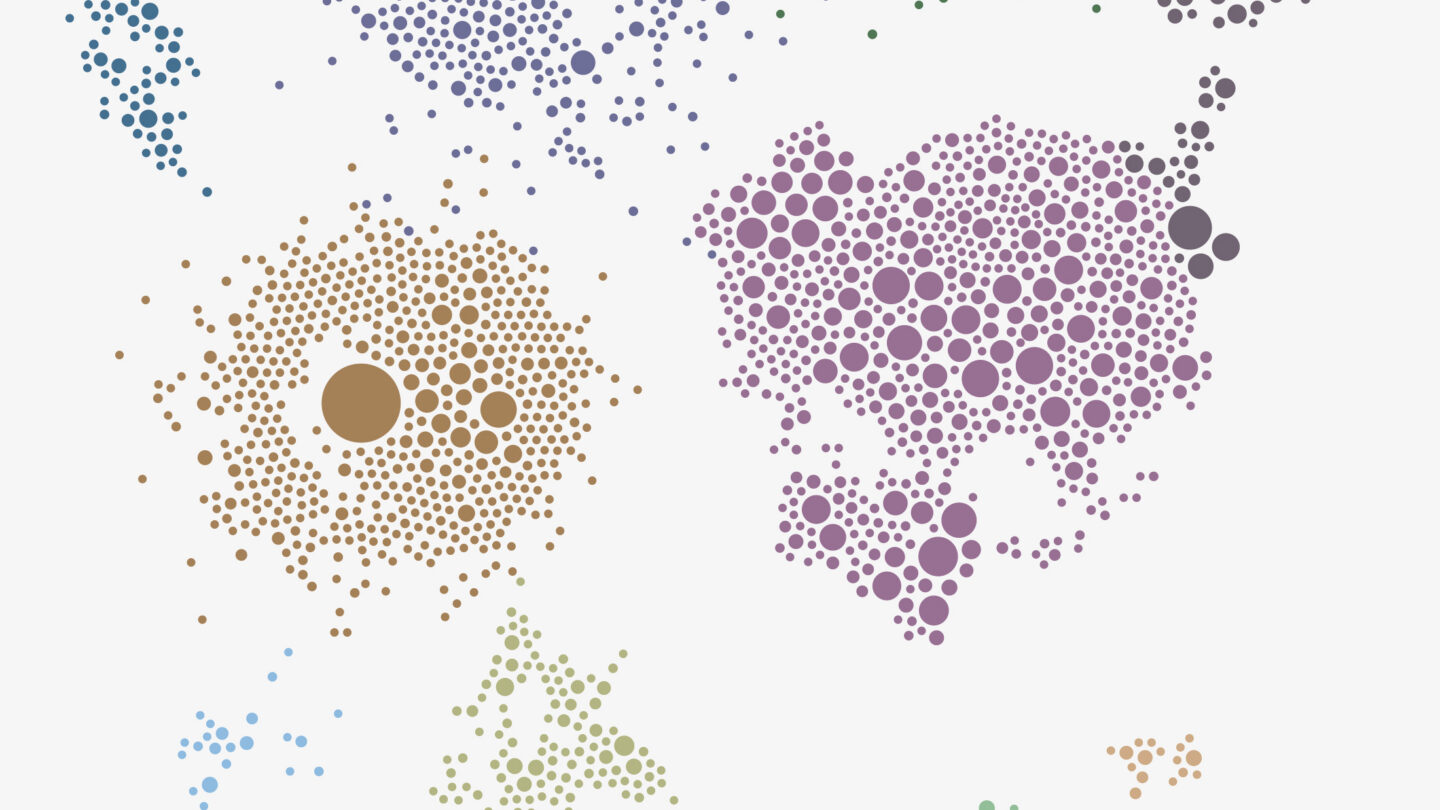
“One way to interpret these results would be to dig through the literature, one gene at a time,” says Theesfeld. Instead, HumanBase provided a far more efficient way forward. It first found relationships between all the genes, then constructed networks of those relationships, and finally displayed the results in weblike maps showing how each gene was associated with the others, as if they were in a circuit. In this way, HumanBase identified clusters of genes, called modules, that have common functions in the cell. This strategy, called functional module detection, can analyze up to 4,000 genes at once. It can even suggest a function, or set of functions, for a previously uncharacterized gene. In the kidney study, functional module detection had already yielded connections between gene clusters and biological processes related to viral entry, replication and immunity. Importantly, the modules from both patient groups — those with DKD and those with COVID-19 — overlapped with each other and with modules generated from functional analysis of published data on genes relevant to SARS-CoV-2. An association between kidney disease and viral processes is intriguing, and scientists plan to test the association through experiments on kidney tissue in vitro. And because some of the genes identified in the study are targets of diabetes drugs, further experiments can probe the potential of known therapeutics to affect susceptibility to and progression of COVID-19.