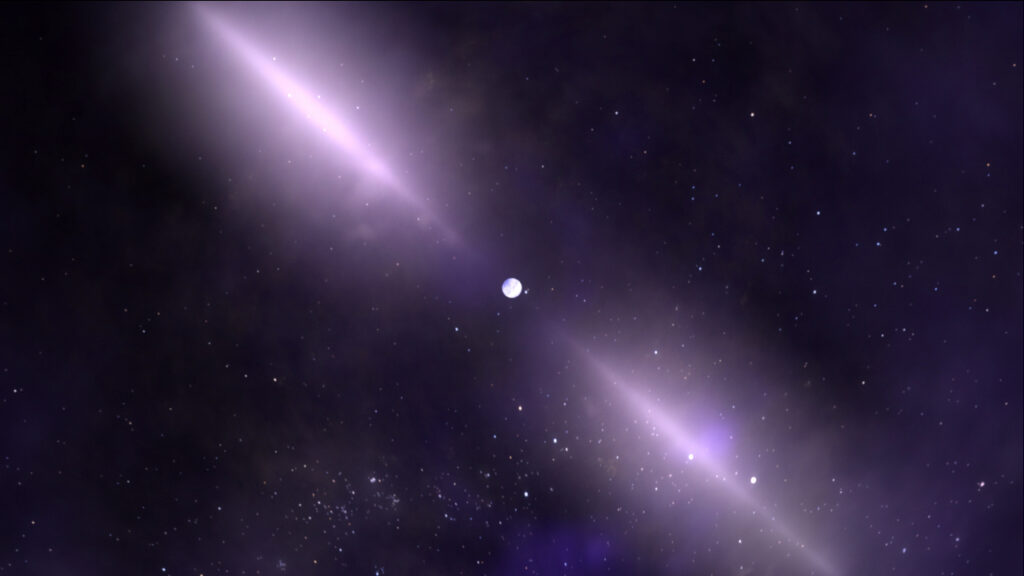
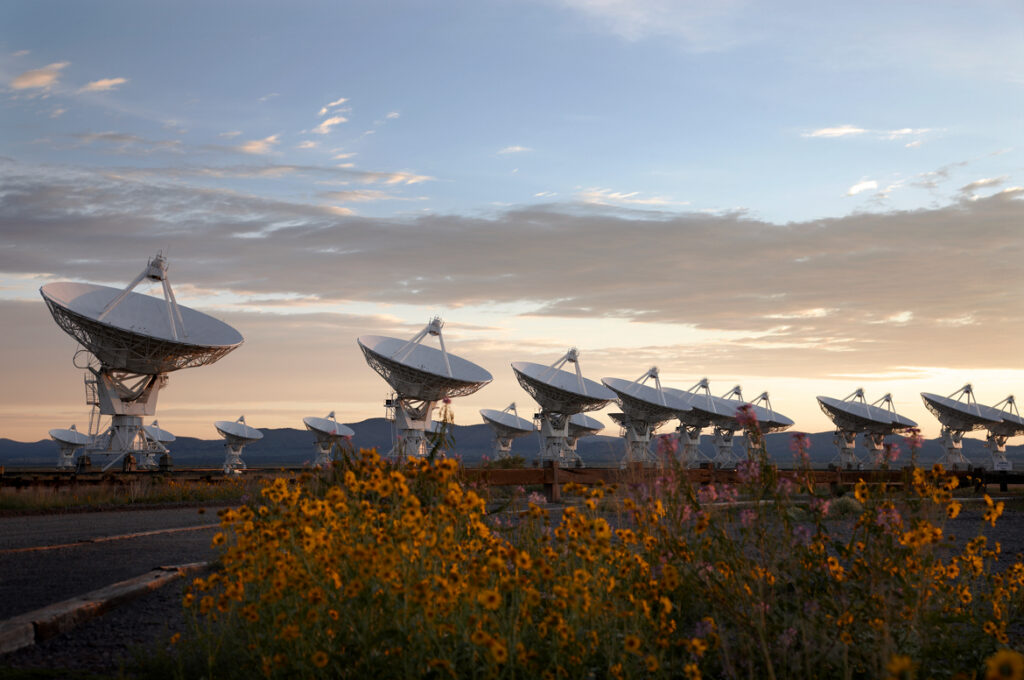
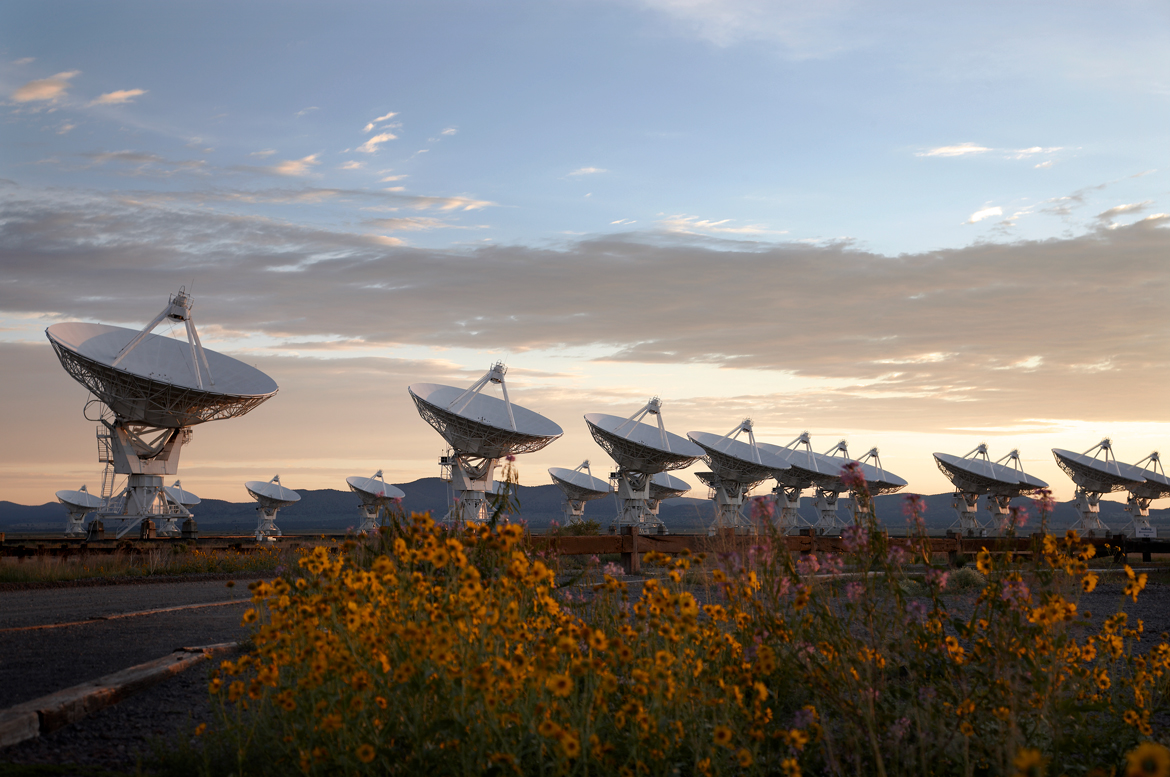
For 15 years, NANOGrav scientists from the United States and Canada closely timed the radio wave pulses from dozens of millisecond pulsars in our galaxy using the Arecibo Observatory in Puerto Rico, the Green Bank Telescope in West Virginia and the Very Large Array in New Mexico. The new findings are the result of a detailed analysis of an array of 67 pulsars.
“Pulsars are actually very faint radio sources, so we require thousands of hours a year on the world’s largest telescopes to carry out this experiment,” says Maura McLaughlin of West Virginia University, co-director of the NANOGrav Physics Frontiers Center. “These results are made possible through the National Science Foundation’s (NSF’s) continued commitment to these exceptionally sensitive radio observatories.”
Detecting the Background
In 2020, with just over 12 years of data, NANOGrav scientists began to see hints of a signal, an extra “hum” common to the timing behavior of all pulsars in the array. Now, three years of additional observations later, they have accumulated concrete evidence for the existence of the gravitational wave background.
“Now that we have evidence for gravitational waves, the next step is to use our observations to study the sources producing this hum,” says Sarah Vigeland of the University of Wisconsin-Milwaukee, chair of the NANOGrav detection working group.
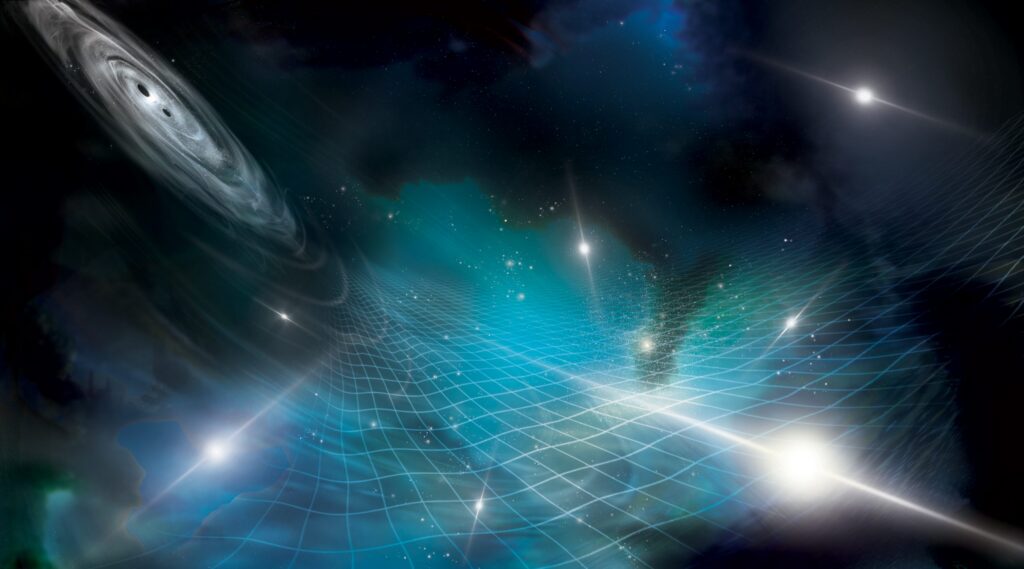
The likeliest sources of the gravitational wave background are pairs of supermassive black holes caught in a death spiral. Those black holes are truly colossal, containing billions of suns’ worth of mass. Nearly all galaxies, including our own Milky Way, have at least one of the behemoths at their core. When two galaxies merge, their supermassive black holes can meet up and begin orbiting one another. Over time, their orbits tighten as gas and stars pass between the black holes and steal energy.
Eventually, the supermassive black holes get so close that the energy theft stops. Some theoretical studies have argued for decades that the black holes then stall indefinitely when they’re around 1 parsec apart (roughly three light-years). This close-but-no-cigar theory became known as the final parsec problem. In this scenario, only rare groups of three or more supermassive black holes result in mergers.
Supermassive black hole pairs could have a trick up their sleeves, though. They could emit energy as powerful gravitational waves as they orbit one another until eventually they collide in a cataclysmic finale. “Once the two black holes get close enough to be seen by pulsar timing arrays, nothing can stop them from merging within just a few million years,” says Luke Kelley of the University of California, Berkeley, chair of NANOGrav’s astrophysics group.
The existence of the gravitational wave background found by NANOGrav seems to back up this prediction, potentially putting the final parsec problem to rest.
Since supermassive black hole pairs form due to galaxy mergers, the abundance of their gravitational waves will help cosmologists estimate how frequently galaxies have collided throughout the universe’s history. Mingarelli, postdoctoral researcher Deborah C. Good of the CCA and the University of Connecticut, and their colleagues studied the intensity of the gravitational wave background. They estimate that hundreds of thousands or maybe even a million or more supermassive black hole binaries inhabit the universe.