Men and women are known to age differently, with women showing better longevity and cognitive resilience. Yet the biological reasons behind this disparity are not well understood.
A study by scientists from the Simons Collaboration on Plasticity and the Aging Brain (SCPAB) presented January 22 in Nature could shed light on why women’s brains age better than men’s. Researchers found that the X chromosome inherited from the mother can impede healthy aging by affecting certain cognition-related genes in the brain. For women, only one of their two X chromosomes is active in a given cell, meaning they may luck out and have their dad’s X chromosome take control. However, men only have one X chromosome: their mother’s.
The new findings could inform strategies for promoting healthy aging for all sexes, says the study’s senior author, SCPAB Investigator Dena Dubal.
“The X chromosome has a potent influence, both in men and in women, but it’s been largely under-studied in aging,” says Dubal, professor and David A. Coulter endowed chair in aging and neurodegenerative disease at the University of California, San Francisco. “Now we’re really unraveling the fundamental ways that it affects brain cells, potentially identifying new therapeutic targets to counter brain aging and diseases like Alzheimer’s.”
Mom’s X vs. Dad’s X
Globally, women tend to live longer than men, and women outliving men is true “in every society that records mortality,” Dubal says. “Discounting diseases like Alzheimer’s and just looking at the typical aging process, women also better preserve cognition as they age.”
These sex differences in aging persist even through famines, epidemics and other extreme environmental stresses, indicating that female longevity and cognitive resilience cannot be fully attributed to culture and society. Genes and other biological factors must also play a role, according to Dubal.
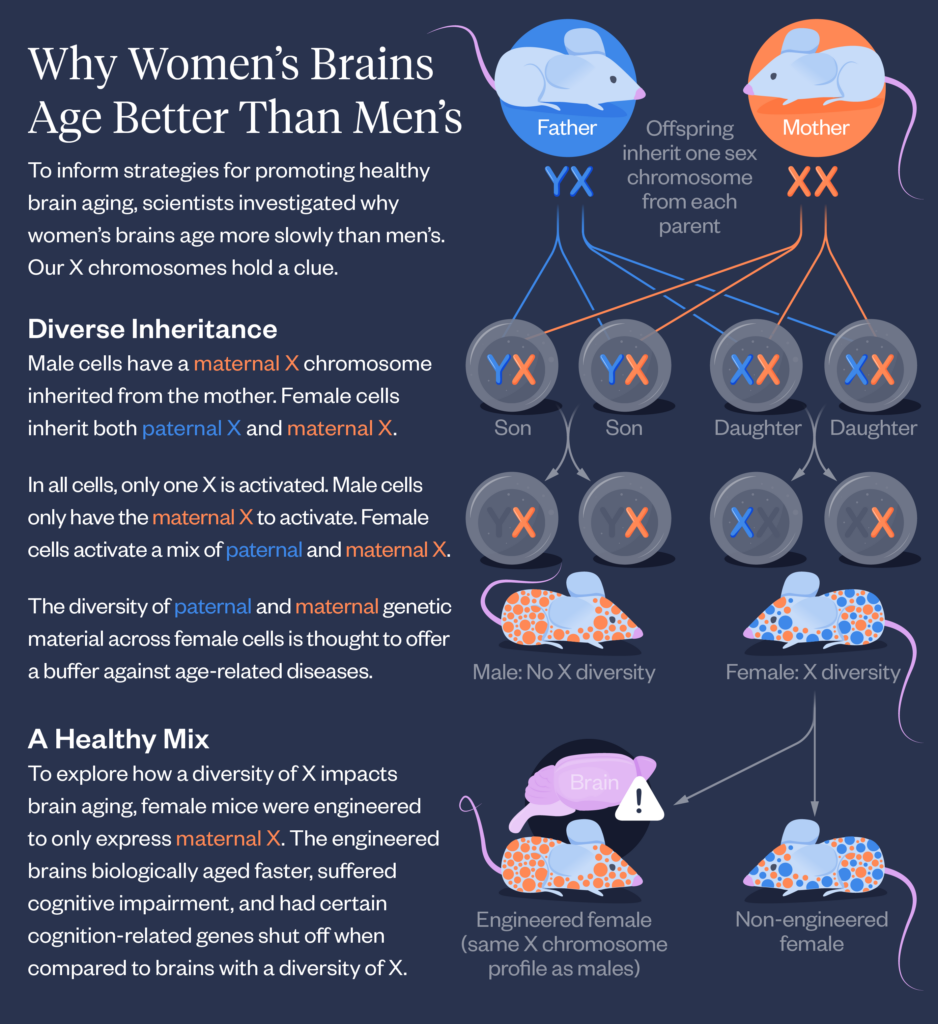
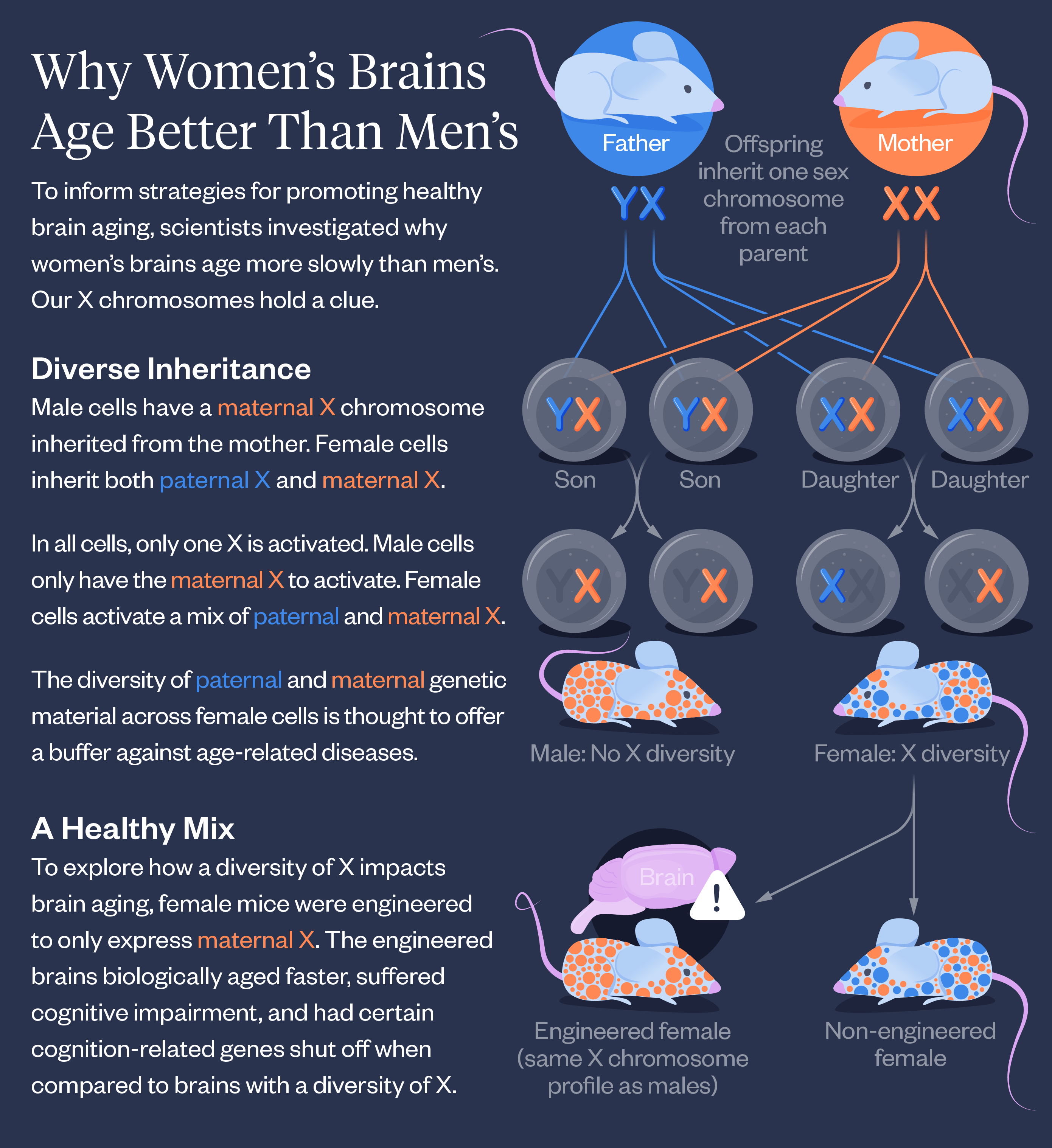
Men have one X chromosome — always from their mother — and a Y chromosome inherited from their father in each of their cells. Women have two X chromosomes in each of their cells: one maternal and one paternal. But in women, only one of these X chromosomes is expressed in each cell: The other one essentially taps out in a phenomenon called X inactivation.
“The process is pretty random: Each cell will inactivate either the X from their mom or the X from their dad without caring what its neighboring cell is doing,” says Samira Abdulai-Saiku, a postdoc in Dubal’s lab, a member of the Simons Fellows-to-Faculty program, and lead author of the study.
This means you’d expect maternal and paternal X chromosomes to activate with a roughly 50-50 split in women. But in some cases, women can express more of a maternal X or more of a paternal X, which is called X-skewing. Skewing entirely one way is rare, however, so most women exist as a “mosaic,” expressing a mix of maternal and paternal X chromosomes.
“We wondered whether that mix — that mosaicism — could offer some kind of a buffer against aging or diseases of aging in women,” says Dubal. “Because when there is diversity in a system, it’s often able to compensate when things go wrong because it can respond in different ways. But to really get at that question, we had to first understand how each X chromosome, either from the mother or father, impacts how a cell behaves.”
Uncovering the X Factor
To test how an X chromosome’s parent of origin impacts cognition, the scientists started by engineering mice to only express maternal X chromosomes. The mice were then put through a series of tasks aimed at testing their learning and memory.
“Having just a maternal X was causing their brains to biologically age faster,” says Dubal. “It also was causing cognitive impairment: In maze tasks, the engineered mice lost their ability to learn and remember compared to their wild-type, mosaic sisters as they aged.”