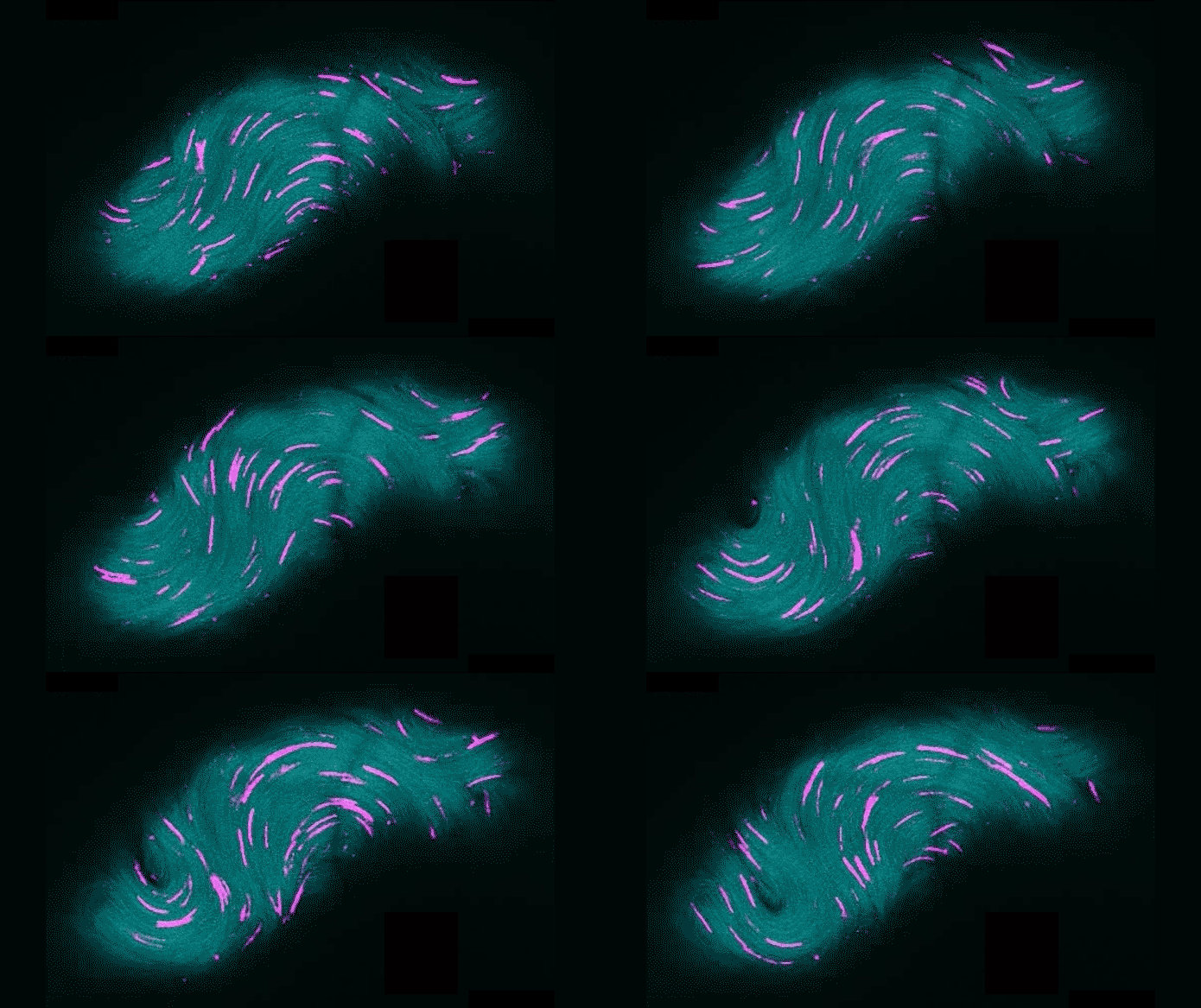
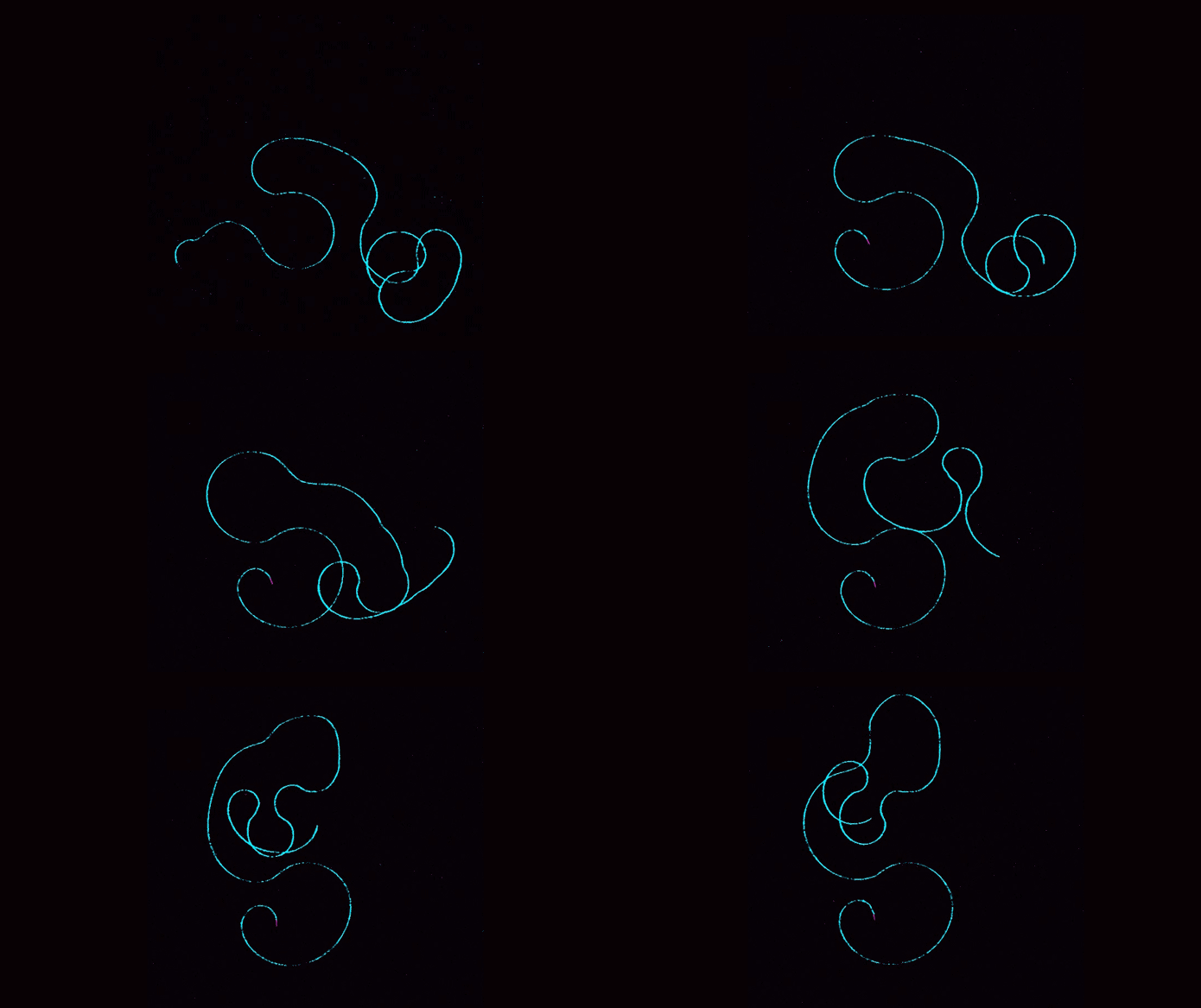
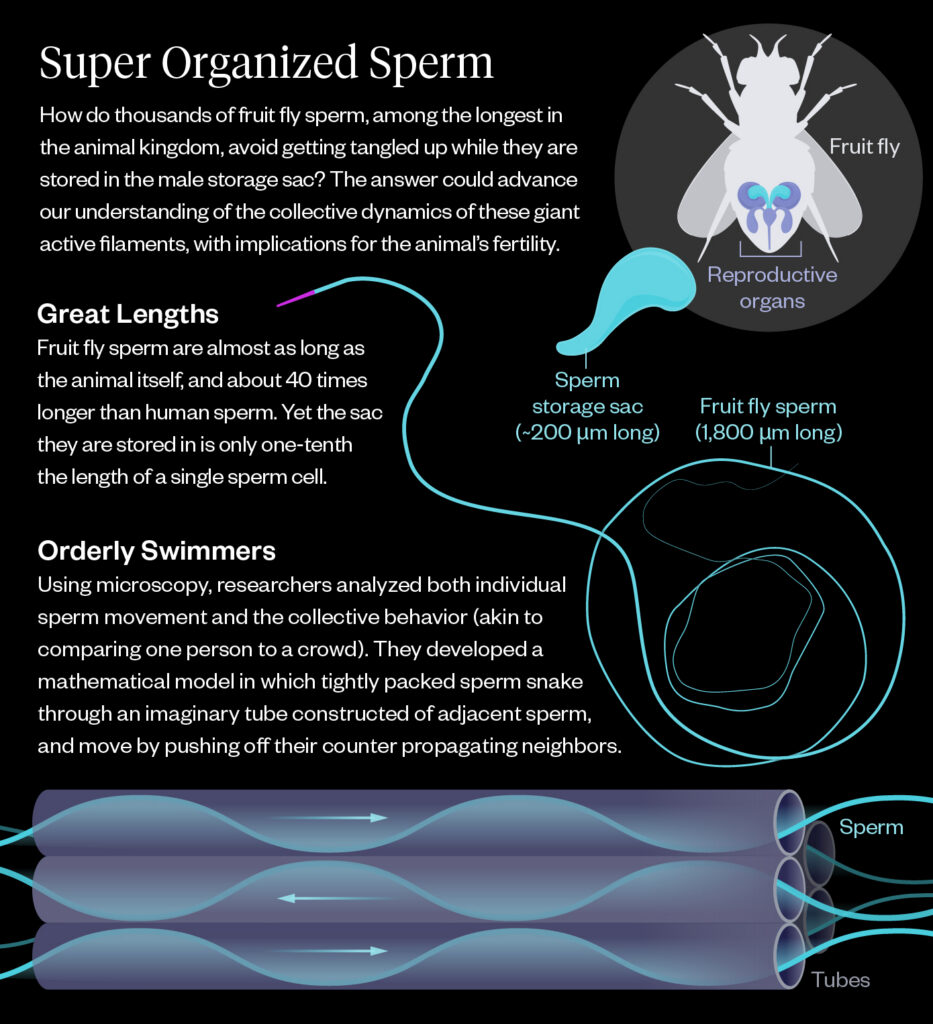
Scott Pitnick, a Syracuse University biologist, has been trying to answer that question for over three decades. The key was to move away from the tradition of looking at just the male side of things. Sperm length, Pitnick realized, has evolved hand in hand with the shape and length of the female reproductive tract — which has gone virtually unstudied.
Females appear to select for larger sperm for several reasons. For one thing, larger sperm seem better at holding their ground and displacing smaller sperm in the female storage organ. For another, the genes for sperm length and testis size are closely tied to those expressed in the brain and nervous system (this is known as the ‘good genes’ hypothesis).
While there is more to uncover, the idea that females are exerting the main evolutionary selection pressure “provides a general explanation for why sperm are so evolutionarily dynamic, why sperm are evolving constantly,” says Pitnick, who published his conclusions in Nature Ecology & Evolution in November 2024. “It might be that understanding all of the variation in sperm throughout the animal kingdom is just males trying to keep up with the changes in females.”
These larger evolutionary questions help give rise to the systems that researchers at the CCB are probing. Together, Chakrabarti and Imran Alsous are asking: Given that these sperm have evolved to be so large, what mechanisms has nature put into place to make sure they can still fertilize eggs properly?
By working with theoreticians from the beginning, Imran Alsous could look to the literature to see whether similar systems had already been described. In fact, mathematicians have studied systems in which a container was filled with filaments, like pieces of rope. But instead of the passive filaments, Imran Alsous was working with active sperm cells, with their massive wave-propagating tails, which added a whole new dimension to the problem.
Each time she came up with new experimental data, Chakrabarti could access the results immediately and use them to inform his theoretical models. Then the models predicted how the sperm’s way of swimming led to their spatial arrangement, which Imran Alsous could test through perturbation experiments. The theory drew inspiration from approaches used in nonequilibrium physics and active matter that describe how interactions between motile or active agents can give rise to larger-scale collective behaviors. “It gave us a framework to think about experimental observations,” she says. “It also gave us the vocabulary to describe what we were seeing.”
Next, they hope to investigate how the male storage organ gradually fills up with sperm in the first place, to figure out when sperm dynamics change to reflect the collective movement they have observed. Imran Alsous is also interested in exploring how sperm behaves in females and how females so efficiently utilize their stored sperm. (For every 800 or so sperm stored, female fruit flies will end up using 400 to 500 of them for fertilization, as opposed to humans, who use around one sperm in every 200 million to 300 million.)
The biological relevance, practicality and novelty of the fruit fly mating system makes these questions endlessly fascinating to Imran Alsous. “The fact that they’re so unlike what you are taught in your biology textbook is really amazing,” she says. “It just doesn’t really get old.”
Yet to her, this is about more than just understanding a reproductive oddity. It is an opportunity to understand the full repertoire of behaviors that animals can use to achieve reproductive success. The work could also inspire future models that can explain other natural systems. Sperm are, after all, one of nature’s most varied cells. “It’s a question of strategy,” she says. “How does nature get to be this way? How do you overcome these barriers?”