Research into tensor networks began in the 1970s, led by physicist and mathematician Roger Penrose, who later shared a Nobel Prize in physics for his mathematical description of black holes. Penrose’s notation for tensor networks is still used, but the applications of these mathematical systems have expanded far beyond the problems for which he introduced them.
In 1992, Steven R. White devised a powerful algorithm for understanding quantum systems — the density matrix renormalization group — which is now understood (thanks in part to the work of Ulrich Schöllwock) to inherit its efficiency from an underlying tensor network structure. Over the last 15 years, the use of tensor networks has exploded, and they are now found in fields from mathematics to chemistry.
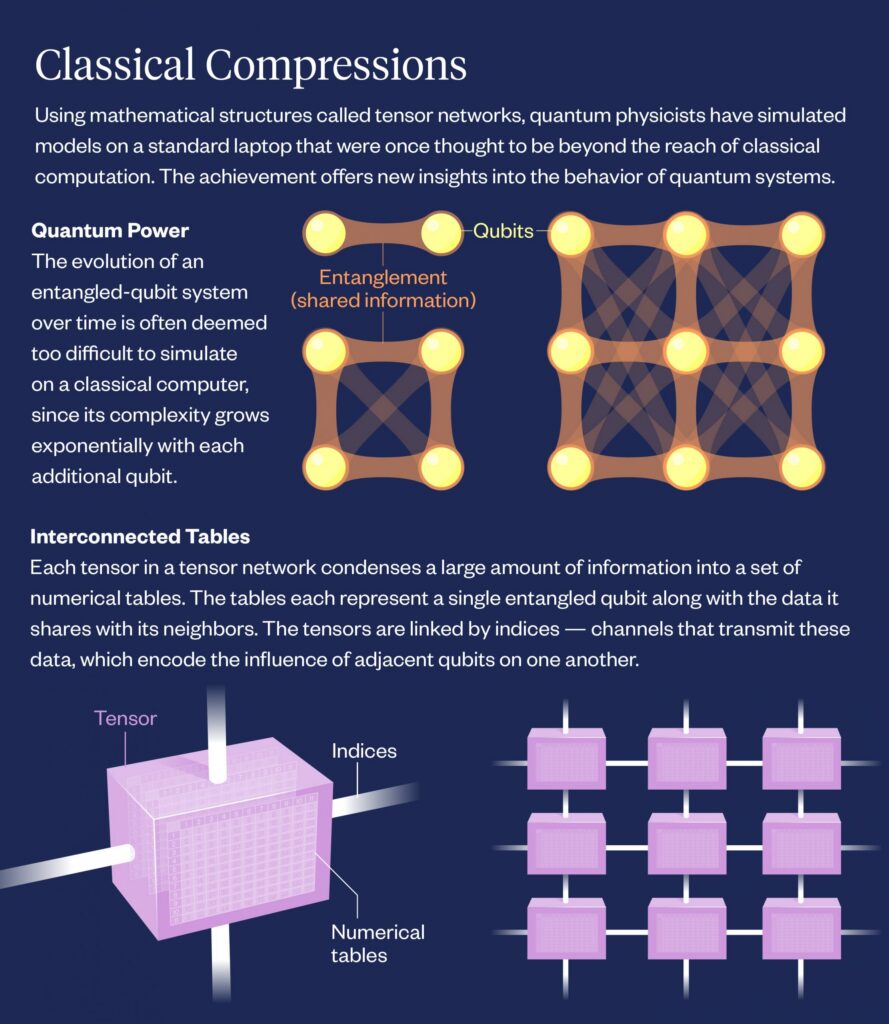
“There are a lot of problems in math and science where you have huge amounts of data — data so big it can’t fit on your computer,” Tindall says. “A tensor network offers a way of compressing that data, kind of like a zip file.” These techniques come from a branch of mathematics called linear algebra that deals with tables of numbers known as matrices. Linear algebra is typically used to describe systems in low dimensions such as those involving a single matrix. But by linking matrices together, researchers realized that linear algebra could be used to describe problems with more dimensions.
Using networks of these linked matrices — that is, tensor networks — researchers can take very complex systems found in quantum dynamics and simplify them enough that they can be handled by classical computers. Some of the mathematical methods used in this simplification were developed recently, while others are hundreds of years old. Some of those techniques, though known to mathematicians, are new to quantum dynamics research.
“One of our mathematicians recently introduced us to this ancient technique widespread in mathematics, which is new to us as physicists,” says Miles Stoudenmire, a research scientist at the CCQ. “It’s blowing our minds because it lets us solve certain problems exponentially faster.”