Quantum Dynamics Breakthrough Overturns Claim of ‘Quantum Supremacy,’ Opens New Research Directions

Using a conventional computer and cutting-edge mathematical tools and code, physicists at the Center for Computational Quantum Physics (CCQ) at the Simons Foundation’s Flatiron Institute and collaborators at Boston University have cracked a daunting quantum physics problem previously claimed to be solvable only by quantum computers.
The technique is so groundbreaking in its efficiency that the researchers were even able to use a personal laptop to solve the problem. By enabling scientists to squeeze extra problem-solving power from classical computers, the breakthrough methodology is opening new avenues for research on quantum dynamics and may be useful as a protocol for solving problems about finding the optimal solution amid an abundance of feasible ones.
The researchers report their work May 21 in Science.
The problem at hand involves simulating a quantum system composed of hundreds of interacting ‘qubits’ — the quantum computing equivalent of the bits used in classical computers — arranged in square, cubic or diamond lattices. While bits can have values of 0 or 1, qubits can exist in a superposition of multiple values, making it challenging for traditional computers to simulate their dynamics.
In a March 2025 article, also published in Science, a group of quantum computing researchers reported that they’d calculated the dynamics of a particularly intricate system of qubits using a quantum computer. They further claimed that their feat was impossible for classical computers to match.
“Whenever we [at the CCQ] see these kinds of claims, we’re always a bit skeptical,” says Joseph Tindall, an associate research scientist at the CCQ and first author on the new Science paper. “Like, ‘Did you try this? Did you try that?’”
The problem served as an opportunity to take their tools “out for a test drive,” says study co-author and CCQ research scientist Miles Stoudenmire. “We could have picked some more arbitrary target,” Stoudenmire says. “But it was like ‘Why not pick this one that has a big claim attached to it?’”
The work was particularly challenging due to quantum entanglement, which means the qubits can’t be treated individually, even when they’re far apart. That entanglement requires sophisticated algorithms to tackle, Tindall says.
“When you have lots of particles that interact by quantum physics, you have this wave function that describes the state of the system,” Tindall says. “It’s this huge object that rapidly gets bigger and bigger the more particles there are.”
As the wave function’s size grows exponentially, “I just can’t directly store it on my computer,” he says. Working with such massive wave functions is a common challenge in quantum physics, but it’s required for tasks such as predicting the properties of quantum materials, like superconductors.
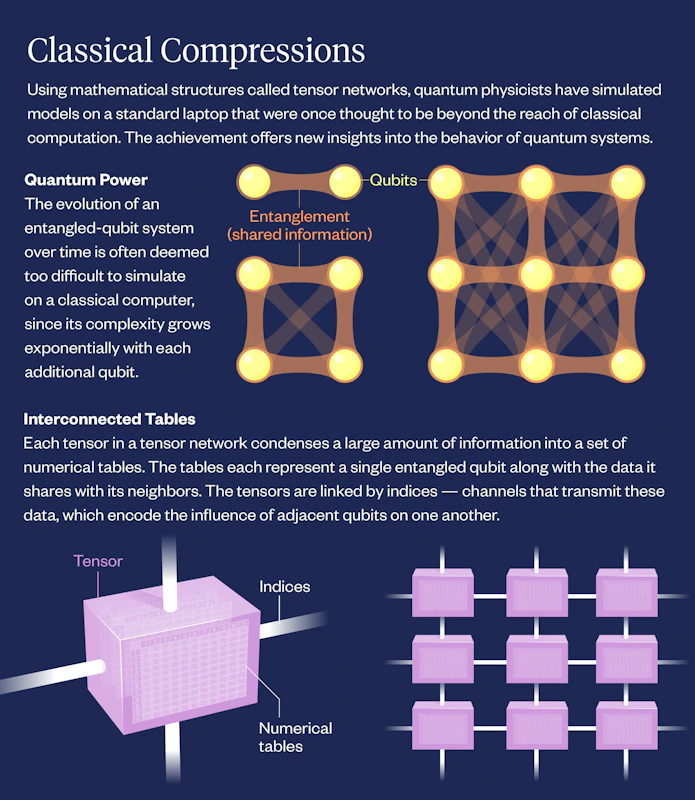
The CCQ team achieved their breakthrough by developing and implementing new tools based on tensor networks, which Tindall likens to “a zip file for the wave function where you’ve taken all this information, and you’ve compressed it into this mathematical data structure full of these small tables of numbers that are interconnected to each other.”
The tensor networks made the problem feasible for classical computers. Tindall performed many of the initial calculations on a laptop computer using code from a high-performance tensor network software library developed at the CCQ called ITensor. The recently published simulations exemplify how the ITensor team is discovering new ways to repurpose tensor methods for novel applications. Those simulations capture the three-dimensional dynamics using a 3D tensor network.
“It’s this very powerful compression that can be very effective, but it’s a pretty complex mathematical object,” Tindall says. “This really is a bit of a frontier, because working with these objects — especially in three dimensions — is very untrodden. You need sophisticated codes and algorithms to deal with them; it’s a software engineering challenge in itself.”
The team ran many of their simulations using relatively modest computational resources. Tindall performed the initial calculations using an older type of algorithm — called belief propagation — from the 1980s that has been recently adapted for quantum systems. “It’s a little more approximate than some of the other methods, but it’s way cheaper, and we can run it much more directly on lots of harder problems,” Stoudenmire says. He contrasts that with “more sophisticated methods in the past of our field” that “wouldn’t be able to even start going for some of these three-dimensional problems, because they’re so big.”
Despite using only modest computational hardware, the researchers demonstrated that their simulations yielded state-of-the-art accuracies. The simulations converged on solutions that matched theoretical predictions and provided accurate results when applied to smaller test problems. The results also agreed with those reported by the quantum computing researchers — but with no quantum computer required.
While researchers in classical and quantum computing may seem to be at odds with each other about the limitations of their respective subfields, Tindall and Stoudenmire note that there’s also shared knowledge and inspiration to be found between the two approaches.
“The good side of the classical versus quantum computing debate is that there’s a lot of synergy between the kind of simulations we’re interested in and the codes we write and what can be realized on these quantum computers,” Tindall says. “That can help guide us, and it can also help guide quantum computing researchers, because, obviously, the barrier for entry for us to simulate certain things is a lot easier than for them, because we don’t have to build a quantum computer. I can just write some code and press ‘run’ on my personal computer.”
The team is pushing their work even further by developing tools for going beyond qubit systems to problems involving electrons that can move between sites — an even more daunting challenge that connects directly to simulating quantum materials. “They’re really, quantitatively, a lot harder problems,” Stoudenmire says. “So that’s one of our next big bars that we want to clear.”
Information for Press
For more information, please contact [email protected].