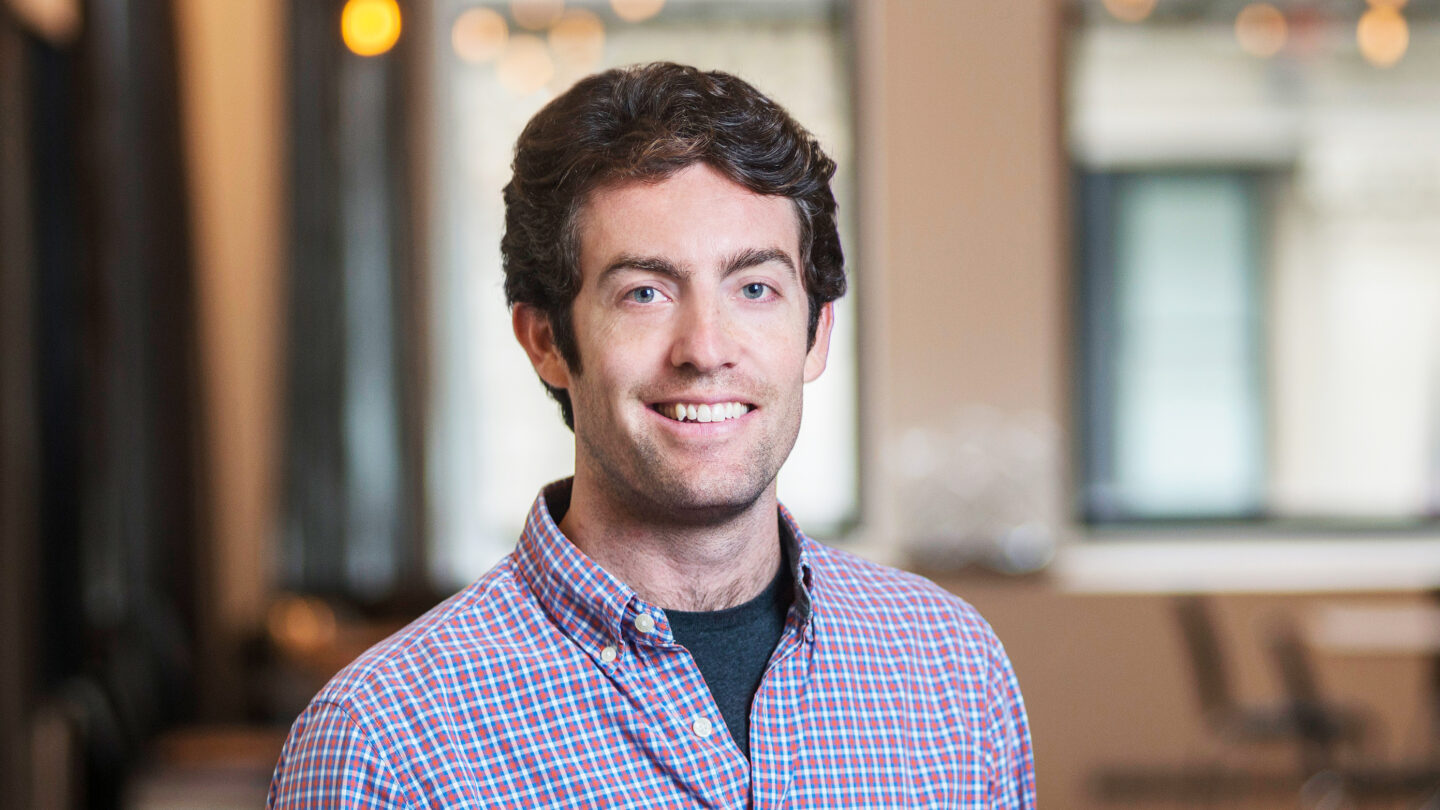
David G. Clark Is Finding Order in the Brain’s Noise

Featuring
-

David G. Clark
Associate Research Scientist, Center for Computational Neuroscience

Bringing people and ideas together to fund, conduct, and share transformative science.
Our grants advance knowledge and strengthen connections between science and society.
Discover the latest news, research, and updates.
We convene scientists, mathematicians, and thinkers to share ideas and explore new questions.
Founded by Jim and Marilyn Simons, we’re a private philanthropy advancing mathematics and basic science.
Work with us on the frontier of basic science research.
The Flatiron Institute is a research center that uses computational science to advance fields like physics, biology, and astronomy.
Search
The Flatiron Institute’s David G. Clark builds mathematical theories of large neural circuits, aiming to explain how neuronal dynamics give rise to thought and action.
Associate Research Scientist, Center for Computational Neuroscience
There are many paths to becoming a neuroscientist. One of them runs through a childhood obsession with magic. David G. Clark spent hours of his youth perfecting tricks to perform for family and friends. He also spent hours puzzling over why the tricks worked, a mindset he now applies to the brain.
Clark builds mathematical theories of neural activity. Neuroscientists are far from a full understanding of how that activity produces our everyday actions, and Clark’s work aims to make progress on the problem.
He recently joined the Simons Foundation’s Flatiron Institute as a group leader and associate research scientist at the institute’s Center for Computational Neuroscience (CCN). He oversees the High-Dimensional Dynamics and Computation group, which develops theories linking synaptic connectivity, neuronal dynamics and computation.
Clark received his doctorate in neurobiology and behavior from Columbia University’s Center for Theoretical Neuroscience in 2025. He then spent a year as a research fellow at Harvard University’s Kempner Institute for the Study of Natural and Artificial Intelligence. He joined the Flatiron Institute in September 2026.
We recently discussed Clark’s work to date and his vision for his future at CCN. The conversation has been edited for clarity.
Everything you’ve ever done — every thought, perception and decision — is the product of billions of neurons in your brain interacting through trillions of synaptic connections. No one understands the relationship between this high-dimensional, nonlinear dynamical system and everyday experience. My goal is to develop comprehensible, parsimonious theories that explain it.
One inspiration for this work is physics, where there’s a long tradition of models that account for complex phenomena. For example, consider a ‘spin glass,’ which consists not of neurons but of many ‘spins’ that influence one another to point up or down. It is a high-dimensional system with random interactions, and it can be understood using beautiful ideas from the physics of disordered systems.
A counterintuitive lesson from that field is that theories actually become simpler as the number of interacting parts grows. These theories also naturally accommodate disorder, which appears in essentially every dataset we have on activity and connectivity in large mammalian circuits. That bodes well for understanding the collective activity of many neurons. Of course, there are limits to applying physics directly to the brain.
Ideas from the physics of disordered systems are a useful framework for what I do, but on their own, they say nothing about the computational demands the brain faces when it moves, thinks or, as has been in the news lately, proves a theorem. Put differently, a spin glass is an elegant model, but it isn’t going to walk across the room and have a conversation with you.
My aim is to extend the kind of insightful mathematical description that physics achieves for its systems to neural circuits that actually do useful computations. I also want to ground these theories in experimental data, of which there are now two important kinds, namely, recordings of neural activity in animals and emerging ‘connectome’ datasets that describe the wiring of large circuits.
I find building theories enormously exciting, but there are challenges with — and objections to — the enterprise.
There’s a short story by [Jorge Luis] Borges whose central observation, if I can make it local, is that the only fully accurate map of Manhattan is Manhattan itself. That is, everything that makes the city what it is — the architecture, parks, transit, shops and so on — is so rich that it resists any compressed description. You might worry that neural circuits, and the activity they produce, are similarly irreducible.
I tend to be more optimistic. A long history of work in my field, along with some of my own, has shown that high-dimensional neural activity and computation can be described in conceptually interpretable ways. One thing that helps is that, unlike the residents of Manhattan, who each have their own goals and habits, the neurons in a circuit must tightly coordinate their activity to produce coherent, controllable dynamics that can drive behavior.
As theorists, we can build theories of these emergent, low-dimensional variables rather than tracking every neuron. And even when the computation in question is not low-dimensional, one can often make progress with the right modeling choices. For instance, one can look for explanations that are locally low-dimensional — a notion of sparsity — even if the whole is high-dimensional. In general, however, I believe our field desperately needs new concepts to make sense of these high-dimensional scenarios.
Notably, we are also working in a remarkable period for data. In previous generations, it was possible to record from one or two neurons at a time in an animal performing a task. Now we can record from thousands or even hundreds of thousands simultaneously. Together with connectome data, that gives theorists far more to work with than ever before.
Human cognition is astounding, but my interest is in large neural circuits in general and how they compute. Other neuroscientists focus on helping people with mental illness or brain disorders, and for that, you need data on human behavior and neural dynamics. That’s important work; it’s just different from my focus, which is more conceptual. Real brains are my primary interest, but modern AI models, which are themselves large neural networks, are also interesting in their own right, and they are certainly more transparent than animal brains.
The postdoc was only a year, but there was time to do some interesting work.
With Blake Bordelon, Jacob Zavatone-Veth and Cengiz Pehlevan of Harvard University, we sought a deeper understanding of neural circuit models trained using machine learning to perform a task. This is a common approach to modeling neural activity recorded in animals performing the same task. Building on my collaborators’ prior work, we studied how the demands of the task shape dynamics in the trained network. Our theory says that activity reflects a competition between two forces, namely, structure due to the task and disorder due to randomness inherent in the connectivity. Using the theory, we analyzed recordings from monkeys performing a simple motor task and concluded that activity in this brain region shows some task-related structure, but not much. That is, the data point to a substantial degree of randomness in the circuit. This was a surprising result, and I’m curious to see how broadly it holds across other datasets.
In other work with my doctoral advisor, Larry Abbott, at Columbia University, and with Haim Sompolinsky of Harvard University, we studied the following problem. If I close my eyes and slowly spin around, I still have some sense of which direction I’m facing at each moment. That means that, somewhere in my brain, there is a representation of my heading that is being updated as I turn. Likewise, if I close my eyes and walk around a room, I can keep track of where I am.
Heading and position are both continuous variables, and the brain has to persistently represent them somehow. In the 1990s, Haim and others developed a beautiful theory to explain how neural circuits could do this. The idea is that if a network’s connectivity has a continuous symmetry — for example, if the network is a ring, with each neuron connected to its neighbors in the same way — its activity settles into a set of stable states that themselves form a ring, providing the desired representation. It’s an orderly, pristine mechanism, and experiments in flies have shown that, astonishingly, it is realized there almost exactly. In rodents, however, the data are heterogeneous and disorderly to a degree that seems to contradict the mechanism.
Our work shows that the rodent data are, in fact, consistent not only with this general kind of dynamics but, more specifically, with a continuous symmetry mechanism. The circuit that generates the representation of heading may be conceptually very similar in flies and rodents; the difference is that in rodents, the symmetry is embedded randomly in a higher-dimensional network. That random embedding makes the responses of individual neurons look messy, even though the underlying mechanism is the same. This was very exciting.
Broadly, I want to build theories of large nonlinear neural circuits that do interesting things, and to understand those circuits. That means understanding the tasks a circuit performs, the connectivity that supports them and the dynamics that result. I’m keeping this intentionally vague for now; it will be fascinating to see what develops. As I said earlier, we need new concepts and ideas, and there’s a lot of work to do!
I’m especially excited about AI tools, which are already helping dramatically with the computational side of this work, allowing me to take on richer and more complex theories than I could have before and to analyze more complex datasets. For now, humans still seem far better at generating good questions and at the art of theory building itself, though I’m curious to see how that evolves.
On a personal note, I’m thrilled to be back in New York City, where I did my Ph.D. The Flatiron Institute is a dream job, and I don’t think there is a better place to be a theoretical neuroscientist than New York. I also walk everywhere and go to a lot of on- and off-Broadway shows, so it’s great to be back for those reasons too.
My passion throughout childhood was magic, and I truly hoped to become a professional magician. I practiced tricks for hours and spent a lot of time studying the literature and watching other performers. I even kept, in the basement of my benevolent parents’ home, a pair of white doves, which I made vanish and reappear, as one does.
That fervor eventually faded, though I still love magic. Strangely, the way I feel when thinking about magic is almost exactly the way I feel when thinking about theoretical questions in neuroscience. The similarity, I think, is that in both cases there is an elegant secret at the heart of a mystery, and I get a great deal of joy and meaning from uncovering those secrets.