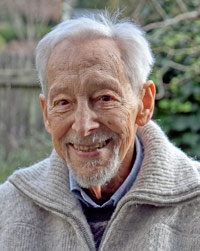
Robert Osserman is currently Professor Emeritus at Stanford and Special Projects Director at the Mathematical Sciences Research Institute (MSRI).
His main areas of research have been in differential geometry, partial differential equations, and complex function theory. He has also worked on ergodic theory, and some recent papers have been on astronomy, geometry, and cartography. His most extensive contributions have been to the theory of minimal surfaces – the surfaces formed by soap films spanning a wire, and on isoperimetric inequalities.
After obtaining his PhD at Harvard University, Robert Osserman joined the faculty of Stanford University and remained there until his retirement, with periods of leave to serve as Head of the Mathematics Branch at the Office of Naval Research, Fulbright Lecturer at the University of Paris, and Guggenheim Fellow at the University of Warwick. In 1987, he was named Mellon Professor for Interdisciplinary Studies, and in 1990 he joined MSRI as half-time Deputy Director.
While at Stanford, he developed and taught a new course designed to present mathematics, science, and technology to a non-technical audience. A portion of the course was elaborated in a book entitled Poetry of the Universe – A Mathematical Exploration of the Cosmos intended to provide the general public with an introduction to cosmology, and focusing on a number of mathematical ideas that have played a key role.
In 2010, he published two papers on Eero Saarinen’s “Gateway Arch” in St. Louis that have cast a new light on its shape and design.