Bringing people and ideas together to fund, conduct, and share transformative science.
Our grants advance knowledge and strengthen connections between science and society.
Discover the latest news, research, and updates.
We convene scientists, mathematicians, and thinkers to share ideas and explore new questions.
Founded by Jim and Marilyn Simons, we’re a private philanthropy advancing mathematics and basic science.
Work with us on the frontier of basic science research.
The Flatiron Institute is a research center that uses computational science to advance fields like physics, biology, and astronomy.
Search
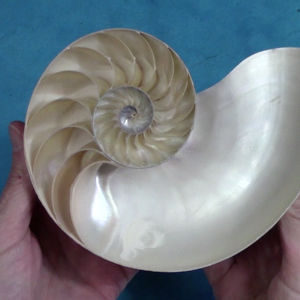
A video explaining how some seemingly complex patterns on sea shells can be created by simple, one-dimensional, two-state cellular automata.
One-dimensional, two-state cellular automata produce a list of bits at discrete time steps, whose output, depending on the parameters, may be trivial or very complex. Surprisingly, this simple mechanism can be Turing complete — that is, capable of calculating anything that any computer can calculate. This video shows two artworks that were inspired by these automata. One example can serve as a model for the patterns on certain sea shells, which appear to be generated by a similar mechanism. A fuller analysis of snail-shell coloring patterns is an open problem. Hans Meinhardt’s book “The Algorithmic Beauty of Sea Shells” is an extended study using continuous-time, continuous-space models, but it is still just a first approximation.
Further Reading
Bays, Carter, William Rollins, Matti Vanninen, Josh Dolinger, and Jamie Huenefeld. “The Game of Three Dimensional Life.”
Fox, Camilla. Home page.
Meinhardt, Hans. The Algorithmic Beauty of Sea Shells. Springer, 1995.
Myskja, Kristoffer. Home page.
Ready program (used to make “Toroidal Life”).
Weisstein, Eric W. “Rule 30.” MathWorld—A Wolfram Web Resource.
Wikipedia contributors. “Rule 110.” Wikipedia, The Free Encyclopedia.
Wolfram, Stephen. A New Kind of Science. Wolfram Science.