In 2011, MESA was officially released to the public along with a ‘manifesto’ — an explicit set of principles for the intended use of the code. Bildsten explains that because MESA was never planned but instead evolved organically to become a community asset, that openness required obligations from its users. With the manifesto, Bildsten, Paxton and the other MESA developers, a team of expert volunteers supporting the instrument’s development from its conception, “made it clear we had a philosophy and rules we were asking the community to abide by,” Bildsten says. Stated within the manifesto are guidelines for using and contributing to MESA. For example, publications using the tool must properly cite it, any modifications or additions to the code need to be made publicly available, and users must help others learn MESA.
In the years since, MESA has become the gold standard for simulating the properties and evolution of stars. MESA’s open-source philosophy and rigorous documentation via peer-reviewed publications led to exponential adoption by the astrophysics community, with thousands of papers published using the software and more than 1,000 global users. In 2021, the American Astronomical Society recognized Paxton with the Beatrice M. Tinsley Prize — a biennial award for outstanding contributions to astrophysics.
Paxton died on July 23, 2025, but the incredible legacy he bestowed on the study of stars lives on. Bildsten notes, “With Bill’s passing, we have all lost a great scientist and supporter for early-career scientists. Bill not only cared deeply about getting it right but also shared his deep passion for clear thinking and deliberate language at all times. My research group meetings and the shared writings of MESA instrument papers were so much more exciting with Bill in the room, always challenging and encouraging all of us to do our best in our science and explanations. Simply put, Bill never left any stone unturned!”
Thanks to Paxton, MESA has revolutionized how researchers study the lives of stars, and with this revolution comes responsibility. When Paxton started stepping away from the project around 2020, the MESA developers had to keep it afloat, a tenuous arrangement for a cohort largely comprised of early-career scientists. After five years of unreliable funding and without Paxton providing full-time developmental support, the Flatiron Institute’s Center for Computational Astrophysics (CCA) stepped in to provide MESA and its worldwide user base with security for sustained research, continued development, and community outreach and engagement.
“Scientific software is as fundamental to modern research as any physical instrument,” says astrophysicist Philip Mocz, who joined the CCA as a full-time software engineer supporting MESA. “MESA has revolutionized astrophysical research, and we are entering an exciting new era for modeling the stars to enable stellar discoveries.”
A Star Is Born
MESA was released with an ‘instrument paper’ — documentation of everything the code could do. Paxton once jokingly described the technical document as “just breathtakingly exciting reading,” but the state-of-the-art stellar evolution model’s reception by the astrophysics community was astounding.
“That is what gained community trust,” says Bildsten. “There was a stark cultural contrast because this was the first stellar evolution code that was intentionally written to be open-source and widely used.” That openness led Bildsten, astrophysicist Frank Timmes of Arizona State University and Paxton to create the MESA Summer Schools, which began in 2012 and continue to this day. These schools, which occurred on UCSB’s campus for a decade, created the MESA community of users and future developers.
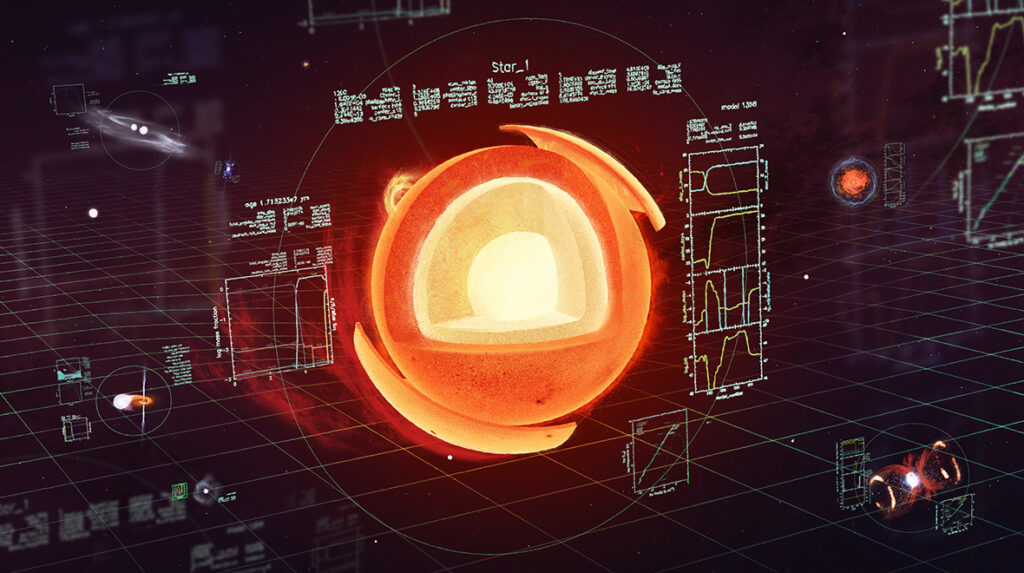
Astrophysicists use MESA to simulate how stars evolve from their initial formation to their final stages. Light from living and dying stars shapes how astronomers study the origin and expansion of the universe, along with the expected — and often unexpected — properties of the universe’s billions of trillions of stars and the astrophysical environments in which they reside.
Matteo Cantiello, a research scientist at the CCA who investigates the lives and deaths of massive stars, is a longtime MESA developer. He likens stars to atoms of our cosmological understanding and describes MESA as one of the most important tools for bridging theoretical models and observational data.
MESA’s rise to widespread adoption coincided with major advances in stellar observations that have opened new areas of science and revealed new properties of stars, such as previously unknown types of stellar explosions, internal rotation and earthquake-like waves that ripple through stars. Many of these findings have yet to be quantitatively resolved, and MESA provides a powerful tool for exploring these phenomena.