In the early 2010s, science entered a new era known as the resolution revolution, powered in large part by advances in a powerful imaging technique called cryo-electron microscopy, or cryo-EM. By bombarding flash-frozen molecules with electrons and analyzing the resulting images, researchers were suddenly able to create atomic-level renderings of everything from enzymes and ribosomes to viruses and antibodies. Cryo-EM turned out new discoveries at such a clip that in 2017, three of its key developers were awarded a Nobel Prize.
Today, the Simons Foundation continues to advance cryo-EM and related technologies in disciplines such as structural biology, biochemistry and medical science. In 2015, the foundation funded the establishment of the Simons Electron Microscopy Center (SEMC) at the New York Structural Biology Center (NYSBC) in Harlem. SEMC is dedicated to training a new generation of scientists, advancing cryo-EM capabilities, and using microscopy to solve pressing scientific questions.
At its core, cryo-EM is a tool powered by math. Researchers start by embedding thousands or millions of molecules they’re interested in imaging into a grid, which they then expose to a beam of accelerated electrons. As the electrons bombard the sample, they produce millions of randomized 2D images that have no consistent angle or orientation. To create a 3D model from that chaotic data, scientists need algorithms capable of reorienting and reorganizing the many slices of the whole, like pieces of bread that, layered together, make a loaf. To do this, mathematical models describe an image by its patterns and details rather than by its pixel locations and match slices with similar properties.
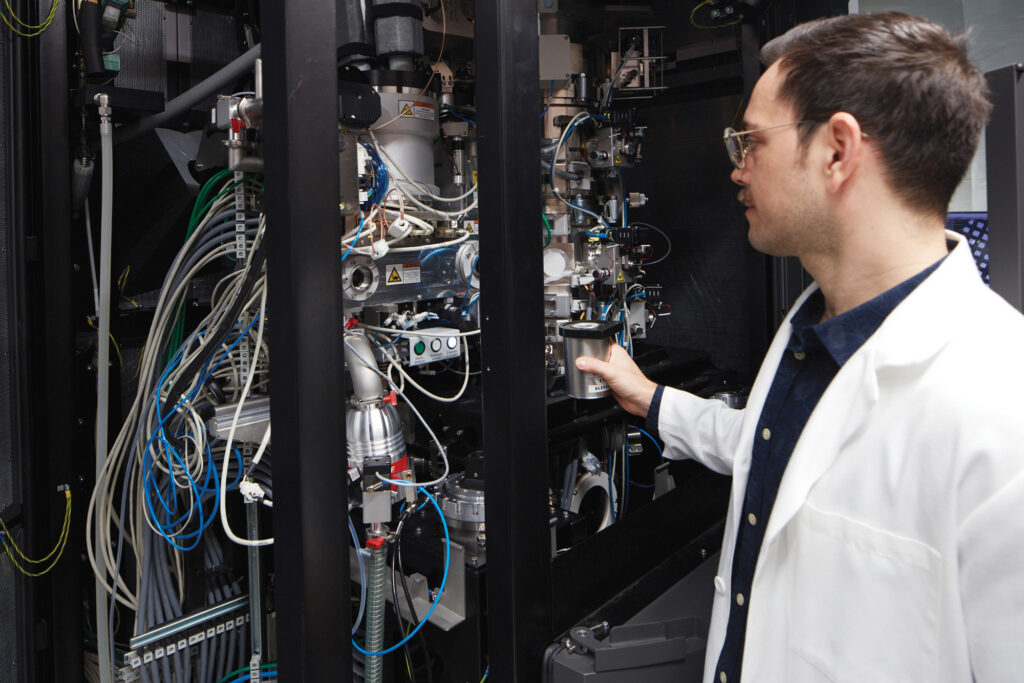
The underlying math is complicated, but the resulting capabilities are unparalleled, and from its first day, the center has helped bring cryo-EM tools to more people, including researchers working in distant fields. The team at SEMC oversees 19 microscopes and a variety of companion machines that would be prohibitively expensive for many labs. Yet the center makes them available — and trains scientists in their use and how to analyze the resulting data — through collaborations with the National Institutes of Health and other groups within the NYSBC and the Simons Foundation’s Flatiron Institute.