What made the Gaia release particularly exciting, Hogg says, was a selfless decision made by the spacecraft’s scientific team. With large scientific missions, the scientists behind the endeavor typically get first dibs on the data. This head start allows the team to make discoveries and write research papers months before anyone else can even touch the data. The Gaia team instead opted to give the data to everyone right away.
“When we were looking at the Gaia data, we were seeing it for the first time, but so were the people who worked on the mission,” Hogg says. “They literally released it to themselves and the world simultaneously. It was truly brand new, and nobody knew what was in there.”
The decision to release Gaia’s data without a proprietary period was made “right from the start” in the early 2000s, says Gaia support scientist Jos de Bruijne. Gaia’s predecessor, the Hipparcos spacecraft, had a one-year proprietary period. Divvying up the data was a nightmare, de Bruijne recalls, with many sponsor countries hankering for prime early access.
“For Gaia, we would have been complexifying the issue by an order of magnitude because it will have many more objects, many more things you can do with the data, and a lot more people interested to get involved,” he says. “We said let’s instead concentrate our efforts on getting the data right, getting it out as quickly as possible and letting the politics rest.”
Bruijne admits that Gaia’s open-data decision may not be the best course for every mission. Postdoctoral researchers rely on publications for career advancement, for instance, and may feel dissuaded from committing to long-term projects without a proprietary period. Funding sources may also require that their scientists get a head start digging into the data.
For Gaia, the decision was ultimately the right one, Bruijne says. “I’ve seen a lot of positive reactions about the data being public immediately. To see that the community was eager to get their hands on the data was rewarding.”
Before dawn on April 25, release day, Hogg and a handful of others were already caffeinated and gathered at the Flatiron Institute in New York City watching the Gaia team’s press conference and waiting for the 6 a.m. ET data release. “Hi everybody, it’s Gaia day!” said astrophysicist Kathryn Johnston of Columbia University with a surprising amount of chipperness for so early in the morning.
For an hour or two after the Gaia team officially released their data, attendees encountered connection issues while trying to download the files. “The servers are not able to handle all the enthusiasm,” Faherty joked.
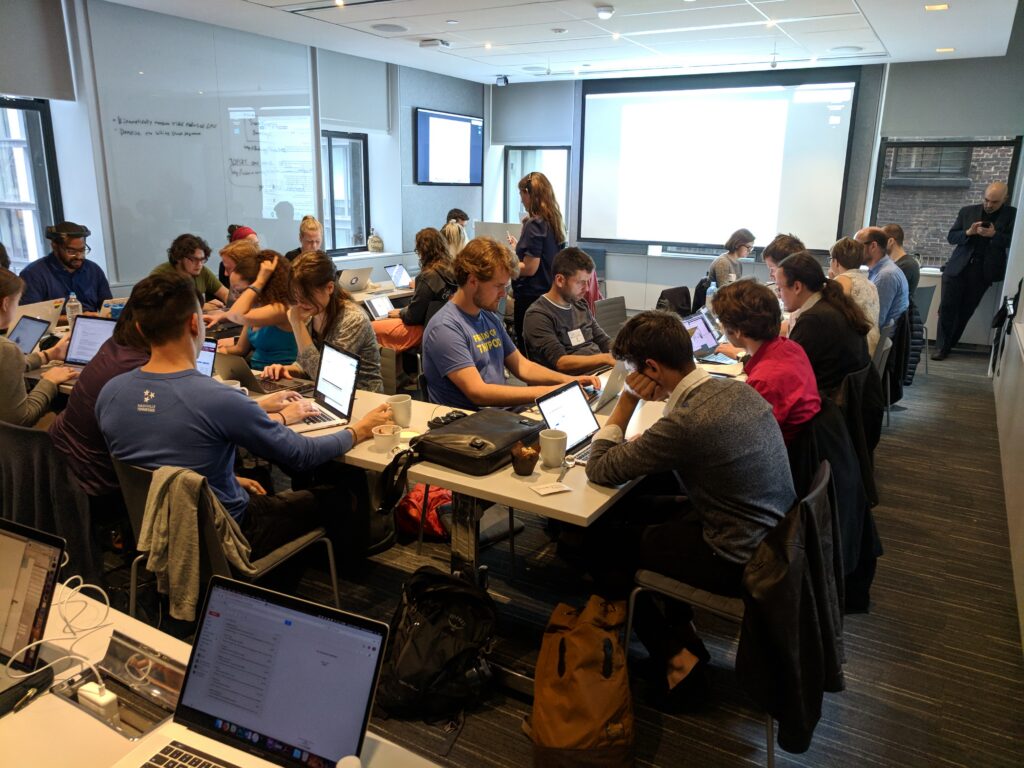
With the files eventually in hand and a roomful of astronomers eagerly sifting through the data, shouts of discovery occasionally pierced the babble of clacking laptop keys. Attendees would crowd around computers to look at a never-before-seen feature of the Milky Way’s structure or the surprising choreography of a band of co-moving stars.
“Even though we spent the last year preparing, it was chaos for the first few hours,” Hogg recalls. “We were still completely swamped by the quantity of the data. We were still completely surprised by what was in the data. People, in the end, didn’t end up doing the projects they prepared to do because other things caught their attention. That’s the way data analysis really is: you spend a lot of time getting ready for a dataset, but what you end up doing is often quite different.”
The event was an ‘un-conference,’ as Hogg describes it. The hackathon had no predetermined schedule, no invited speakers, no strict structure. “Everybody was here to work,” he says. “The idea is to get people together to benefit from each other’s working expertise.” Following the lead of the Gaia team, attendees agreed to openly share their ideas, expertise, code and interim results with other participants and the greater scientific community.
Just hours after the data release, astrophysicists Adrian Price-Whelan of Princeton University and Ana Bonaca of Harvard University discovered something surprising in the Gaia dataset that could help illuminate the distribution of dark matter around our galaxy.
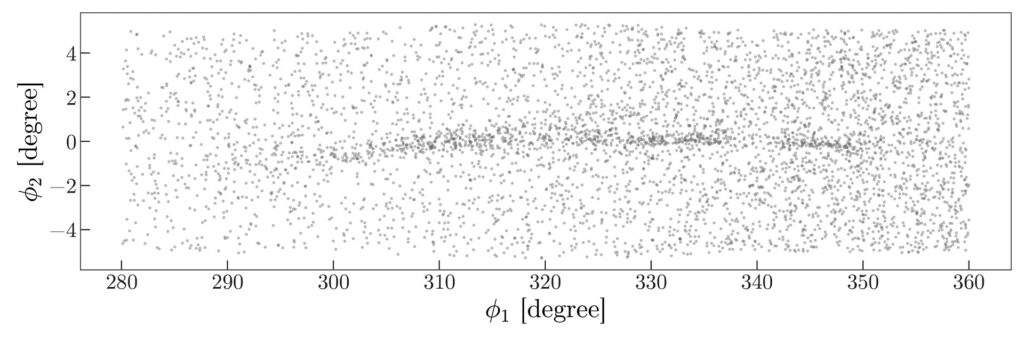
They studied a long, thin string of stars that move together in the relatively barren, though potentially dark matter–rich, halo that surrounds our galaxy. These stars were probably once part of a cluster that was stretched and pulled like taffy by the Milky Way’s gravity. Thanks to Gaia, Price-Whelan and Bonaca could examine the conga line of stars with unprecedented clarity. The clearest look yet of the river of stars revealed a surprise: a big gap in the string where something knocked some stars out of alignment.
The gap was probably caused by the string passing too close to a massive object, such as a giant interstellar cloud. However, given the location of the stars, a more exciting culprit could be to blame: an invisible clump of dark matter. The existence of such clumps, Bonaca says, “has been a big question mark in dark matter theory” — predicted but never observed. The yawning chasm between the stars could be one of the first clear signs that such clumps exist. “It’s still highly, highly speculative,” Price-Whelan says, “but when we looked at this, our first reaction was ‘oh my God.’”