Bringing people and ideas together to fund, conduct, and share transformative science.
Our grants advance knowledge and strengthen connections between science and society.
Discover the latest news, research, and updates.
We convene scientists, mathematicians, and thinkers to share ideas and explore new questions.
Founded by Jim and Marilyn Simons, we’re a private philanthropy advancing mathematics and basic science.
Work with us on the frontier of basic science research.
The Flatiron Institute is a research center that uses computational science to advance fields like physics, biology, and astronomy.
Search
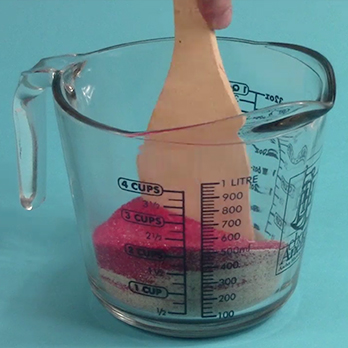
Can you combine simple observations and mathematical thinking to show that atoms exist?
For most of recorded history, no one believed in atoms, even though Democritus, Lucretius and other ancient philosophers described them. Aristotle claimed matter was infinitely divisible and his view dominated for 2,000 years.
Imagine you lived 1,000 years ago. What evidence could you provide to attest to the existence of atoms? How could you combine simple observations and mathematical thinking to resolve the question, without any modern equipment?
Notes:
I want to thank the Hicksville Gregory Museum and the RISD Nature Lab for access to some of the specimens shown.
Richard Feynman’s exact statement:
If, in some cataclysm, all of scientific knowledge were to be destroyed, and only one sentence passed on to the next generation of creatures, what statement would contain the most information in the fewest words? I believe it is the atomic hypothesis that all things are made of atoms — little particles that move around in perpetual motion, attracting each other when they are a little distance apart, but repelling upon being squeezed into one another. In that one sentence, you will see, there is an enormous amount of information about the world, if just a little imagination and thinking are applied.
From “The Feynman Lectures on Physics,” 1964.
Related:
More videos from the Mathematical Impressions series.