The details of the software, published in February in Bioinformatics, stand to radically improve the quality of protein function prediction, in part by unveiling aspects of how proteins interact that have been invisible to researchers until now. “Proteins play an important role in many complex diseases. Knowing protein functions is the first step in designing successful drugs and therapies,” says Gligorijević.
A computational approach to the protein function problem
Determining protein function experimentally is challenging because it places a premium on computation. The first computational methods to predict protein function relied on straightforward comparison. Algorithms would take the amino acid sequence of a protein with unknown function and compare it to sequences of proteins with known functions. A match meant that the two proteins had similar functions. Yet, as high-throughput methods increased the number of available sequences to compare, problems arose, wrote Iddo Friedberg, an associate professor of vet microbiology and preventive medicine at Iowa State University, in a 2006 paper. Errors stemming from the assumption that sequence similarity means function similarity bubbled to the surface. As the diversity of sequences grew, the statistical power in connecting sequence similarity to function dimmed. “Errors in protein function attribution based on sequence similarity propagated throughout databases and remains a problem today,” says Friedberg. In response to this growing problem, scientists began to supplement sequences with new data sources, like networks that show how proteins interact with each other.
Broadly speaking, three sources of information reveal pieces of the protein function puzzle: sequence, structure and protein-protein interactions (PPIs). These different data sources complement each other. For example, a sequence can reveal that a protein acts as a catalyst in a chemical reaction, while the PPI network can reveal additional context in which the reaction takes place — where in the cell it occurs, and what other molecules are involved. “We see that sequence-based methods tend to work better for molecular function,” says Friedberg, whereas other approaches better illuminate biological pathways. “Any method that is single-source will inherently miss a lot, especially since sequence and protein-protein interactions are the biggest predictors of function,” adds Barot.
A software program called deepNF, built in 2018, sought to solve for these challenges. Developed by Barot, Gligorijević and Bonneau, deepNF predicted protein function by integrating different types of protein network information, but the software was limited to a single species. “We thought, wouldn’t it be better to extend this to multiple species?” says Barot. “We were always limited by the single-organism approach,” adds Gligorijević. “Say you have an organism that’s not well characterized. If you can integrate networks from similar species into the analysis, that would be a huge advantage.” With the goal of integrating sequence and PPI data from different species into one protein function prediction method, the idea for NetQuilt was born.
Setting a new standard for integrating diverse sources of data
Combining PPI networks from different species was far more complicated than just building one network onto another. “PPI networks are so different,” explains Bonneau. “In humans, you have 20,000 genes. In yeast, you have 8,000. Each network has a totally different topology.” Gligorijević adds, “The challenge was, how do you put all of the networks into the same space?”
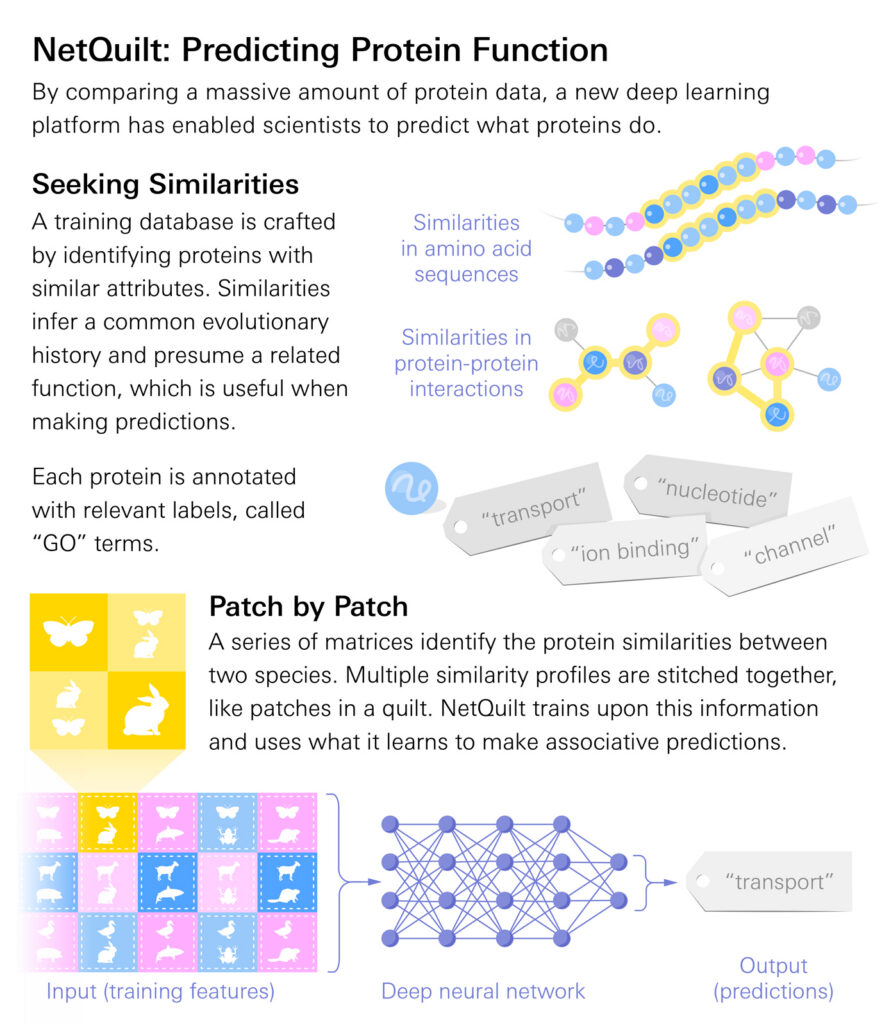
As a start, the scientists applied an alignment algorithm called IsoRank, developed in 2008 in part by Bonnie Berger, a professor of mathematics, engineering and computer science at the Massachusetts Institute of Technology. The algorithm allowed the researchers to align both protein sequence and PPI network information from different species. “We make an N × N quilt, where N is the number of proteins,” explains Barot. Integrating information across about 10 species yielded a space with about 140,000 proteins, a sevenfold increase over the number of proteins in humans. Network patches were stitched together in ways that maximized meaningful similarities between datasets of different species. Using both sequence and network information was especially important in obtaining a comprehensive picture of protein function. In cases where sequence similarity was limited, networks could add important information, and vice versa.
This ‘meta-network’ of proteins, built from sequence and PPI network information from multiple species, was then used as an input to train the deep learning algorithms to predict function, in a unique and direct way. Other methods will typically cluster proteins, learn which proteins are similar to others, and then predict function and interactions. “Instead, in NetQuilt, Meet and Vlad said, ‘Let’s directly predict all of the functions.’ They connected the map directly to [protein] function prediction,” says Bonneau.
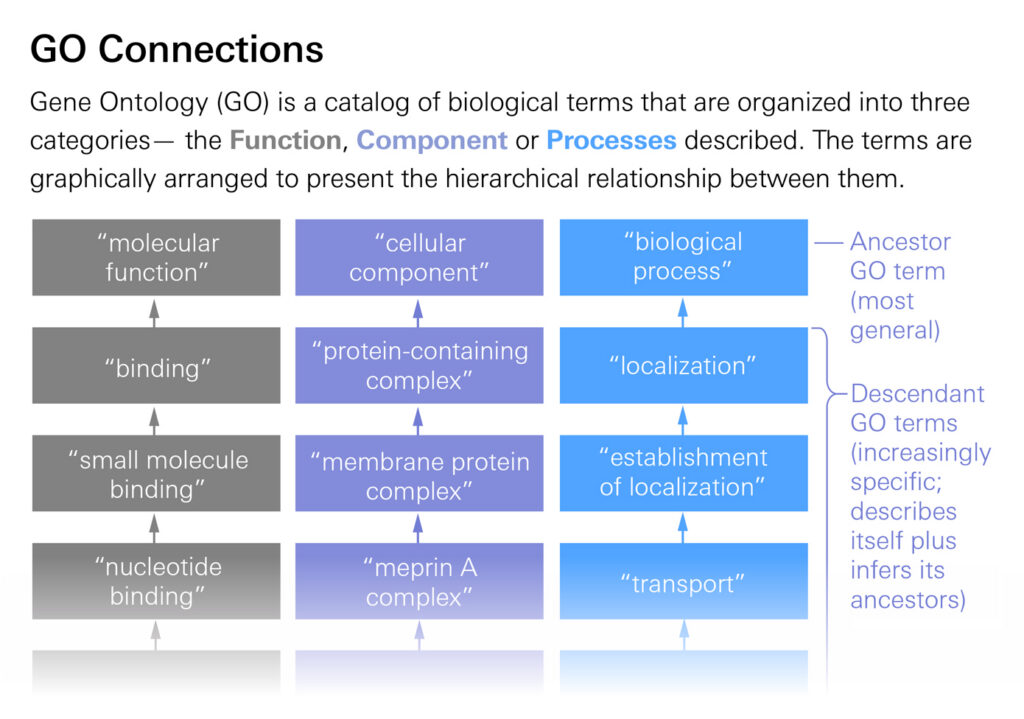
Specifically, the algorithm selected functions from Gene Ontology (GO), a repository of terms that is the gold standard among biologists for representing protein function. Some GO terms are well represented in the repository. In the human genome, for example, the term ‘monosaccharide binding,’ a molecular function, describes 70 distinct genes. Other terms appear rarely, like the biological process term ‘positive regulation of optic nerve formation,’ which describes just one human gene. The power of the deep learning algorithm used by NetQuilt increases with the number of training examples, or proteins, the algorithm can learn on. Increasing the training examples to include proteins from multiple species allowed the algorithm to train on rarer GO terms, while also improving its prediction power on the more abundant terms.